Is there a way to access my Airport Express and see who is connected to it at any given time... Maybe even see how much bandwidth they are using up?


Got a tip for us?
Let us know
Become a MacRumors Supporter for $50/year with no ads, ability to filter front page stories, and private forums.
Who's connected to my Airport?
- Thread starter PeterBonnar
- Start date
- Sort by reaction score
You are using an out of date browser. It may not display this or other websites correctly.
You should upgrade or use an alternative browser.
You should upgrade or use an alternative browser.

I think this is the single biggest detractor for the Apple AirPort range. They're easy to set up, they're reliable, they're fast and they're user-friendly but after a year's usage I still haven't worked out how to see who's on my network. 

Go to this page:
http://www.apple.com/support/airport/
And download the file called Airport Management Tools, on the right, under the heading, "Additional Resources." It will contain two more airport management utilities (now if anyone can give me an answer as to why there need to be five separate airport management utilities in my Utils folder.... )
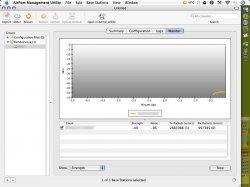
Actually both of these new utilities provide monitoring services; the management utility also allows some multi-airport config stuff in a faster but less user friendly way than the standard Airport utility. They seem pretty neat. You can get visual charts of Signal:Noise and activity level, as well as details on each connection.
http://www.apple.com/support/airport/
And download the file called Airport Management Tools, on the right, under the heading, "Additional Resources." It will contain two more airport management utilities (now if anyone can give me an answer as to why there need to be five separate airport management utilities in my Utils folder....
)Actually both of these new utilities provide monitoring services; the management utility also allows some multi-airport config stuff in a faster but less user friendly way than the standard Airport utility. They seem pretty neat. You can get visual charts of Signal:Noise and activity level, as well as details on each connection.
Thank you very very much mkrishnan. That's very helpful.
Now, why doesn't it come as standard in the normal AirPort Admin Utility?
Very un-Apple like.
Now, why doesn't it come as standard in the normal AirPort Admin Utility?
Very un-Apple like.
mad jew said:Very un-Apple like.
Agreed. I now have:
- Airport Admin Utility
- Airport Client Monitor
- Airport Management Utility
- Airport Setup Assistant
- Airport Setup Assistant for Graphite or Snow
I really don't understand why all of these five applications could not easily be different parts of the same application. Take the last two for instance. How can it possibly be so hard to just start with a "Does your Airport Base Station look like Mr. Left, or Ms. Right?"
But anyway, you do have to give them credit... the monitoring tools are much sweeter than anything in web-based administration of a Linksys or Netgear.
mkrishnan said:But anyway, you do have to give them credit... the monitoring tools are much sweeter than anything in web-based administration of a Linksys or Netgear.
It's getting late over here so nope, no credit, I'm far too grumpy for my own good.
Sure they're more comprehensive and for competent Mac people, they're great, but the generic brands still win out on user-friendliness IMO.
mad jew said:It's getting late over here so nope, no credit, I'm far too grumpy for my own good.
Awww, it's okay. I've heard some things are better mad.

Raven VII said:They eliminated AirPort Setup Assistant for Graphite or Snow in Tiger, so there's only 4 now
Really? I wonder why I have it then.... *goes to delete* It's not like I'm ever going to own one anyway....
*checks for appropriate smiley usage*
EDIT: Sure enough, the date on it is Nov 04.... It must've moved over during archive and install.

I can't seem to get any use out of either of these utilities on my "snow" (pre-extreme) base station. The AirPort Management Utility says "AirPort 3.4 is required," which I think must be the firmware for the base station. Or not. If so, is an older version of this software available? Then the Client Monitor only seems to work wirelessly and I want to run it on my desktop Mac, which is hooked up to the ethernet side of the router.
Any suggestions?
Any suggestions?


Using Airport Management Utility: Choose the base and press the Monitor tab and all the clients attached will be identified with their wireless cards MAC address (I only got one client attached, my iBook):MacTruck said:Am I missing something here? How do I know if someone is on my network with these utilities?
Attachments

What about grabbing a couple of widgets to do the job for you?
SysStat or NetStat might be what you are looking for.
SysStat or NetStat might be what you are looking for.
DJY said:SysStat or NetStat might be what you are looking for.
Cool.
How do you get them to show who else is on your network though?
mad jew said:Cool.
How do you get them to show who else is on your network though?
I think Network Interfaces... will list different computers (and their IP addresses)
So if you see any there that you don't recognise as your own.. then voila! you have them.
Changing your security passwords is also a good thing!

Raven VII said:They eliminated AirPort Setup Assistant for Graphite or Snow in Tiger, so there's only 4 now
LOL! Good one. What a relief, just f-o-u-r now!!

THANKS!!! I agree about the annoying number of airport utilities in my folder now...mkrishnan said:Go to this page:
http://www.apple.com/support/airport/
And download the file called Airport Management Tools, on the right, under the heading, "Additional Resources." It will contain two more airport management utilities (now if anyone can give me an answer as to why there need to be five separate airport management utilities in my Utils folder....
Actually both of these new utilities provide monitoring services; the management utility also allows some multi-airport config stuff in a faster but less user friendly way than the standard Airport utility. They seem pretty neat. You can get visual charts of Signal:Noise and activity level, as well as details on each connection.
stevietheb said:THANKS!!! I agree about the annoying number of airport utilities in my folder now...
Too funny. Glad it helped, though.
Don't you collect them, too...?stevietheb said:THANKS!!! I agree about the annoying number of airport utilities in my folder now...

Not religiously - I've deleted the Airport Graphite/Snow one. I guess the reason for not putting them together is to avoid confusing new users. Perhaps by the time they have enough knowledge to know someone might be using their network is the time they also have enough knowledge to understand the client monitoring? I'd prefer to have it on an advanced tab somewhere in the Admin Utility though
I think the different set-up methods have something to do with it. When a new user sets up an Apple base, they're walked through the process with adding security to their network an integral part of it. I suspect most people setting up a network with an Airport base end up with some form of security as a default.
Compare that to the purely web-based Linksys/Belkin etc which I helped a couple of friends set up. Adding security is an afterthought - in the Belkin manual, it was a mere suggestion that you might want to think about it.
I think the different set-up methods have something to do with it. When a new user sets up an Apple base, they're walked through the process with adding security to their network an integral part of it. I suspect most people setting up a network with an Airport base end up with some form of security as a default.
Compare that to the purely web-based Linksys/Belkin etc which I helped a couple of friends set up. Adding security is an afterthought - in the Belkin manual, it was a mere suggestion that you might want to think about it.
Go to this page:
http://www.apple.com/support/airport/
And download the file called Airport Management Tools, on the right, under the heading, "Additional Resources."
Is the program still available? I cannot locate on Apple site.
TF

Is the program still available? I cannot locate on Apple site.
TF
What are you trying to do with the program?
Register on MacRumors! This sidebar will go away, and you'll see fewer ads.