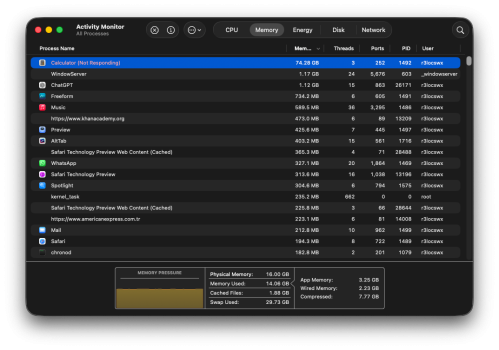
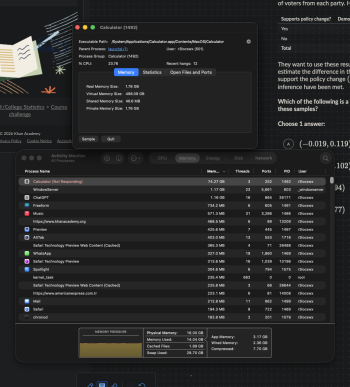
While investigating a transient system slowdown on macOS Tahoe 26.4, I encountered what appears to be a rather disproportionate allocation pattern:
Calculator.app consuming ~74 GB of memory on a system with 16 GB physical RAM (M2 Pro, 14-inch MacBook Pro).
Observed state:
- Memory pressure: high
- Compressed memory: ~7.7 GB
- Swap usage: ~29 GB
- System responsiveness: increasingly theoretical
This is not attributable to the usual suspects (Chrome, Electron, indexing, etc.). This occurred under normal usage conditions with the stock Calculator.
At face value, this suggests a straightforward runaway allocation or memory leak.
That said, given the scale, it does feel less like a bug and more like an unintentional stress test of macOS’s memory compression and swap subsystems — with the SSD serving as an entirely unconsulted participant.
Activity Monitor, at this point, feels less like a diagnostic interface and more like a passive observer.
Out of curiosity: has anyone else on Tahoe 26.4 observed similar behavior from Calculator, or is this a particularly pathological one-off?
Also — and purely as a hardware consideration — I’m beginning to wonder whether an M2 Pro is simply insufficient for Calculator workloads at this scale.
Should I be looking at an M5 Max upgrade for more stable arithmetic performance, or is this expected behavior within current architectural limits?
Happy to provide logs if useful.
Calculator.app consuming ~74 GB of memory on a system with 16 GB physical RAM (M2 Pro, 14-inch MacBook Pro).
Observed state:
- Memory pressure: high
- Compressed memory: ~7.7 GB
- Swap usage: ~29 GB
- System responsiveness: increasingly theoretical
This is not attributable to the usual suspects (Chrome, Electron, indexing, etc.). This occurred under normal usage conditions with the stock Calculator.
At face value, this suggests a straightforward runaway allocation or memory leak.
That said, given the scale, it does feel less like a bug and more like an unintentional stress test of macOS’s memory compression and swap subsystems — with the SSD serving as an entirely unconsulted participant.
Activity Monitor, at this point, feels less like a diagnostic interface and more like a passive observer.
Out of curiosity: has anyone else on Tahoe 26.4 observed similar behavior from Calculator, or is this a particularly pathological one-off?
Also — and purely as a hardware consideration — I’m beginning to wonder whether an M2 Pro is simply insufficient for Calculator workloads at this scale.
Should I be looking at an M5 Max upgrade for more stable arithmetic performance, or is this expected behavior within current architectural limits?
Happy to provide logs if useful.