Become a MacRumors Supporter for $50/year with no ads, ability to filter front page stories, and private forums.

greenmike

macrumors member
Original poster
Nov 27, 2024
48
33
Assuming that the new Cinebench 2026 offers a better support for efficiency cores, including Apple Silicone chips, it leaves me a little bit baffled given that old CPU's like the 9900K have increased performance of nearly 100% compared to the 14700K for example.

So it looks like that Cinebench 2026 actually handles efficiency cores worse than Cinebench 2024.

I'm quite disappointed because I know from my own experience, comparing 14700K and 14900K to the 9900K in apps that I use, that the score of Cinebench 2024 reliably represented the respective CPUs' performance difference.

The same also applies to my Mac Mini M4 Pro. A much smaller performance gap all of a sudden to older CPUs with less efficiency cores. Dunno what they did but Cinebench 2026 is worse at handling efficiency cores, evidently.

And please don't mention Geekbench being a better benchmark for Macs or I'll eat my hat.
 
A tiny mention of the mini but you opened up about how the differences are impacting intel

What ever, I was trying to be helpful you wanted to just be insulting - I'm out
 
  • Like
Reactions: greenmike
A tiny mention of the mini but you opened up about how the differences are impacting intel

What ever, I was trying to be helpful you wanted to just be insulting - I'm out
Sorry, didn't mean to be rude, I was just a bit cheeky.

I mentioned Intel because I was able to draw a bigger performance gap but this also applies to Apple Silicone.
 
  • Like
Reactions: maflynn
From the article linked to earlier in this thread:

Cinebench 2026 uses the latest version of the Redshift engine that Maxon says ought to be six times harsher on multi-threaded tests compared to the the previous version.

Depending on how Maxon has implemented this, it could explain the perceived differences in results. It's also important to note that scores between different versions of Cinebench are not directly comparable to each other, so comparing 2024 and 2026 scores has no real value.

Whether the systems being tested are running x86 (Intel/AMD) or Apple Silicon (no e) is irrelevant, as the testing methodology is identical across platforms.
 
  • Like
Reactions: Anonymous Freak
From the article linked to earlier in this thread:


Depending on how Maxon has implemented this, it could explain the perceived differences in results. It's also important to note that scores between different versions of Cinebench are not directly comparable to each other, so comparing 2024 and 2026 scores has no real value.

Whether the systems being tested are running x86 (Intel/AMD) or Apple Silicon (no e) is irrelevant, as the testing methodology is identical across platforms.

The aforementioned might be the case but it's very odd that older CPUs all of a sudden perform better. There's some mishap going on with the efficiency cores, 100%.

Newer versions of the engine should harness newer CPUs better and not the other way around.
 
Assuming that the new Cinebench 2026 offers a better support for efficiency cores, including Apple Silicone chips, it leaves me a little bit baffled given that old CPU's like the 9900K have increased performance of nearly 100% compared to the 14700K for example.

So it looks like that Cinebench 2026 actually handles efficiency cores worse than Cinebench 2024.

I'm quite disappointed because I know from my own experience, comparing 14700K and 14900K to the 9900K in apps that I use, that the score of Cinebench 2024 reliably represented the respective CPUs' performance difference.

The same also applies to my Mac Mini M4 Pro. A much smaller performance gap all of a sudden to older CPUs with less efficiency cores. Dunno what they did but Cinebench 2026 is worse at handling efficiency cores, evidently.

And please don't mention Geekbench being a better benchmark for Macs or I'll eat my hat.
Are the numbers from your own testing? Could you provide them? For Apple Silicon, the only older CPUs with fewer efficiency cores than the 4 E-core M4 Pro is the M1 Pro/Max which only had 2 E-cores but increased the frequency of those E-cores to compensate. The M3 Pro meanwhile had 6 E-cores. Doing a quick comparison on cpu monkey between the M3 Pro/Max and M4 Pro does indeed show the M3 catching up to the M4 a little (about 10%). However, even the single threaded test the older CPU improves about 6-7% on the newer test relative to the newer CPU and the number of E-cores does not appear to matter - also I wasn't able to recapitulate your extreme Intel results for the 14900K/9900K*:

ST Ratio CB 26ST Ratio CB 24MT Ratio CB 26MT Ratio CB 24
M4 Pro (14) / M3 Max (14)1.181.251.151.26
M4 Pro (14) / M3 Pro (11)1.191.271.781.98
i9 14900K/9900K1.71.83.253.4


ST Ratio CB 24/26MT Ratio CB 24/26
M4 Pro (14) / M3 Max (14)1.061.1
M4 Pro (14) / M3 Pro (11)1.071.11
i9 14900K/9900K1.061.05

As always there is a few % variation expected due to noise and slight differences in performances between chips of the same type.


*For the 14700K, it may be an issue with that chip in particular (which is very strange):


And whatever that something is, it should have nothing to do with E-cores as the 14900K has more (16 vs 12). Of course it is also possible that it is CPU Monkey's 14900K result that is flawed. CPU monkey has a lot of flawed data on it - I did my best to check what I could (the Mac data seems to be okay above, though I saw other questionable Mac data that I did not include). So if you could supply your data that would be really good. The 285K seems to more or less recapitulate the results from above though again the 14900K seems to catch up to it by about 10% and 9900K catches up to it by about 16% in the newer test.

I'm not sure where CPU-monkey sourced their data from, but another source of user generated data is here:


Though for the PC-users many of these are likely overclocked variants making comparisons difficult.

While on one hand your assertion that older CPUs catch up to newer ones in the newer test seems to be true, it seems to be by a small amount, not a large one - provided the data . Still interesting. Could be that the new test is hitting the FP vector units harder and if those have changed by a smaller amount between the M3 and M4, they'll perform slightly more similarly. I'd have to check other benchmarks to confirm.

EDIT: for what it is worth the ST & MT ratio for the M4/M3 of GB 6's Ray tracer is 1.16 and 1.76 (huge variability in those measures though) and the Blender 4.5 CPU (tricky because they don't explicitly split the Macs by CPU core count for some odd reason in open-data, so you have to look at the distribution and pick the part of the histogram applying to your core count) for M4 Pro (14)/M3 Pro (11) is 1.8 (MT only) so both Blender and GB 6 RT subtest are very similar to CB 26's ratios rather than CB 24's.

 
Last edited:
Are the numbers from your own testing? Could you provide them? For Apple Silicon, the only older CPUs with fewer efficiency cores than the 4 E-core M4 Pro is the M1 Pro/Max which only had 2 E-cores but increased the frequency of those E-cores to compensate. The M3 Pro meanwhile had 6 E-cores. Doing a quick comparison on cpu monkey between the M3 Pro/Max and M4 Pro does indeed show the M3 catching up to the M4 a little (about 10%). However, even the single threaded test the older CPU improves about 6-7% on the newer test relative to the newer CPU and the number of E-cores does not appear to matter - also I wasn't able to recapitulate your extreme Intel results for the 14900K/9900K*:

ST Ratio CB 26ST Ratio CB 24MT Ratio CB 26MT Ratio CB 24
M4 Pro (14) / M3 Max (14)1.181.251.151.26
M4 Pro (14) / M3 Pro (11)1.191.271.781.98
i9 14900K/9900K1.71.83.253.4


ST Ratio CB 24/26MT Ratio CB 24/26
M4 Pro (14) / M3 Max (14)1.061.1
M4 Pro (14) / M3 Pro (11)1.071.11
i9 14900K/9900K1.061.05

As always there is a few % variation expected due to noise and slight differences in performances between chips of the same type.


*For the 14700K, it may be an issue with that chip in particular (which is very strange):


And whatever that something is, it should have nothing to do with E-cores as the 14900K has more (16 vs 12). Of course it is also possible that it is CPU Monkey's 14900K result that is flawed. CPU monkey has a lot of flawed data on it - I did my best to check what I could (the Mac data seems to be okay above, though I saw other questionable Mac data that I did not include). So if you could supply your data that would be really good. The 285K seems to more or less recapitulate the results from above though again the 14900K seems to catch up to it by about 10% and 9900K catches up to it by about 16% in the newer test.

I'm not sure where CPU-monkey sourced their data from, but another source of user generated data is here:


Though for the PC-users many of these are likely overclocked variants making comparisons difficult.

While on one hand your assertion that older CPUs catch up to newer ones in the newer test seems to be true, it seems to be by a small amount, not a large one - provided the data . Still interesting. Could be that the new test is hitting the FP vector units harder and if those have changed by a smaller amount between the M3 and M4, they'll perform slightly more similarly. I'd have to check other benchmarks to confirm.

EDIT: for what it is worth the ST & MT ratio for the M4/M3 of GB 6's Ray tracer is 1.16 and 1.76 (huge variability in those measures though) and the Blender 4.5 CPU (tricky because they don't explicitly split the Macs by CPU core count for some odd reason in open-data, so you have to look at the distribution and pick the part of the histogram applying to your core count) for M4 Pro (14)/M3 Pro (11) is 1.8 (MT only) so both Blender and GB 6 RT subtest are very similar to CB 26's ratios rather than CB 24's.
Numbers are from my testing and also from computerbase to verify my finding:


I don't know which score you used for the 9900K but that's where I noticed this.

I tested my 9900K system because I was about to sell that particular system and ran the new benchmark on the M4 Pro, just to see where it's at now.

Which was roughly 2990 points for the 9900K and 6700 with my M4 Pro.

In Cinebench 2024, I scored 635 points on the 9900K and 1754 points on my 14-Core M4 Pro.

Which means in Cinebench 2024, the M4 Pro scored almost 3 x the performance of the 9900K (2.76 times to be exact).

In Cinebench 2026 the 9900K with 2950 points fits only 2.27 times

That's quite a significant difference. Particularly from a CPU which's architecture was released in 2017.

Something is wrong with the new engine and CPUs with efficiency cores, which is hilarious because they claimed to have now better implemented the latter with 2026.

The 2024 score also made more sense when I first got my M4 Pro and made a performance benchmark in Avid's Pro Tools to compare them.

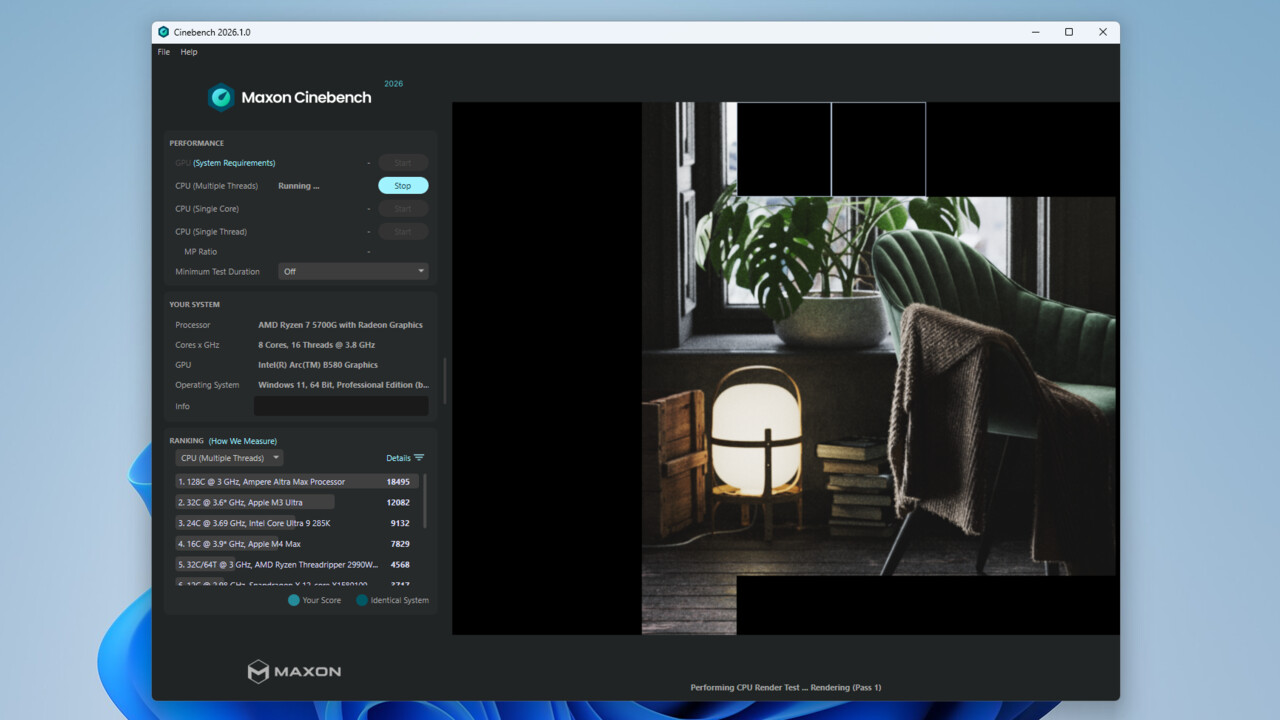
Here's my M4 Pro score:

cb2026.jpg
 
  • Like
Reactions: senttoschool
Numbers are from my testing and also from computerbase to verify my finding:


I don't know which score you used for the 9900K but that's where I noticed this.

I tested my 9900K system because I was about to sell that particular system and ran the new benchmark on the M4 Pro, just to see where it's at now.

Which was roughly 2990 points for the 9900K and 6700 with my M4 Pro.

In Cinebench 2024, I scored 635 points on the 9900K and 1754 points on my 14-Core M4 Pro.

Which means in Cinebench 2024, the M4 Pro scored almost 3 x the performance of the 9900K (2.76 times to be exact).

In Cinebench 2026 the 9900K with 2950 points fits only 2.27 times

That's quite a significant difference. Particularly from a CPU which's architecture was released in 2017.

Something is wrong with the new engine and CPUs with efficiency cores, which is hilarious because they claimed to have now better implemented the latter with 2026.

The 2024 score also made more sense when I first got my M4 Pro and made a performance benchmark in Avid's Pro Tools to compare them.

Here's my M4 Pro score:

View attachment 2596402
The numbers I used were from CPU Monkey - the raw data is in the links I provided above and the 9900K got 640 and 2996 respectively, so similar to the results you quote. Similar scores for the M4 Pro.

It's not efficiency cores. The M3 Pro has more efficiency cores than the M4 Pro and improves on its score relative to the M4 Pro by 11% in the new test compared to the old one (or at least by 7-8%, CPU Monkey's score for the 11 core M3 Pro might be a bit on the low side but regardless the additional E-cores aren't hurting it, the M3 Pro is getting better relative to the M4 not the other way around). Further, there is no difference between the 285K and 9950X3D in CB 24 or 26 - again the E-cores don't seem to be hurting the 285K in CB26. There doesn't appear to be a shift between the M4 and M5 in the two tests.

Basically there seems to be a shift of about 6-8% in favor of x86 in CB26 and additional ~10% gain in favor of older CPUs regardless of E-cores or not.
 
Last edited:
  • Like
Reactions: greenmike
The numbers I used were from CPU Monkey - the raw data is in the links I provided above and the 9900K got 640 and 2996 respectively, so similar to the results you quote. Similar scores for the M4 Pro.

It's not efficiency cores. The M3 Pro has more efficiency cores than the M4 Pro and improves on its score relative to the M4 Pro by 11% in the new test compared to the old one (or at least by 7-8%, CPU Monkey's score for the 11 core M3 Pro might be a bit on the low side but regardless the additional E-cores aren't hurting it, the M3 Pro is getting better relative to the M4 not the other way around). Further, there is no difference between the 285K and 9950X3D in CB 24 or 26 - again the E-cores don't seem to be hurting the 285K in CB26. There doesn't appear to be a shift between the M4 and M5 in the two tests.

Basically there seems to be a shift of about 6-8% in favor of x86 in CB26 and additional ~10% gain in favor of older CPUs regardless of E-cores or not.
I've read through it, yeah seems to be gains for X86 over ARM and generally 10%+ on older CPUs.

Seems to be generally an instruction set bottleneck due to bad implementation on Maxon's side for newer CPUs?

In actual real world tasks, the scores made a lot more sense in Cinebench 2024 because in Pro Tools for example, which fully supports the M4 Pro and the efficiency cores, I was able to duplicate my 9900K benchmark session, which hit the CPU overload, about 2.9 times.
 
  • Like
Reactions: crazy dave
I've read through it, yeah seems to be gains for X86 over ARM and generally 10%+ on older CPUs.

Seems to be generally an instruction set bottleneck due to bad implementation on Maxon's side for newer CPUs?

In actual real world tasks, the scores made a lot more sense in Cinebench 2024 because in Pro Tools for example, which fully supports the M4 Pro and the efficiency cores, I was able to duplicate my 9900K benchmark session, which hit the CPU overload, about 2.9 times.
Don't know ... CB26 isn't boosting SMT or hurting E-cores or that would show up in AMD vs Intel and it doesn't seem to - though one issue is the high variability in x86 results just in general. So to really nail it down we'd need a professional reviewer with access to lots of chips running the test on both of them. We might get something like that when new chips come out at some point this year. Other possibilities are differences in FP vector unit usage. But then the M4 and M5 seem to have the same relationship in 2026 as 2024. So ... yeah ... it's a little odd. Again, hopefully as more chips come out and reviewers start benchmarking them we'll get a better idea of what's happening (though sadly most of the time reviewers do not have a huge amount of older hardware sitting around so it's rare for them to be able to use a new benchmark on an older device which is something we would need to nail down why older chips perform better).

As I said, to be fair Blender 4.5 and GB 6 RT seem to show more similar results in some respects to 2026 than 2024 BUT your mileage will vary. As you said, your apps behaved more similarly to 2024. Just goes to show that individual data points are instructive but not conclusive.
 
  • Like
Reactions: greenmike
Don't know ... CB26 isn't boosting SMT or hurting E-cores or that would show up in AMD vs Intel and it doesn't seem to - though one issue is the high variability in x86 results just in general. So to really nail it down we'd need a professional reviewer with access to lots of chips running the test on both of them. We might get something like that when new chips come out at some point this year. Other possibilities are differences in FP vector unit usage. But then the M4 and M5 seem to have the same relationship in 2026 as 2024. So ... yeah ... it's a little odd. Again, hopefully as more chips come out and reviewers start benchmarking them we'll get a better idea of what's happening (though sadly most of the time reviewers do not have a huge amount of older hardware sitting around so it's rare for them to be able to use a new benchmark on an older device which is something we would need to nail down why older chips perform better).

As I said, to be fair Blender 4.5 and GB 6 RT seem to show more similar results in some respects to 2026 than 2024 BUT your mileage will vary. As you said, your apps behaved more similarly to 2024. Just goes to show that individual data points are instructive but not conclusive.
I mean, generally, you could argue that it might be a driver related issue when in a newer release, an older CPU all of a sudden performs better than the 6 year old newer, technically more advanced counterpart.

It's nothing new, you have it in software all the time but I expected better from Maxon.

I was also as disappointed by Apple and their Logic Pro optimization for their own M-Chips, which is amongst the worst of all DAWs and Avid actually did it properly, which I didn't expect at all and rather excepted them to slack.
 
In Cinebench 2024, I scored 635 points on the 9900K and 1754 points on my 14-Core M4 Pro.

Which means in Cinebench 2024, the M4 Pro scored almost 3 x the performance of the 9900K (2.76 times to be exact).

In Cinebench 2026 the 9900K with 2950 points fits only 2.27 times

That's quite a significant difference. Particularly from a CPU which's architecture was released in 2017.

Something is wrong with the new engine and CPUs with efficiency cores, which is hilarious because they claimed to have now better implemented the latter with 2026.

One issue is that you are assuming that if one benchmark shows a 3x difference, all subsequent updates and revisions should/will also show the same difference. However, that would only be accurate if both the scoring paradigm and benchmark engine remained exactly the same. Maxon did change the engine used in 2026, which will affect the results across all systems. Simply pointing to the performance differential being less with 2026 does not mean that there are any issues, and even Maxon states CB2026 scores cannot be compared to CB2024 scores:

Updated Scoring Methods​

It's crucial to note that Cinebench 2026 scores cannot be compared to those of its predecessor, Cinebench 2024. With the incorporation of the latest Redshift technology and optimized performance, Cinebench 2026 offers a distinctly enhanced and accurate evaluation of modern hardware capabilities.

On that same page, Maxon lists adding support for M4 and M5 Apple Silicon as a feature of CB 2026. So the issue may not be that 2026 has issues handling efficiency cores, but that the prior versions did not properly support M4 series silicon.
 
  • Like
Reactions: greenmike
One issue is that you are assuming that if one benchmark shows a 3x difference, all subsequent updates and revisions should/will also show the same difference. However, that would only be accurate if both the scoring paradigm and benchmark engine remained exactly the same. Maxon did change the engine used in 2026, which will affect the results across all systems. Simply pointing to the performance differential being less with 2026 does not mean that there are any issues, and even Maxon states CB2026 scores cannot be compared to CB2024 scores:

The point of the discussion was not whether something changed, but what changed and how. It's true you can't compare the scores directly between versions, but what you can do is compare the ratio of scores between versions. Again, new version of the benchmark, new engine (and new scene being rendered, not something to be overlooked), thus differences in such ratios are expected, so the question is what changed that older CPUs are suddenly more performant relative to newer ones and why x86 chips got a small boost relative to Apple Silicon in the newest version of the engine? A question only answerable with a lot more data than we have currently (and may not be answerable at all without a deep dive into the internals of each benchmark).

On that same page, Maxon lists adding support for M4 and M5 Apple Silicon as a feature of CB 2026. So the issue may not be that 2026 has issues handling efficiency cores, but that the prior versions did not properly support M4 series silicon.

We've moved past the efficiency core hypothesis. However, the M4 and M5 got worse relative to the M3 in 2026 as compared to 2024 - so arguably the 2024 version handles the M4 and M5 better despite CB26 listing official support while obviously CB24 came out before.
 
The point of the discussion was not whether something changed, but what changed and how. It's true you can't compare the scores directly between versions, but what you can do is compare the ratio of scores between versions. Again, new version of the benchmark, new engine (and new scene being rendered, not something to be overlooked), thus differences in such ratios are expected, so the question is what changed that older CPUs are suddenly more performant relative to newer ones and why x86 chips got a small boost relative to Apple Silicon in the newest version of the engine? A question only answerable with a lot more data than we have currently (and may not be answerable at all without a deep dive into the internals of each benchmark).


We've moved past the efficiency core hypothesis. However, the M4 and M5 got worse relative to the M3 in 2026 as compared to 2024 - so arguably the 2024 version handles the M4 and M5 better despite CB26 listing official support while obviously CB24 came out before.
I fully agree to what you're saying but I think you get what I mean?

It's odd for a CPU that is now officially supported to perform worse than when it wasn't, particularly compared to 8 year old CPUs.

Obviously you can't compare 2 different tests, depending on the content but here, in the case of Cinebench 2024 and 2026, it's the task of rendering (which has not changed) and on top of that the EXACT same scene, which from what it looks like seems to be using all the same materials and rendering properties. I'd probably not make such a scene if they had used a completely different session.

Whatever built-in CPU scheduling by Apple that was used for the M4 Chips in Cinebench 2024 handled tasks more efficiently than Cinebench's now own official implementation in 2026 LOL
 
One issue is that you are assuming that if one benchmark shows a 3x difference, all subsequent updates and revisions should/will also show the same difference. However, that would only be accurate if both the scoring paradigm and benchmark engine remained exactly the same. Maxon did change the engine used in 2026, which will affect the results across all systems. Simply pointing to the performance differential being less with 2026 does not mean that there are any issues, and even Maxon states CB2026 scores cannot be compared to CB2024 scores:


On that same page, Maxon lists adding support for M4 and M5 Apple Silicon as a feature of CB 2026. So the issue may not be that 2026 has issues handling efficiency cores, but that the prior versions did not properly support M4 series silicon.

I bet you that if Maxon would remove their own optimization of the M4/M5 chips from Cinebench 2026 and let them handle tasks the way they did it in 2024, these CPUs would score higher again, which is a shame.
 
I bet you that if Maxon would remove their own optimization of the M4/M5 chips from Cinebench 2026 and let them handle tasks the way they did it in 2024, these CPUs would score higher again, which is a shame.
It's possible they didn't do any special optimization for the M4/M5 - in fact I don't think Apple has even released an optimization guide since the M3 or maybe M4. That's just a list of supported hardware, it does not mean they did anything special to optimize running on the newer cores. It just has to work.

The six times harsher on multithreaded tests claim is interesting though. If it were a question of bandwidth the Macs should've gotten better as Macs tend to have fantastic bandwidth for their CPUs and older x86 CPUs in particular tend to have poor bandwidth. It's possible they changed how much vector processing is happening - poor NEON optimization during ray tracing was a possible problem for CB23. Apple likes to use a larger number of 128b vector units in its cores and if CB26 is more optimized for longer vectors than CB24 that could explain why Intel/AMD catch up a bit. I mean we shouldn't get overboard it's not like CB 23. But it might also explain why the M3 catches up a bit to the M4/M5 as I'm not sure the vector throughput has changed much since the M3 in the E-core or P-core for AS beyond clock speed but @leman or someone else knowledgeable might know for sure - I know at least a couple of generations there were changes but I can't remember which. So other advancements in the CPU cores might matter less if it's hitting the vectors harder.

It could also be changes in the particulars of the scene rather than the engine. While I could make a stronger case for such on the GPU, I can imagine different rendering scenes having different performance characteristics on different CPUs. Basically you'd need to test using the latest version of Redshift more than just the current benchmark scene and time it yourself. Ideally you'd be able to test the CB24 scene as well - and to really nail it down test the current scene on the version of the Redshift engine represented by CB24. I'm not sure how doable any of that is (and to be clear I'm not volunteering).

EDIT: Never mind the above, the scene appears to be the same.
 
Last edited:
  • Like
Reactions: greenmike
The six times harsher on multithreaded tests claim is interesting though.
I'd like to know what it can possibly mean given that CB24 and earlier were already capable of near-perfect multithreaded scaling. Maybe you'd run into some issues with really huge hardware thread counts - CB's renderer tiles the scene and then uses one core to render each tile, so if there are fewer tiles than cores you'd hit a scaling limit, but I don't think this was a meaningful problem at the core counts found in typical enthusiast and mainstream PCs and Macs.

Honestly, it seems likely to be a weird marketing claim, not engineering reality.
 
  • Like
Reactions: crazy dave
I'd like to know what it can possibly mean given that CB24 and earlier were already capable of near-perfect multithreaded scaling. Maybe you'd run into some issues with really huge hardware thread counts - CB's renderer tiles the scene and then uses one core to render each tile, so if there are fewer tiles than cores you'd hit a scaling limit, but I don't think this was a meaningful problem at the core counts found in typical enthusiast and mainstream PCs and Macs.

Honestly, it seems likely to be a weird marketing claim, not engineering reality.
The only thing I can really think of is that the scene is being rendered at a higher resolution with more rays but I don't know how you would check that. The scene looks the same to me, but that's just looking at the preview render (it does however seem slower to build that render in CB26 than in CB24 and the file size is larger).

Also, I get what you mean that wouldn't necessarily hit the CPU that much harder since you're right they're already pretty much saturated - maybe we could tell the difference between top level Threadrippers or EPYC/Xeons.
 
From Windows forum:

“What’s new in Cinebench 2026 (at a glance)
New Redshift core: Uses the latest Redshift rendering code, aligning Cinebench results more closely with real Cinema 4D 2026 render performance and Redshift improvements.

Expanded GPU support: Adds consumer NVIDIA Blackwell (RTX 50xx) support and AMD RX 9000‑series (RDNA4) support on Windows; adds NVIDIA Hopper and Blackwell data‑center GPU support.
Apple M‑series support extended: Official support for Apple M4 and M5 systems is included.

Windows ARM64 native build: Cinebench 2026 supports Windows on Arm, continuing the platform coverage introduced in recent releases.

SMT-focused single-core test: A new test mode measures the performance of a single SMT-enabled logical core versus strictly single-threaded execution, intended to reveal how SMT/hyper-threading implementations affect real rendering.

Score recalibration: Scores are calculated in a new range — Maxon moved the scoring scale upward to avoid confusion with Cinebench 2024 results because the new engine and compiler toolchain produce faster run times on identical scenes.

These headline changes are aimed at improving the benchmark’s predictive value for real content-creation workloads while bringing support for modern accelerators and SoCs closer to production renderers.

Technical deep dive: Redshift, compilers and score changes:

Why Redshift matters:

Redshift is a production-grade GPU-accelerated renderer used by many studios and integrated tightly into Cinema 4D. By moving Cinebench to the newest Redshift codebase, Maxon reduces the gap between a synthetic benchmark and the workloads artists actually run in production. This improves the ecological validity of scores — that is, how well benchmark results predict user experience in Cinema 4D 2026 and Redshift‑based projects.

Compiler and platform toolchain changes:

The Cinebench 2026 knowledge base notes updates to compiler toolchains (newer Clang/Visual toolchains and Xcode versions), which produce modest performance improvements across CPU and RS‑CPU code paths. Maxon explicitly stated that newer compilers and Redshift optimizations led to faster runtimes for the same scene, prompting a decision to move to a different (higher) score range to prevent direct comparisons with Cinebench 2024. This is a crucial point for reviewers and historical comparisons: raw numbers no longer have the same baseline.

“Six times harsher” and what that means:

Press coverage and Maxon commentary around the release has described the updated Redshift engine as substantially more strenuous on multi‑threaded tests — one outlet relayed Maxon’s characterization that the new engine is ‘six times harsher’ for multi‑threaded workloads. That description should be interpreted with nuance: it reflects the engine’s different computational profile and increased utilization of GPU and CPU resources, rather than a deterministic multiplication factor across all hardware. Real measured uplift (or penalty) will vary across CPU microarchitectures, memory subsystems, and GPU pairings.

Compatibility and hardware support: who’s covered:

Cinebench 2026 explicitly expands hardware compatibility to match the state of modern PC and workstation hardware:

NVIDIA: consumer Blackwell (50xx / RTX 5000‑series) and data center Hopper and Blackwell cards are supported.
AMD: Radeon RX 9000 series / RDNA4 consumer GPUs are supported on Windows.
Apple: native Apple Silicon support now extends to M4 and M5 SoCs. Maxon also lists macOS builds with pre‑compiled shaders for supported macOS versions.

Platforms: Windows x86‑64, Windows ARM64 (native), and macOS are supported.
Maxon’s KB gives more granular notes, including a roster of supported AMD GPUs, OSX compatibility details and the fact that the new build removes macOS AMD GPU support (a notable change for Mac Pro users relying on discrete AMD cards). That removal is a practical compatibility shift that Mac users should be aware of.

The new SMT measurement: what it is and why it matters:

What Cinebench 2026 measures
The Single Core SMT measurement is a new option that runs the single-threaded rendering test on a logical core that still has SMT enabled (i.e., measuring the performance of a hyper‑threaded logical core rather than forcing SMT/hyper‑threading off at the OS or BIOS level). This provides a direct way to observe how SMT interacts with real rendering threads and to quantify the effective single‑threaded performance when SMT is present.

Practical implications:

For reviewers: it’s now possible to present a clearer picture of how a CPU’s SMT implementation affects rendering workflows without the extra step of toggling BIOS settings or relying on OS affinity hacks.
For hardware buyers: the test helps answer a practical question — “If I run my render jobs with SMT enabled, how much single‑threaded headroom am I losing or gaining?” — which is useful for selecting server hardware or workstation CPUs where SMT tradeoffs matter.

For overclockers and system builders: the measurement is a useful diagnostic for subtle scheduling behavior, thermal headroom and SMT-related performance quirks.

Caveat: SMT behavior is sensitive to OS scheduler policies and microarchitectural details. The SMT measurement is best used comparatively (same OS, same driver set, same BIOS) rather than as an absolute indicator across wildly different platforms.

Score comparability: why history is a minefield now:

Maxon’s KB and the official announcement both stress that Cinebench 2026 scores cannot be compared directly to Cinebench 2024 results because scale, code paths and compilers changed. This has major implications for benchmarking databases, long‑term score charts and any reviewer or user who expects continuity between versions.

If you maintain a public score database: do not merge 2024 and 2026 numbers in the same leaderboard. Treat 2026 as a new baseline.

For CPU performance regressions or driver comparisons: retest hardware under Cinebench 2026 rather than attempting to normalize old results.

Maxon moved its scoring calculation into a higher range deliberately — not because hardware suddenly became vastly better overnight, but because the benchmark’s runtime and output calibration changed. The practical consequence: historical percentiles and comparisons lose meaning unless re-baselined against the new runtime.

Practical considerations for testers and labs
Minimum system requirements and resource notes:

Maxon’s tech information lists minimum and recommended memory and GPU characteristics for reliable runs. For macOS Apple Silicon GPU tests, Maxon recommends 16 GB of unified memory for GPU runs, while CPU-only tests can run with less memory but may suffer paging effects. For Windows GPU tests, supported AMD/NVIDIA cards typically require 8 GB or more VRAM to participate. These practical minima matter for labs and reviewers running legacy laptops or low‑VRAM testing rigs.

Drivers, CUDA and platform toolchains
Cinebench 2026 adds CUDA 12 support and includes Apple Metal performance optimizations; version‑specific driver behavior can materially change results.

For reproducible benchmarking:
Use vendor‑approved drivers for the target GPU family (NVIDIA/AMD) and document exact driver versions.

Keep OS patches and compiler versions consistent across comparative runs.
For Windows ARM64 testing, ensure drivers and platform support are production‑grade; Windows‑on‑Arm still has ecosystem fragility compared with x86‑64.

GPU-only caveats:

Redshift’s GPU renderer still requires GPUs with adequate VRAM and compatible feature sets. Intel discrete GPUs are not supported by Redshift currently, so integrated Intel graphics remain out of the GPU test loop; that’s a continuing gap for some laptop reviewers. If your workflow or comparison set includes Intel Arc or integrated Intel solutions, note that GPU testing coverage in Cinebench will remain limited for those devices.

Risks and limitations:

1. Non‑comparable historical data
The most immediate risk is misinterpretation: users who compare 2026 numbers with 2024 or earlier will draw wrong conclusions. Reviewers and vendor PR teams should avoid mixing versions in charts or press releases without explicit clarification.

2. Platform and GPU gaps
macOS: Maxon’s KB lists removed macOS AMD GPU support for this release, which creates a blind spot for Mac Pro users relying on discrete AMD cards. This change could upset professional Mac workflows that previously used AMD eGPUs/discrete GPUs for Redshift rendering.

Intel GPUs: Redshift still lacks Intel discrete GPU support, leaving Intel Arc and integrated Xe‑class devices outside GPU metric coverage. Testers relying on integrated Intel solutions will need to stick to CPU render scores.

3. Memory and VRAM friction
GPU rendering demands have risen. Maxon’s guidance on unified memory minimums for Apple Silicon GPU tests and the VRAM thresholds for Windows GPU tests mean that many older laptops and entry‑level GPUs will be ineligible for GPU tests, limiting broad comparability. This can skew multi‑platform comparisons unless carefully controlled.

4. Proprietary engine changes and black‑box effects:

While aligning Cinebench to Redshift increases fidelity to Cinema 4D workflows, it also means the benchmark’s internal decisions (memory management, sampling strategies, denoising, OCIO/OIDN versions) tightly couple Cinebench results to a particular renderer’s implementation. That’s good for Cinema 4D parity, but it reduces neutrality for broader cross‑renderer comparisons. Maxon’s KB mentions upgrades to OCIO/OIDN versions and changes to bump mapping, GI convergence and instancing; these changes alter the workload in ways that aren’t strictly transparent from a numbers‑only viewpoint. Exercise caution when extrapolating Cinebench 2026 results to other renderers or entirely different workloads.

How reviewers and power users should use Cinebench 2026:

Treat Cinebench 2026 as a new baseline: start fresh comparative tables and include a clear note that the dataset is Cinebench 2026‑based.

Document everything: OS build, GPU driver version, BIOS/firmware, memory configuration, and whether SMT/hyper‑threading is enabled. The new SMT measurement makes such metadata particularly important.

For GPU testing: confirm VRAM limits and ensure test systems meet the 8+ GB VRAM(Windows) or 16 GB unified memory (Apple GPU) guidelines to avoid invalid runs.
When presenting charts: do not mix 2024 and 2026 scores on the same axis without normalization and a clear methodological appendix explaining the recalibration.

Benefits and opportunities:

Closer alignment to production: Because Cinebench 2026 uses the latest Redshift engine, results should correlate better with Cinema 4D 2026 rendering performance — a boon for artists, studios and hardware buyers who care about real workloads.

Modern accelerator support: Support for Blackwell and RDNA4 lets labs evaluate the very latest consumer cards under a production renderer, helping inform GPU buying decisions for creatives.

Granular SMT insight: The SMT test is a practical addition for server and workstation evaluation; it allows a clearer empirical look at SMT tradeoffs without BIOS gymnastics.”
 
Last edited:
  • Like
Reactions: greenmike
The only thing I can really think of is that the scene is being rendered at a higher resolution with more rays but I don't know how you would check that. The scene looks the same to me, but that's just looking at the preview render (it does however seem slower to build that render in CB26 than in CB24 and the file size is larger).

Also, I get what you mean that wouldn't necessarily hit the CPU that much harder since you're right they're already pretty much saturated - maybe we could tell the difference between top level Threadrippers or EPYC/Xeons.
Is it a bottleneck of the M4 Chips they hit with how they changed the renderer?

Is there a commonality beyond the M4 in the other processors? The 14700K has a similar observable issue, in it's case fewer efficiency cores compared to the 14900K, same amount of P cores.

Although the M3 Max has has also a proportionally higher amount of P to E cores like the M4 Pro and scores higher than it in the new test.

Basically the M4 Pro 8.5% ahead of the M3 Max in Cinebench 2024 and in 2026, they are both neck and neck.

Compared to the 14900K, in Cinebench 2024, the M4 Pro was 20% behind and in Cinebench 2026, that gap is roughly 32%.

I dunno what Maxon did but it definitely is causing issues with some CPUs.

It's way worse with the 14700K, which was 7% behind the 14900k in Cinebench 2024 and in 2026, it's freaking 35%.

The 14700K is practically just a 14900K with 4 fewer E-cores and that score in Cinebench 2024 made a lot more sense. Even if you remove the power Limit and end up full throttle with 300 watts power draw from the CPU, the score is gonna be around 7400 points, which is still a difference of 25% compared to the 7% before, still quite a difference.

Taking this anomaly above makes Cinebench 2026 pretty unusable to compare CPUs and something has gone wrong with the latest update unless I'm missing something.
 
Last edited:
Maxon’s KB and the official announcement both stress that Cinebench 2026 scores cannot be compared directly to Cinebench 2024 results because scale, code paths and compilers changed. This has major implications for benchmarking databases, long‑term score charts and any reviewer or user who expects continuity between versions.
Yeah please don't compare the results, even if you find such an abnormal score difference between the 14700K and the 14900K, we don't want any criticism, please just move on and trust in our new code 😆

Something is rotten in the state of Bad Homburg.
 
Last edited:
  • Like
Reactions: M4pro
Detouring from the technical talk:

Wow. That 2024/2026 benchmark scene is some ugly ahh s…

There’s no connection between that type of dark arch-viz / still-life image and why artists use Redshift.

Changing over to a new benchmark scene for 2026 could have been an easy win for Maxon.

Commission one of the studios featured in the Redshift demo reel. Create a bright colorful new scene infused with visual style, inspiration, and fun.

Making simple but impactful changes where you can is always good company strategy.

Honestly have no clue why Maxon kept barfing on their shoes instead.
 
Is it a bottleneck of the M4 Chips they hit with how they changed the renderer?

Is there a commonality beyond the M4 in the other processors? The 14700K has a similar observable issue, in it's case fewer efficiency cores compared to the 14900K, same amount of P cores.

Although the M3 Max has has also a proportionally higher amount of P to E cores like the M4 Pro and scores higher than it in the new test.

Basically the M4 Pro 8.5% ahead of the M3 Max in Cinebench 2024 and in 2026, they are both neck and neck.

Compared to the 14900K, in Cinebench 2024, the M4 Pro was 20% behind and in Cinebench 2026, that gap is roughly 32%.

I dunno what Maxon did but it definitely is causing issues with some CPUs.

It's way worse with the 14700K, which was 7% behind the 14900k in Cinebench 2024 and in 2026, it's freaking 35%.

The 14700K is practically just a 14900K with 4 fewer E-cores and that score in Cinebench 2024 made a lot more sense. Even if you remove the power Limit and end up full throttle with 300 watts power draw from the CPU, the score is gonna be around 7400 points, which is still a difference of 25% compared to the 7% before, still quite a difference.

Taking this anomaly above makes Cinebench 2026 pretty unusable to compare CPUs and something has gone wrong with the latest update unless I'm missing something.
Could it be that the compiler is doing better for Intel systems (I noticed no one is comparing AMD scores, or are noting a change in performance with them) in this release than past ones? Are the GPU scores still scaling the same? They claim that the OS scheduler matters, but maybe the older chips are doing better because of how crappy Windows scheduler is for big.little systems?

WRT the 14900K vs 14700K I'd be curious to know if they ran the 2024 test then the 2026 test on the same system, back to back keeping everything equal.
 
Yeah please don't compare the results, even if you find such an abnormal score difference between the 14700K and the 14900K, we don't want any criticism, please just move on and trust in our new code 😆

Something is rotten in the state of Bad Homburg.

That just standard boilerplate for a new version of a benchmark. What we're doing, comparing score ratios is fine. What they asking people not do to is the thing that should be obvious not to do (but you know people ...) which is directly compare the 14700K score in CB26 with its score in CB24 - like wondering why it scored 10,000 in one and 3,000 in the other. Obviously with a different baseline and possibly engine changes the scores are indeed not directly comparable. Comparing the rank or ratio of the 14700K scores to another chip's like the 14900K in one benchmark to another benchmark, regardless of the relationship between the two benchmarks, is, again, totally fine.

Could it be that the compiler is doing better for Intel systems (I noticed no one is comparing AMD scores, or are noting a change in performance with them) in this release than past ones? Are the GPU scores still scaling the same? They claim that the OS scheduler matters, but maybe the older chips are doing better because of how crappy Windows scheduler is for big.little systems?

I did above - first glance AMD looks similar to Intel (the 9950X3D got basically the same score as the 285K in both benchmarks so both newer x86 chips gained relative to M4/M5 chips and stayed static relative to M3s). But I haven't delved deeply into AMD's scores to confirm if older AMD chips catch up to newer ones. It's possible it's compiler differences, it's possible that the way the scene is being rendered has changed (more rays), etc ... the difference between new x86 chips and new Apple Silicon chips isn't huge <10%, so nothing to be terribly bothered by if that was the only difference.

Further, there is no difference between the 285K and 9950X3D in CB 24 or 26 - again the E-cores don't seem to be hurting the 285K in CB26.

Basically there seems to be a shift of about 6-8% in favor of x86 in CB26 and additional ~10% gain in favor of older CPUs regardless of E-cores or not.

EDIT: while newer AMD chips appear to maintain their relative scores to newer Intel chips between the two benchmarks, at first glance older AMD chips do not appear to catch up to newer ones in CB26 relative to CB24:


WRT the 14900K vs 14700K I'd be curious to know if they ran the 2024 test then the 2026 test on the same system, back to back keeping everything equal.

As far as I can tell, no, these are all just user generated benchmarks (well I'm assuming so for CPU Monkey but I don't actually where they get their data) with all the variance that entails. Given how extreme the 14700K differences are, something appears to be off. I would be cautious to assign fault to the benchmark itself without more data.

Is it a bottleneck of the M4 Chips they hit with how they changed the renderer?

Is there a commonality beyond the M4 in the other processors? The 14700K has a similar observable issue, in it's case fewer efficiency cores compared to the 14900K, same amount of P cores.

Although the M3 Max has has also a proportionally higher amount of P to E cores like the M4 Pro and scores higher than it in the new test.

Basically the M4 Pro 8.5% ahead of the M3 Max in Cinebench 2024 and in 2026, they are both neck and neck.

Compared to the 14900K, in Cinebench 2024, the M4 Pro was 20% behind and in Cinebench 2026, that gap is roughly 32%.

I dunno what Maxon did but it definitely is causing issues with some CPUs.

It's way worse with the 14700K, which was 7% behind the 14900k in Cinebench 2024 and in 2026, it's freaking 35%.

The 14700K is practically just a 14900K with 4 fewer E-cores and that score in Cinebench 2024 made a lot more sense. Even if you remove the power Limit and end up full throttle with 300 watts power draw from the CPU, the score is gonna be around 7400 points, which is still a difference of 25% compared to the 7% before, still quite a difference.

Taking this anomaly above makes Cinebench 2026 pretty unusable to compare CPUs and something has gone wrong with the latest update unless I'm missing something.
The 14700K results are the only ones I've seen that egregiously different and as @diamond.g said, we'd need to make sure the original results and the new ones are being run on the exact same systems - that people weren't quoting results for an overclocked model vs an stock/underclocked model, etc ... That's the problem with user generated benchmarks, unless like 3DMark's website they let you filter by the full range of specs (and even then it can be dicey simply because sometimes people benchmark because their system isn't working right). I mean on the flip side the 14900K in CPU Monkey gains like 10% on the 285K, but looking at other user generated data from computerbase, the possible range of 14900K results is ginormous.

That's why we would need a reviewer with the exact same system running both sets to make sure the 14700K results we're seeing aren't aberrant. Only @greenmike's test on the older Intel 9900K chip is, as far as I know, being run on the exact same system. So the variation for most of these x86 results has to be taken with a big grain of salt. We need more people to upload that kind of data where we know the results from the two benchmarks came from the same system.

Overall though I'd be less bothered by changes of ~10% individually as heck even running the same benchmark on the exact same system can yield a few percent difference and then there's the caveat mentioned above further complicating the problem. So a change in the way the benchmark runs resulting in about 10% differences in relative scores would not be in and of itself be that unusual. It's the fact that there are at least 2 such changes that push older x86 CPUs to be more like 20% more performant relative to newer Apple Silicon chips that makes whatever changed a little more ... interesting. But that's just my threshold for curiosity, others may have a different one!
 
Last edited:
  • Like
Reactions: greenmike
Register on MacRumors! This sidebar will go away, and you'll see fewer ads.