Become a MacRumors Supporter for $50/year with no ads, ability to filter front page stories, and private forums.

Prodo123

macrumors 68020
Original poster
Nov 18, 2010
2,326
10
Hi, noob at circuitry here.

My video equipment happens to use a standard 9v 300mA DC input, but if I want to use it wirelessly the battery dies pretty quickly. So I came up with an idea to build a rechargeable battery pack of my own, after seeing that the other alternative was a $50 flat battery pack.
I took inspiration from the MacBook Air external battery thread. Using this 9.9v battery and this resistor I calculated that the output would be 9v 300mA. Did I do it right?

Also, on the battery, there's four cables. The red and black are obviously the outbound +/- connections. But then there's the red and yellow connectors that I can't identify what their uses are.

Just like the rechargeable Air battery, I'll be using this charger but I don't know how to connect it.

Can someone help me put all these together? I'm trying to learn this stuff which might come in handy for other DIY power supplies.

Thanks!
 
If you're thinking you're gonna get a 9 V drop across your cam DC jack by using one resistor, you're not

And the extra wires are lipo balance wires
 
If you're thinking you're gonna get a 9 V drop across your cam DC jack by using one resistor, you're not

And the extra wires are lipo balance wires

You know what would be helpful?
Teaching me how to do it if that is not gonna work.
 
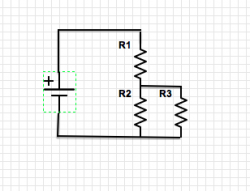
It will not work. First you would need at least two resistors, and even then, it only works in optimal conditions. Here's why.

Capture d’écran 2012-06-17 à 12.46.47.png

The source is 9,9V, the resistors R1 and R2 are used to produce the voltage you need and R3 is your load. If you know the exact resistance of the load (which can be obtained by measuring the current at the terminals and the voltage at the terminal, and using R=V/I), then it is quite easy to calculate the needed resistors:

R1 needs to be 10 times as large as the combined resistance of R2 and R3 (so you have 0,9V at the leads of R1 and 9V at the leads of both R2 and R3). The combined resistance of R2 and R3 is calculated by (R2*R3)/(R2+R3). You would obviously need a bit of algebra and knowledge of Ohm's law to find out the correct values (because your two added resistors will limit available current).

However, in real conditions, your load will have varying power needs and will not always use the same amount of current. In that case, the voltages in the circuit will vary, and you will not always have 9V.

EDIT: you would have better results a super cheap and commonly available 9V voltage regulator. These guys need a voltage higher than 9V and will produce 9V voltage up to 1 ampere, no matter what the input tension is and no matter how much current the load uses.
 
Last edited:
I wasn't rude to you, I told you you can't make a voltage divider with one resistor and I told you what the other wires were

Stay butthurt

Well the way you worded it sounded like you completely disregarded my opinion and had no intention of helping.
Which is very rude.
 
The resistor voltage drop will vary as the load varies, correct? Also, this battery pack does not appear to be rechargeable.

LiFePo4 batteries by definition are rechargeable, so I have no worries there.
And you are correct, I overlooked the fact that the voltage will vary, so I think I'll be going with lewis82's suggestion of a 9v voltage regulator.
One more question. The output of a 7809 regulator is 9v 1A, but I need 300mA. How would I reduce the current to the needed current?
Thanks.
 
LiFePo4 batteries by definition are rechargeable, so I have no worries there.
And you are correct, I overlooked the fact that the voltage will vary, so I think I'll be going with lewis82's suggestion of a 9v voltage regulator.
One more question. The output of a 7809 regulator is 9v 1A, but I need 300mA. How would I reduce the current to the needed current?
Thanks.

It is a maximum of 1A, but it will supply the amount of current needed by the device (it will never supply more current than needed, as it would breach Ohm's law). Also, the 300mA of the DC input is a maximum rating, most likely.

(To go more into detail: voltage sources have fixed voltage (meaning it won't vary by itself, not that it can't be modified) but variable current. The current will vary so that the voltage drop in the circuit is always the one selected. On the other hand, current sources supply a fixed current and modify the voltage accordingly.)

EDIT: one thing you need to check... the spec sheet of the 7809 seems to call for a minimum voltage of 11.5V... so you might need to use a 12V battery. And be sure to use a heatsink, these things run quite hot!
 
It is a maximum of 1A, but it will supply the amount of current needed by the device (it will never supply more current than needed, as it would breach Ohm's law). Also, the 300mA of the DC input is a maximum rating, most likely.

(To go more into detail: voltage sources have fixed voltage (meaning it won't vary by itself, not that it can't be modified) but variable current. The current will vary so that the voltage drop in the circuit is always the one selected. On the other hand, current sources supply a fixed current and modify the voltage accordingly.)

Thank you so much, I will try it out and get back to you :D
 
Register on MacRumors! This sidebar will go away, and you'll see fewer ads.