Become a MacRumors Supporter for $50/year with no ads, ability to filter front page stories, and private forums.

noobinator

macrumors 604
Original poster
Jun 19, 2009
7,609
7,438
Los Angeles, CA
In my brain this seems like we are going a bit backwards if you have to contact your carrier each time you want to switch phones. I guess it's only a problem for people who have multiple phones are switch often. Seems like we are going back to the days when I had to call into Cingular to get my new sim to work in my phone.

Is the only benefit of e-sim the fact that you can use 2 lines now? Which is the same as having a dual sim phone? Maybe I'm missing something.
 
  • Like
Reactions: Reno Raines
In my brain this seems like we are going a bit backwards if you have to contact your carrier each time you want to switch phones. I guess it's only a problem for people who have multiple phones are switch often. Seems like we are going back to the days when I had to call into Cingular to get my new sim to work in my phone.

Is the only benefit of e-sim the fact that you can use 2 lines now? Which is the same as having a dual sim phone? Maybe I'm missing something.
If Apple required you to provide your passcode before shutting off the phone the eSIM could be used as a security feature since it can’t be removed like a SIM could. But otherwise I agree, so much easier to just swap SIM’s if you use multiple devices.

In a way it almost does seems like a step backwards and reminds me of the Verizon CDMA days before they had LTE phones. To switch phones you had to contact them.
 
A big advantage for a few people is that you have five possible eSIM cellular plans available, plus the physical SIM.

Although you can have only two cellular plans active at once, this still presents a chance at an easier life for frequent travellers who will not have to change physical SIM so often and keep track of the unused ones.

iOS acts like the physical SIM is your main plan. You’ll notice that Open Signal identifies your physical SIM even if you have turned it off. This makes me think that perhaps those of us who put our main plans on an eSIM might be missing something, and that perhaps T-Mobile is right to wonder why we want our main plans on an eSIM.

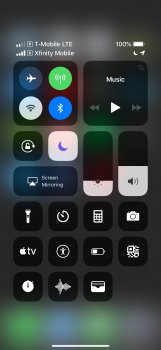
In my case, a wonderfully aggressive T-Mobile plan is on an eSIM, and an Xfinity Mobile plan is on the physical SIM, just so I have a choice in a case where there is a coverage advantage. So far I have not really had to use it but it is nice to have a choice.

Whatever the purpose, we have more flexibility than we had before.
 
This might help with the idea of why eSIM are valuable (or at least why dual SIM is valuable).

I'm rapidly approaching a place where T-Mobile will fall off, but I will still have the Xfinity Mobile signal because of the Verizon MVNO.
 

Attachments

  • IMG_0119.jpeg
    IMG_0119.jpeg
    223.8 KB · Views: 179
So it does seem that most of the benefits are because of the 2nd line/imei not necessarily the esim.

For me it’s about only carrying 1 phone for both work and personal. Hated carrying around 2 phones throughout the day. The other is for when traveling, you can get a local sim and pay cheaper rates abroad.
 
Swapping out little carts on the Nintendo Switch is a nuisance when digital downloads are right there, same concept. Getting rid of physical media. Just tap and boom, you got it.

But right now don't you have to go through a lengthy call/chat with the carrier to boom get it?
 
So it does seem that most of the benefits are because of the 2nd line/imei not necessarily the esim.

I think that for many of us in the United States, who do not travel much internationally, the answer is yes. The two lines probably mean more to us than the ease of an eSIM.

However, if you move to a different part of the country or visit Canada or something, then I can see that the eSIM's ease of installation would be quite a boon for adding a temporary cellular plan.
[doublepost=1545511417][/doublepost]
But right now don't you have to go through a lengthy call/chat with the carrier to boom get it?

The four major providers have handled it in different ways.

Sprint is pretending the eSIM does not exist, and the same with Xfinity Mobile.

AT&T wants you to get a physical piece of something from them with a QR code on it.

Verizon's iOS application allows an easy installation of a postpaid plan, but not a traveller's prepaid plan.

T-Mobile has an application that allows an easy installation of a prepaid plan, but the application does not allow for postpaid, normal, everyday cellular plans that most of us would be using. They're thinking about the viability of allowing postpaid plans, but they haven't done it, yet.

Some support personnel at T-Mobile mention problems, but I cannot imagine what they would be. My T-Mobile primary cellular plan has been on an eSIM ever since I learned how to do it, and it has been just fine. No problems at all.

The comments about problems with conversations with support personnel refers to the fact that since we've started doing this and everybody's caught on to it, the support personnel will ask you if it's for an eSIM when you call to say you want a SIM swap. That's what's stopping people cold...they just can't bring themselves to lie to the support person.

:)

T-Mobile is very service oriented, and I can't imagine that they'd keep us from doing this forever. I don't know what the problems would be that are stopping them from adding the functionality, but there must be something.

 
Last edited:
Register on MacRumors! This sidebar will go away, and you'll see fewer ads.