

Become a MacRumors Supporter for $50/year with no ads, ability to filter front page stories, and private forums.

MacRumors

macrumors bot
Original poster


Apple this week announced a new Mac Studio with the M5 Max and M5 Ultra chips, discontinuing the M4 Max and M3 Ultra models that had been on sale since March 2025.
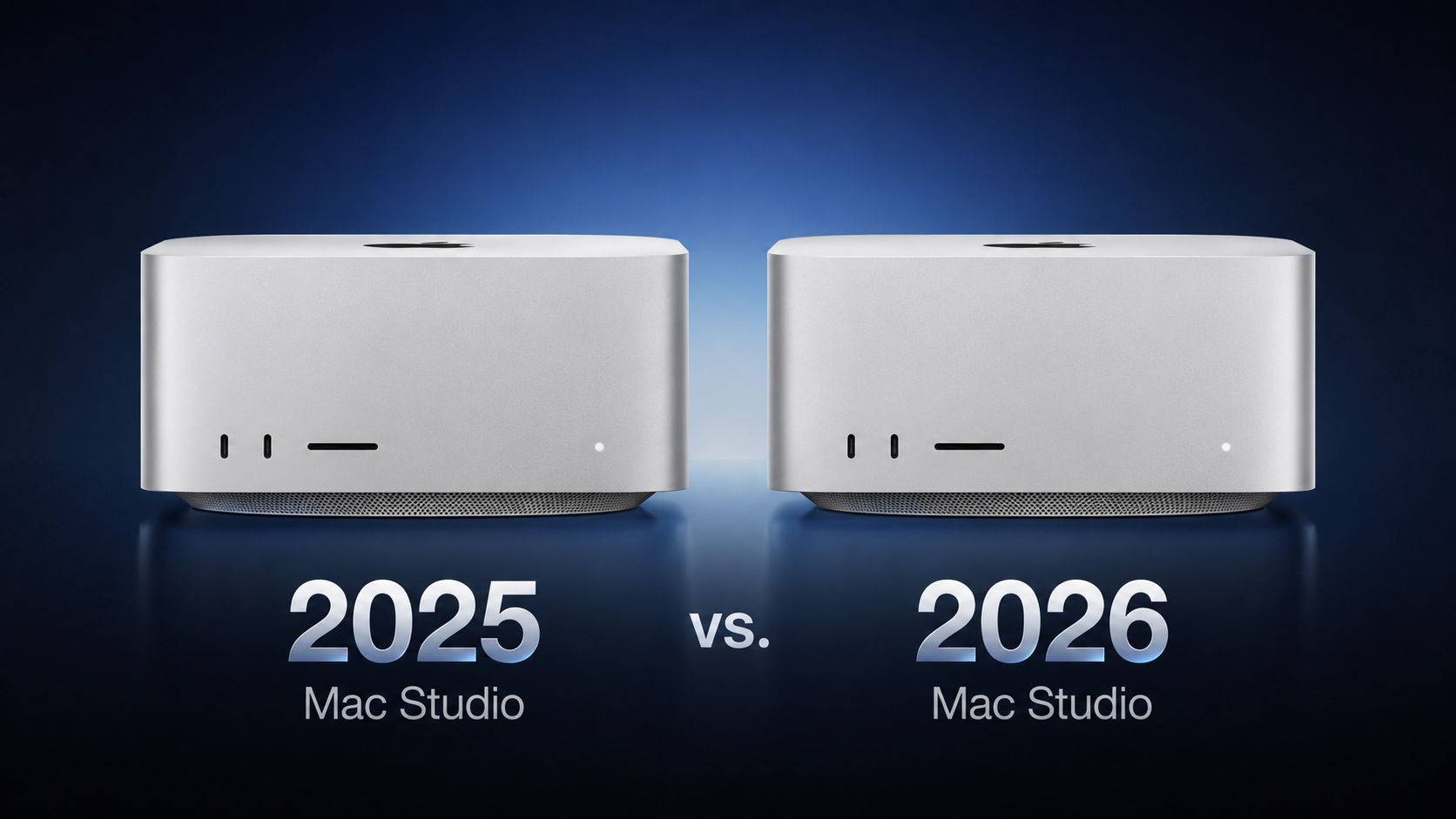
image.png

The machine's design is unchanged for a fifth consecutive year, with all of the upgrades being internal. The table below details everything that changed regardless of whether you choose a Max or an Ultra chip. The two tables that follow break down the differences within each tier.

What Changed Across Both Models

Here's everything that differs between the 2025 and 2026 Mac Studio irrespective of configuration:

Mac Studio (2025)Mac Studio (2026)
Baseline SSD read and write speedsNext-generation SSD architecture built on PCIe Gen 6, with up to twice the read and write speeds
Wi-Fi 6E (802.11ax)Wi-Fi 7 (802.11be) via the Apple-designed N1 chip
Bluetooth 5.3Bluetooth 6
Genlock over USB-C


With the latest model, Wi-Fi 7 and Bluetooth 6 arrive on the Mac Studio for the first time, facilitated by the same N1 chip Apple introduced in the iPhone 17 lineup. Apple also says the new machine is made with 35% recycled content overall, including 100% recycled aluminum in the enclosure and 100% recycled rare earth elements in all magnets.

Mac Studio M4 Max vs. M5 Max

Here's everything that differs between the M4 Max and M5 Max configurations:

Mac Studio (M4 Max, 2025)Mac Studio (M5 Max, 2026)
M4 Max chipM5 Max chip
14-core CPU, configurable to 16-core, with 12 performance cores and 4 efficiency cores18-core CPU with 6 super cores and 12 performance cores
32-core GPU, configurable to 40-core32-core GPU, configurable to 40-core, with Neural Accelerators built into every core and enhanced shader cores
Second-generation hardware-accelerated ray tracingThird-generation hardware-accelerated ray tracing
Up to 546GB/s memory bandwidthUp to 614GB/s memory bandwidth
36GB unified memory with the 32-core GPU, or 64GB with the 40-core GPU (128GB option withdrawn in May 2026)36GB unified memory with the 32-core GPU, or 48GB, 64GB, or 128GB with the 40-core GPU
Weighs 6.1 pounds (2.74 kg)Weighs 6.0 pounds (2.7 kg)
Now discontinuedStarts at $2,499


The most immediately useful change is at the entry level. The M4 Max started with a 14-core CPU and could be configured up to 16 cores, whereas the M5 Max has an 18-core CPU as standard with no CPU upgrade to buy. Apple has also changed its core architecture, dropping the performance and efficiency split in favor of 6 super cores and 12 performance cores.

Mac Studio M3 Ultra vs. M5 Ultra

The table below outlines every difference between the two Ultra configurations:

Mac Studio (M3 Ultra, 2025)Mac Studio (M5 Ultra, 2026)
M3 Ultra chipM5 Ultra chip
28-core CPU, configurable to 32-core, with 24 performance cores and 8 efficiency cores30-core CPU, configurable to 36-core, with 12 super cores and 24 performance cores
60-core GPU, configurable to 80-core64-core GPU, configurable to 80-core, with Neural Accelerators built into every core and enhanced shader cores
First-generation hardware-accelerated ray tracingThird-generation hardware-accelerated ray tracing
Dynamic CachingSecond-generation Dynamic Caching
819GB/s memory bandwidth1.2TB/s memory bandwidth
96GB, 256GB, or 512GB unified memory (512GB option withdrawn in March 2026 and the 256GB option withdrawn in May 2026)96GB or 256GB unified memory, or 512GB with the 80-core GPU
Now discontinuedStarts at $5,499


Across both generations, the maximum GPU still contains 80 cores, the Neural Engine still contains 32 cores, display support and media engine is identical, storage still maxes out at 16TB, and maximum unified memory is still 512GB. The 1.2TB/s of bandwidth feeding that memory, which is 50% higher than before, and the Neural Accelerators for each GPU core, are among the key changes.

How Big Are the Upgrades?

Apple's own comparisons against the outgoing chips are heavily weighted toward AI and graphics. For the M5 Max against the M4 Max, Apple claims:

  • Up to 3.9x faster LLM prompt processing in LM Studio
  • Up to 3.5x faster text-to-image performance
  • Up to 3x faster Magic Mask performance in Blackmagic Design DaVinci Resolve Studio
  • Up to 1.9x faster basecalling for DNA sequencing in Oxford Nanopore MinKNOW
  • Up to 50% faster graphics performance

For the M5 Ultra against the M3 Ultra, Apple claims:

  • Up to 4.3x faster text-to-image performance
  • Up to 4x faster LLM prompt processing in LM Studio
  • Up to 3.3x faster CopyCat ML training performance in Foundry Nuke
  • Up to 1.8x faster graphics performance
  • Up to 1.7x faster scene rendering performance in Maxon Redshift
  • Up to 1.3x higher multithreaded CPU performance

On either chip, tasks that use matrix multiplication can run three to four times faster thanks to new Neural Accelerators in each GPU core.

Which to Choose?

Apple no longer sells the M4 Max or M3 Ultra models, which became relatively poor value for money by the end of their run. The M4 Max cost $2,499 with a 14-core CPU and up to 64GB of memory. For the same price, the M5 Max has an 18-core CPU, 614GB/s memory bandwidth, up to 128GB of memory, twice-fast storage, and Wi‑Fi 7. The M3 Ultra ended at $5,299 with a 96GB memory limit. For $200... Click here to read rest of article

Article Link: 2025 vs. 2026 Mac Studio Buyer's Guide: All Upgrades Compared
 
  • Like
  • Haha
Reactions: KeithBN and rjw1678
Who needs all this power (other than ai?)

The chosen benchmarks imply some video/3D effects/processing can use this power: "Up to 3x faster Magic Mask performance in Blackmagic Design DaVinci Resolve Studio"

Additionally, there are many scientific computing tasks that could use this or more (as in a building full of machines like this). The interesting question is how many of these tasks are worth running locally but are too big for a modern laptop/desktop? The benchmarks imply this is still one use case: "Up to 1.9x faster basecalling for DNA sequencing in Oxford Nanopore MinKNOW"

That said the design decision to enhance the GPU with Neural Accelerators built into every core, etc is likely driven by AI and similar ML tasks. Matrix multiplication is common in many disciplines but the need to accelerate it at this level is likely AI driven. Even a lowly 2018 i7 can multiply large matrices at 300 GFlops FP64 with the integrated GPU offering another >600 GFlops FP16, all of which is pretty good for most things not AI.
 
  • Like
Reactions: sos47 and bhodinut
I do. I edit a lot of 4k video and the extra processing power will save me a lot of time.
do you have an actual estimate on how much time it would save you in a week or in a month? I am always skeptical on real significant savings for work, especially in CPU generations this close. I know in just plain old graphic design the newer CPU's don't offer significant benefits that would be worth the hardware upgrade costs.
 
These specs seem fast by yesterday’s standards, but when I used to work in 3D full time - many years ago- my conclusion back then was that I needed a machine that was 20X faster than what I had - and what I had was a top tier Mac Pro.
So for those wondering what all this power is for on the new Studio - guaranteed there’s going to be guys waiting and waiting and waiting for their task to complete while the Top of The Line Mac Studio churns through it all.

Every computer apple has ever made and will ever make will eventually become a slow old dog - because the software becomes more and more demanding as time goes on.
 
do you have an actual estimate on how much time it would save you in a week or in a month? I am always skeptical on real significant savings for work, especially in CPU generations this close. I know in just plain old graphic design the newer CPU's don't offer significant benefits that would be worth the hardware upgrade costs.
“Upgrade costs” is always relative to what is being upgraded from.
 
  • Like
Reactions: KeithBN
What is the price point for a comparable model of prev generation, so 2026 vs 2025? Trying to figure out if the base model and upgrades became more costly
 
  • Like
Reactions: Lemonice
For me, the question is, "Will the older Mac Studio M4 Max feel any slower than the new M5 Max? I don't care what the numbers are if I can't feel the difference.
 
  • Like
Reactions: mar58
Who needs all this power (other than ai?)
I work in visual effects / animation. We had a project with 12k EXRs and the only computer that could process this quick enough was a mac studio with it's memory bandwidth. These high end machines are super needed in many use cases in professional worlds... in fact I wish they were even faster cause we're constantly bottlenecked with data throughput and processing speeds
 
Every computer apple has ever made and will ever make will eventually become a slow old dog - because the software becomes more and more demanding as time goes on.
Slower over what time frame? My M1 Pro is as fast as when I got it years ago. Some of the software I use is also faster now because it's been optimized.
 
  • Like
Reactions: ingik
“Upgrade costs” is always relative to what is being upgraded from.
I agree, though I was thinking of the upgrade from the M4 to the M5 that is in the article. Probably not what the person I quoted has but that is where my mind was. How how time would it actually save in a work week with the increased of spreed.
 
I agree, though I was thinking of the upgrade from the M4 to the M5 that is in the article. Probably not what the person I quoted has but that is where my mind was. How how time would it actually save in a work week with the increased of spreed.
Unless there is some generational tech “jump“, I don’t think you could ever financially justify upgrading from one generation to the next.

*unless - maybe - you are doing a LOT of volume.
 
Last edited:
Why didn’t you include the price of the M4 model and just write “now discontinued”? So people wouldn’t see just how outrageous Apple’s price increases have become and how much more customers are being made to pay?
 
  • Like
Reactions: davitur
Why didn’t you include the price of the M4 model and just write “now discontinued”? So people wouldn’t see just how outrageous Apple’s price increases have become and how much more customers are being made to pay?
Well, it's sort of tricky.

The M4 model's starting price was $2499 before it got discontinued. Same price as the M5's price. When it was first introduced, it came out at $1999. So, technically, there was no price bump for the M5. Not sure how to parse it 🙂
 
I paid $1979 for my M4 Studio with a 1TB drive. That is with a veteran's discount. The trade-in value is $1420. To replace what I have (1TB drive at $300) the new M5 Max is $2800.

So, essentially, it is $1400 dollars for more speed, GenLock, monitor capability, etc. Add in the veteran's discount and the price gets down to around $1300. Not sure it will be worth it to me.
 
Why didn’t you include the price of the M4 model and just write “now discontinued”? So people wouldn’t see just how outrageous Apple’s price increases have become and how much more customers are being made to pay?

☝️100% this.

I know people will argue, "but they raised the price of the M4 Max." Yes, they did...in 2026. The table says "M4 Max, 2025" - so lets give it a 2025 price...which was $1,999. So, if we are comparing all upgrades, let's also look at the upgrade in price.

Yes, the M5 Max is clearly better. And the starting price of the M5 Max Studio is 25% more expensive than the M4 Max.

Mac Studio (M4 Max, 2025)Mac Studio (M5 Max, 2026)
M4 Max chipM5 Max chip
14-core CPU, configurable to 16-core, with 12 performance cores and 4 efficiency cores18-core CPU with 6 super cores and 12 performance cores
32-core GPU, configurable to 40-core32-core GPU, configurable to 40-core, with Neural Accelerators built into every core and enhanced shader cores
Second-generation hardware-accelerated ray tracingThird-generation hardware-accelerated ray tracing
Up to 546GB/s memory bandwidthUp to 614GB/s memory bandwidth
36GB unified memory with the 32-core GPU, or 64GB with the 40-core GPU (128GB option withdrawn in May 2026)36GB unified memory with the 32-core GPU, or 48GB, 64GB, or 128GB with the 40-core GPU
Weighs 6.1 pounds (2.74 kg)Weighs 6.0 pounds (2.7 kg)
Starts at $1,999 (Now discontinued)Starts at $2,499
 
  • Like
Reactions: bbeagle
Register on MacRumors! This sidebar will go away, and you'll see fewer ads.