Become a MacRumors Supporter for $50/year with no ads, ability to filter front page stories, and private forums.
I am not at all against the AS SoC approach , rather I applaud that and there is no lust for the hardware to be large physically in towers. But I do dislike the changes that remove choice like dropping support for OpenGL, not having a pro ”halo” line of products and especially all the sandboxing and service integrations. Oh, and Tahoe is the first OS in over 20 years I have not ”upgraded” to due to many things but mainly for it feeling mostly like a downgrade and also horrible aesthetics.
I think the biggest hurdle here is that Apple Silicon, by its very nature, was always designed for efficiency first, not performance.

This makes it ideal for laptops, where you get great performance, long battery life and better sustained performance because the chip is less prone to throttling. It's less of an advantage for desktops because power consumption is less of a concern. Apple has tried to work around this by designing desktop form factors that you normally don't see with PCs (the iMac's all-in-one design, and the Mac Studio's more compact shape) to differentiate their offerings because x86 processors tend to generate more heat, and require more room for cooling as a result, and so you don't really see this being done well in Windows computers.

This leaves the Mac Pro in a bit of an awkward position because a giant tower is antithetical to the entire intent of Apple Silicon. It's non-expendable, you don't need the extra space for cooling or expansion, and so you are just paying extra cash for features you never really get to benefit from. Any Mx Extreme chip would also entail a ton of engineering resources for very limited gain (Mac Pros don't exactly sell by the truckload), and I feel that just doing away with this product category altogether is the more prudent move in the long run. It just doesn't seem to fit in with the overall intent and purpose of Apple silicon overall.
 
It would be very un-Apple-like, but it would be amazing if they would just sell an ATX-form-factor Mac motherboard with PCIe and NVMe slots. This would be particularly useful for anyone who needs to fit the hardware in a specific enclosure (1U rack server, vehicle mount enclosure, etc.).

ok, but how many pcie devices actually exist that have apple silicon driver support?

there are no gpus obviously. maybe a handful of nvme adaptors and network cards? A couple video capture cards?
 
ok, but how many pcie devices actually exist that have apple silicon driver support?

there are no gpus obviously. maybe a handful of nvme adaptors and network cards? A couple video capture cards?

There is no technical reason why GPUs could not exist. Nvidia has drivers for both Windows and Linux on ARM, for example. This is a companies-being-stupid problem.

And, yes, storage (HBAs, RAID cards, etc.) and networking would be the most common PCIe cards.
 
There is no technical reason why GPUs could not exist. Nvidia has drivers for both Windows and Linux on ARM, for example. This is a companies-being-stupid problem.

And, yes, storage (HBAs, RAID cards, etc.) and networking would be the most common PCIe cards.

the reason doesn't really matter. apple silicon doesn't support gpu's so that is one less reason to have a giant machine with pcie slots

there are also no PCIe RAID cards with apple silicon support, whether they could exist or not is irrelevant, the fact is they don't

there's a few network cards, something like 4 different video capture cards and 2 or 3 audio cards (most recording studios use outboard usb or thunderbolt stuff anyway), and a bunch of nvme expansion cards, that's it

the possible actual uses of PCIe slots with apple silicon are so minimal that it in and of itself probably has a lot to do with the Mac Pro being discontinued
 
  • Like
Reactions: jlc1978
There is no technical reason why GPUs could not exist. Nvidia has drivers for both Windows and Linux on ARM, for example. This is a companies-being-stupid problem.

Incidentally, there are technical reasons why apple silicon lacks dGPU support. One has to do with Unified Memory Architecture and macOS and Metal being optimized for a "zero-copy" environment as opposed to a slower PCIe bus. Beyond that apple's custom PCIe implementation doesn't support GPU-related protocols.

it's not as simple as Nvidia has GPU drivers for windows ARM (which they don't really) or linux ARM, so they can make drivers for apple silicon if only apple would let them. apple silicon is it's own custom ARM implementation, ARM ≠ ARM the same way that x86 = x86.
 
Last edited:
True. If Apple had just allowed the development of drivers for AMD/NVIDIA PCIe cards, there would certainly have been a market for that segment over time. But okay, I also understand Apple's intention to push its architecture with all its might.

But the part I regret is that they didn't take the opportunity to put PCIe AI Accelerator cards in the Mac Pro. They preferred to go with RDMA over Thunderbolt, which can never offer the speed of modern PCIe 7.0. A new Mac Pro M5 Ultra with 6 PCIe 7.0 slots and an AI accelerator in each would be an incredibly powerful workstation for businesses that want to have their own local AI to protect privacy and trade secrets.

Now we have some kind of tinkering with still expensive Mac Studio machines and Apple doesn't even want to add a couple of free NVMe slots to them. And that's a shame.
 
During the 2017 roundtable (the one that discussed the future of Mac Pro and the famous ‘thermal corner’ quote) Phil Schiller did say that Mac Pro represented “single-digit percent of Mac sales”.

That was before the 7,1 raised the prices substantially, and before the M2Ultra kneecapped it.


I think the problem is more that no one wants to be responsible for any possible mess that could result from porting it. And COBOL itself is pretty solid, according to my buddy. So they just run the VM’s and keep it going.
Ah, I'd argue that even with the $6k base price, with PCIe slots, it was worth keeping around and updating. The cult following on the used market alone would be worth the glow. Would love to see total sales figures for 6,1 vs 7,1 FWIW.
The issue is not translating, it's figuring out out all the edge cases and kluges built into the system to make it work properly. You could translate the code and seriously break a company's processes.

COBOL is the DC3 of programing...


I don't nor never claimed it is, my reasoning is that if it generated the required ROI they would have continued to assign resources to it's development. That they killed it has me to speculate the ROI was insufficient and perhaps the effort / ability to produce a MP replacement with Apple Silicon and work with typical admin boards was mot worth the effort. Last I heard, from any public announcements, it was in the single digits of overall sales, so it's not surprising.

Given AS' SOC approach, it may be designing it to handle an acceptably robust and fast expansion buss simply was a bridge to far, and since that was one of the main differentiators of the MP, they pulled the plug.

Only Apple knows for sure. A saying from one of my previous lives, "Those who talk don't know and those who know, don't talk", is very applicable to Apple.


Yea, as Apple migrates form a computer company to a broader phone/home automation/services company stuff like that is likely to keep disappearing or be gone forever.
One day we may get a peek behind the curtains... I sure would like to know. Re: Apple becoming a phone / home automation / services company, this is EXACTLY why it is bone-headed to discontinue the networking devices:

People want commercial grade firewalls in their homes. Apple firewall - hold your iphone next to it, you're instantly authenticated. Under 18 devices are recognized as such, and parental controls automatically applied. Effortless Time Machine backups. All that stuff. Apple would be killing Ubiquiti and whoever else.
I don't know about "portless" but even in the PC world tower/PCIe systems are already becoming more and more niche. as people switch to laptops and mini-PCs. x86 is moving towards systems-on-a-chip, with integrated GPUs/NPUs and (predomenantly non-upgradeable) LPDDR RAM. Modern small form factor systems can provide a lot of power, and the Mac Studio can be used to build powerful clusters - the real "Heavy lifting" is moving onto industrial-grade server hardware in machine room racks - often in the cloud. The age of the "high end personal tower workstation" is over.

Maybe Apple will decide to produce some sort of server-grade Apple Silicon cluster but it wouldn't be anything like trhe Mac Pro.


Well, the whole tech industry will catch a cold if/when that happens but ARM has the advantage of not being in the chip fabrication business - they'll lose license revenue and royalties but won't be left with unsold stock and idle production capacity on their hands... (well, they're now dipping a toe in making their own ARM chips but so far that's only risking a toe...).
Nobody wants the drawbacks of a 'powerful' (it's still just a bunch of studios) cluster if you can stuff it all into one box. Especially when the box is quiet like a MP. I don't know how loud studios get under load.

Let us imagine for a minute that Apple decided to keep Intel + AMD on the high end for now. Do you think we would have a (dual??) Xeon and MPX modules with a higher performance envelope than 4 studios daisy-chained? Damn right we would.

But instead, a **** Mac Studio is now the flagship. Are. You. Serious. 😐. Have you no pride. Seriously, wtf Apple.
 
Last edited:
Incidentally, there are technical reasons why apple silicon lacks dGPU support. One has to do with Unified Memory Architecture and macOS and Metal being optimized for a "zero-copy" environment as opposed to a slower PCIe bus. Beyond that apple's custom PCIe implementation doesn't support GPU-related protocols.
Is there a good online technical reference explaining the details of all this?
 
  • Like
Reactions: wyliej
There is no technical reason why GPUs could not exist. Nvidia has drivers for both Windows and Linux on ARM, for example. This is a companies-being-stupid problem.

There are technical reasons why 3rd-party GPUs don't work with Apple Silicon specifically. I'm not a chip designer, but as others have noted, the entire structure of the SOC (CPU, GPU, caches, and system RAM) is inward-facing, and not designed to interface with other graphics hardware in the traditional sense of queuing instructions and sending them down the PCIe pipeline.

Is it a companies-being-stupid problem, or "this company doesn't want to make what I want them to make, regardless of the realities of the market?"

True. If Apple had just allowed the development of drivers for AMD/NVIDIA PCIe cards, there would certainly have been a market for that segment over time.
Not really? Apple is not in the business of selling generic DIY PCs at multiple price points so people might build gaming / 3D / AI rigs with them. They sell specific prebuilt computers equipped with features and software that they know their users actually use, based on user feedback, sales data, App Store data and other telemetry.

People were not clamoring for Apple to come out with an expandable AAA gaming rig, and as a 30-year Mac user I don't know that they ever have. Apple's already making bank on iOS / iPadOS gaming, which has a much, much larger market share and profit margin, so why would they try to compete where they don't have to?

Further, even PC gaming is a somewhat minority sliver of the market, and high-end AAA gaming is a fraction of that, with a higher barrier of entry (cost, knowledge, skills, free time).

As a workstation, yeah, it'd be cool to have a HyperMac, but there's a line between jobs a workstation does well and stuff that a server farm does well. I don't necessarily need all the power to be in my personal machine, as long as it's fast and responsive enough, if that job makes more sense to turn into a massively parallelized task like graphics rendering or database queries sent to a bunch of boxes elsewhere.

But the part I regret is that they didn't take the opportunity to put PCIe AI Accelerator cards in the Mac Pro. They preferred to go with RDMA over Thunderbolt, which can never offer the speed of modern PCIe 7.0.
It has long been evident that Apple's approach to AI is to do most of it in the cloud. Again, the market isn't clamoring for a Mac to run local ML / LLM tasks, when there's any number of commodity PC hardware solutions to do it cheaper.

It was rumored that Apple was designing their own AI chips for some sort of in-house blade server design to run stuff in their secure cloud, but that's never been confirmed. And with the supply chain crunch at the moment I don't know what foundry would even be making them?

Ah, I'd argue that even with the $6k base price, with PCIe slots, it was worth keeping around and updating.
Apple apparently disagreed.

The cult following on the used market alone would be worth the glow. Would love to see total sales figures for 6,1 vs 7,1 FWIW.
I hate to say it, but both of those would probably pale in comparison to MacBook sales (across all versions). As of 2025 MacBooks represented 86% of all Macs. Desktops were 14% and I'm guessing the majority of those were iMacs and Mac Minis. As of 2024, MacBook Pros were about 53% of all MacBook sales.

People want commercial grade firewalls in their homes.
Citation needed. Which people? Where?

Do people need better firewalls? Probably. But it's hard to sell people on an invisible concept. The easier solution for most users who don't have 35 different networked devices is to just deliver better firewalls within the structure of the OS and note it as part of OS security.

If they are prosumer / pro users with a bunch of IP-based home security cameras and door locks and whatnot, either they or their vendor should know about hardware firewall solutions.

Let us imagine for a minute that Apple decided to keep Intel + AMD on the high end for now. Do you think we would have a (dual??) Xeon and MPX modules with a higher performance envelope than 4 studios daisy-chained? Damn right we would.
We don't have to imagine, because they didn't. The Intel Mac Pro was an enormously complex set of workarounds to overcome the limits of legacy PCI technology because Intel wasn't shipping PCI 4.0 yet. And Apple backed themselves into a corner; as MPX modules would only ever work in Mac Pros, who would make third-party cards for such a tiny market? It wasn't even an ecosystem, more a blob of algae in a wading pool.

But instead, a **** Mac Studio is now the flagship. Are. You. Serious. 😐. Have you no pride. Seriously, wtf Apple.
I guess. But, on a different topic, did you know that some people don't derive their self-worth and identity from consumer products? Crazy, I know!

 
Let us imagine for a minute that Apple decided to keep Intel + AMD on the high end for now. Do you think we would have a (dual??) Xeon and MPX modules with a higher performance envelope than 4 studios daisy-chained? Damn right we would.

What makes you believe that would outperform 4 studios?

Have you actually done the maths on that?

Maybe in 2020 not likely anymore.

Or if it could, one can only imagine the noise, would probably bring one back to the old mdd wind tunnel days
 
Last edited:
  • Like
Reactions: JayKay514
Ah, I'd argue that even with the $6k base price, with PCIe slots, it was worth keeping around and updating. The cult following on the used market alone would be worth the glow. Would love to see total sales figures for 6,1 vs 7,1 FWIW.

I think Apple Silicon’s design philosophy is fundamentally incompatible with Mac Pro.

It’s all about tighter integration, CPU, GPU and Neural engine all working from the same memory pool, lower latency and higher efficiency.

They gave Mac Pro users the M2U as a stopgap solution, but I think the very nature of Apple Silicon signaled where the Mac was going.

I think you hit the nail on the head with ‘cult following’. Yes, Mac Pro enthusiasts are a vibrant and vocal community, but one that I fear will soon more closely resemble classic car enthusiasts.


Personally, I would like to see a Mac Studio ”Pro” with a few .M2 slots so users can easily add fast storage. I think a lot of Mac Studio users would love it, but even that seems unrealistic with Apple’s current trajectory.
 
  • Like
Reactions: JayKay514
Are you asking me to do a web search for you ?

No, web search provides plenty of instances of the generalization, but, not the specifics of why 20 lanes of PCIe supporting everything an AMD or Nvidia GPU would need -cannot- be provided. It may be true, but, the specifics are hard to come by. Why can't an appropriate I/O controller be designed? Or, is it just that Apple doesn't want to bother, now that they know how to make their own decent tightly-coupled iGPUs.

In all honesty, I wouldn't buy an "AS Pro" machine myself. I'm not a gamer, but, I know gamers. And, gamers tell me that, sure, Windows still has major deficiencies, but, all the games run on Windows, and most of them run best on Windows, and, if Windows fades away completely for other uses, it will still be in use for games. Windows might be around 100 years --for games-- long after every other OS is performant, hardened, robust, and easy to use. So, the use of PCIe eGPUs for games on MacOS is limited.

That still leaves other uses for PCIe cards, including FP-heavy scientific and engineering simulations, apps like AutoCAD etc that run well with good eGPUs, and photo, audio and video apps with specialized cards. These were once important to Apple but, don't seem to be so important any more. I do think it is a mistake to ignore these markets, because once into mass-market-only, customers and employees go into Wal-Mart mode, bean-counters rule, and there is no escape from the black hole of mediocrity.

So, why --can't-- an appropriate IO controller exist with AS?
 
  • Like
Reactions: wyliej
I would guess 9 out of 10 people don’t even know what a firewall is

Anyone that does know and cares enough to be bothered is likely capable of buying and setting up their own router
Fair enough. Most folks have bigger issues than firewalls. ☹️. The folks I'm dealing with are small business owners who KNOW that they need to protect their business network with firewalls, etc. It follows that they want the same level of protection at their homes, and they want the same professional to install it. There's too much at risk.
 
  • Like
Reactions: JayKay514
Fair enough. Most folks have bigger issues than firewalls. ☹️. The folks I'm dealing with are small business owners who KNOW that they need to protect their business network with firewalls, etc. It follows that they want the same level of protection at their homes, and they want the same professional to install it. There's too much at risk.

well they are ahead of the game then.

I work for a small business and sad to say I can guarantee that the owner does not know what a firewall is
 
  • Sad
Reactions: Flint Ironstag
No, web search provides plenty of instances of the generalization, but, not the specifics of why 20 lanes of PCIe supporting everything an AMD or Nvidia GPU would need -cannot- be provided. It may be true, but, the specifics are hard to come by. Why can't an appropriate I/O controller be designed? Or, is it just that Apple doesn't want to bother, now that they know how to make their own decent tightly-coupled iGPUs.

In all honesty, I wouldn't buy an "AS Pro" machine myself. I'm not a gamer, but, I know gamers. And, gamers tell me that, sure, Windows still has major deficiencies, but, all the games run on Windows, and most of them run best on Windows, and, if Windows fades away completely for other uses, it will still be in use for games. Windows might be around 100 years --for games-- long after every other OS is performant, hardened, robust, and easy to use. So, the use of PCIe eGPUs for games on MacOS is limited.

That still leaves other uses for PCIe cards, including FP-heavy scientific and engineering simulations, apps like AutoCAD etc that run well with good eGPUs, and photo, audio and video apps with specialized cards. These were once important to Apple but, don't seem to be so important any more. I do think it is a mistake to ignore these markets, because once into mass-market-only, customers and employees go into Wal-Mart mode, bean-counters rule, and there is no escape from the black hole of mediocrity.

So, why --can't-- an appropriate IO controller exist with AS?


The issue isn't the number of PCIe lanes, but rather a difference between how a dGPU uses memory compared to how apple silicon is wired.

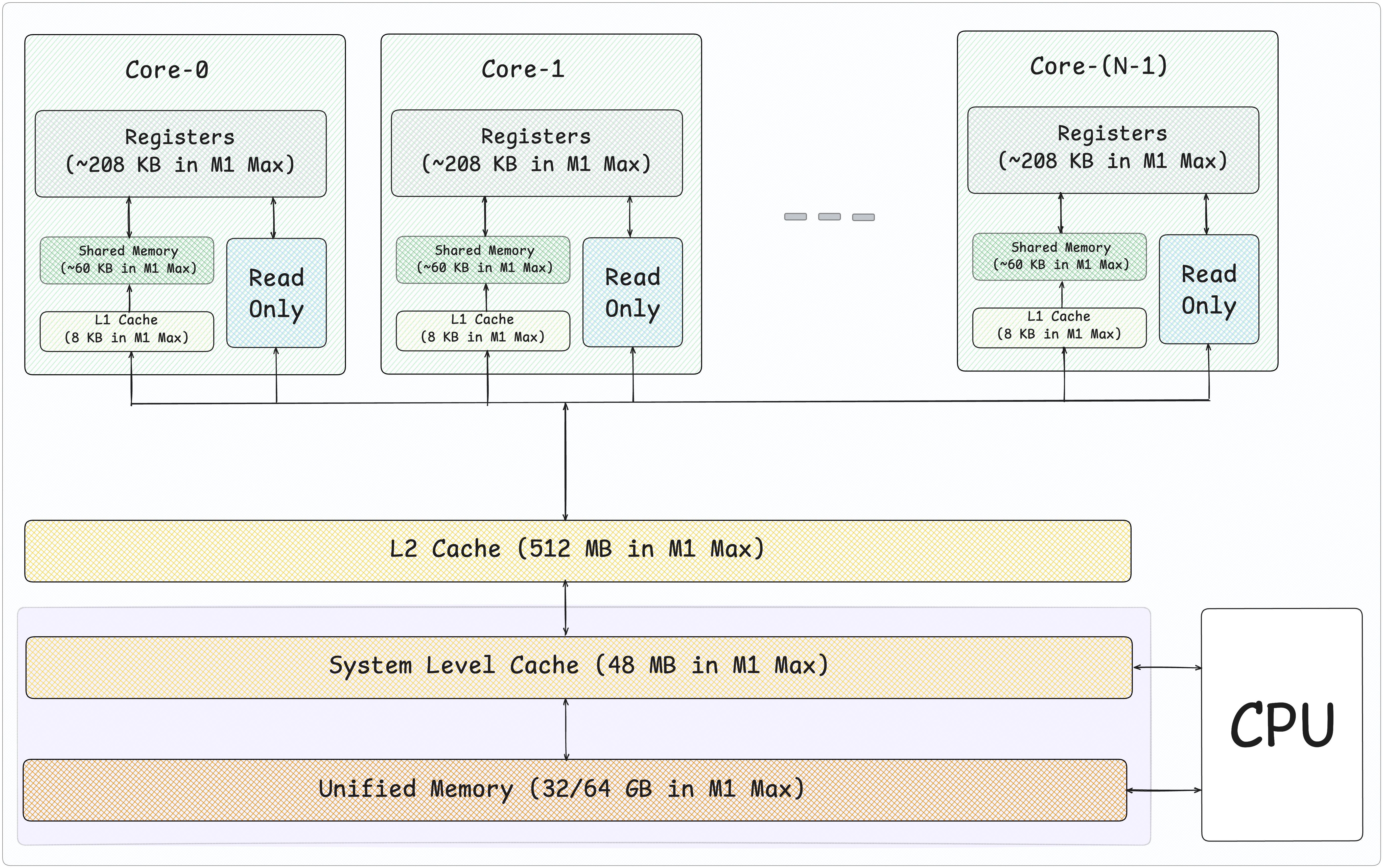
Apple uses Unified Memory Architecture. In a PC, the CPU and GPU have separate memory pools (RAM vs. VRAM). They communicate by copying data across the PCIe bus. Apple Silicon is designed for Zero-Copy. The CPU and GPU share the exact same physical memory blocks. When the CPU finishes a task, the GPU can immediately start working on that data without moving it.

Metal and apple's hardware drivers are hardcoded for this zero-copy behavior. To support a dGPU apple would have to rewrite their entire graphics stack to handle "Split Memory" again. This would introduce latency that would attenuate the efficiency gains of their chip design.

While the Mac Pro has 20+ PCIe lanes, Apple’s implementation of the PCIe is different. Newer GPUs require Resizable Bar so that the CPU can access the entire VRAM of the GPU, apple's controllers prioritize internal memory and the cache is designed to expect everything on the same die, the hardware just is not built to manage cache over a high-latency PCIe bus.

So could they design IO that would work with dGPUs?

sure they COULD, but they would then have to redesign their SOC AND support two completely different way of handling data within one OS.

I wouldn't call this a "companies being stupid problem" but I suppose that's a matter of opinion.

As far as FP-heavy work goes, Apple has begun signing limited drivers that allow Nvidia/AMD GPUs to work via PCIEe/Thunderbolt for compute only by bypassing the display server, so you still wouldn't be able to use something like autocad this way since the dGPU cannot provide video to the display.

I am going to assume that those who are going to drop $15,000 - $65,000 on a box to speed up "AI" tasks are such extreme edge case uses that apple has decided it is not worth building a tower to accommodate them, especially when it can be done over TB.


Last edited:
The UI also had a certain quality to it that was not available elsewhere.

There really was something charming about classic Mac OS - it was so 'friendly' and full of thoughtful touches. I always liked how flexible it was with where things were located - e.g. you could just drag the System Folder to another disk and boot from it. Probably not realistic in the modern computing environment, though.

When nextstep became macos and we also got intel machines with graphics card it was really the best of all worlds for a brief moment.

Aye.

I am not at all against the AS SoC approach , rather I applaud that and there is no lust for the hardware to be large physically in towers. But I do dislike the changes that remove choice like dropping support for OpenGL, not having a pro ”halo” line of products and especially all the sandboxing and service integrations.

The laptops are awesome, no doubt. For me at least, I don't particularly 'lust' after towers, but do appreciate having the space, cooling and power to support whatever I want, without needing to worry about compatibility. Or having to fiddle with access, cables etc. in tight spaces. It also lives under my desk, so take up less space on my desk than a mini would.

Oh, and Tahoe is the first OS in over 20 years I have not ”upgraded” to due to many things but mainly for it feeling mostly like a downgrade and also horrible aesthetics.

Ditto. My iPad's still on 18 too. I don't mind 26 on my phone, but would likely downgrade if it were possible (just for consistency with my other Apple devices).

My hope for wwdc is that there will be be a focus for macos27 to not go towards becoming even more ios-like but rather stabilize to a solid workhorse where AI is not forced down my throat.
If apple would come up with a way to make the studio line a little more pro I would be all for it The biggest issues is probably that there is no way to add ssds that run full speed and changed by the user easily and that having faster networking requires large external chassis. Both of these issues would easily be solved by a ”studio ultra ” that allowed for 2 small PCIe cards.

1. They clearly don't want you to be able to add SSDs that run at full speed. They want you to have to choose between a fast internal one, bought from the factory at a steep mark up, or to a slower one that requires you to use up a TB5 port and pay for an enclosure.
2. The Studio comes with 10GbE as standard, which is pretty fast. If/when there is significant demand for faster networking, they'll likely sell a factory upgrade option.

lets just hope they don’t drop the studio line as well and skip the ultra chips this time around.

I doubt that will happen. The Studio is ultimately a repurposed MBP, so doesn't represent a massive effort to cover the top end of the Mac desktop market. A Studio working flat out will be a lot quieter than a MBP, and doesn't require the customer to pay for a screen, battery and keyboard they're not going to use. It also makes the Ultra model possible, which clearly wouldn't be suited to a laptop.

TBH I use both macOS and Windows 11 for work. Win11 has issues, but as a daily driver it's a perfectly cromulent operating system.

Agree.

The thing that bugs me about Windows is the levels of cruft. Even though it's been based on NT since XP, it has so many legacy mini-apps / control panels / settings quirks (Registry editing? Really?) that date back decades, for application compatibility reasons.

Yeah. I really don't get why MS doesn't pay a UI designer to just go through Windows rooting out all this stuff and replacing it with consistent, modern replacements.

For instance: I wanted the Taskbar clock to display the full day and date, but the regular settings screen doesn't let you do that. I looked up an obscure control panel you have to invoke using the Run command, and its window uses legacy UI systems, including, apparently, bitmap fonts, as it appeared blurry and aliased.

Check out WindHawk - I use it for exactly this (and other UI tweaks, like customising the Start Menu).

I think the biggest hurdle here is that Apple Silicon, by its very nature, was always designed for efficiency first, not performance.

This makes it ideal for laptops, where you get great performance, long battery life and better sustained performance because the chip is less prone to throttling. It's less of an advantage for desktops because power consumption is less of a concern. Apple has tried to work around this by designing desktop form factors that you normally don't see with PCs (the iMac's all-in-one design, and the Mac Studio's more compact shape) to differentiate their offerings because x86 processors tend to generate more heat, and require more room for cooling as a result, and so you don't really see this being done well in Windows computers.

Yeah, the laptops are awesome. But the desktops are an afterthought that just repackage the Air / low-end MBP / high-end MBP as the iMac / mini / Studio. Given that desktops represent a small % of Apple sales, and AS is so optimised for mobile that deviating from it would take a lot of effort / $, you can see why Apple just calls it a day with the models they have.

This leaves the Mac Pro in a bit of an awkward position because a giant tower is antithetical to the entire intent of Apple Silicon. It's non-expendable, you don't need the extra space for cooling or expansion, and so you are just paying extra cash for features you never really get to benefit from. Any Mx Extreme chip would also entail a ton of engineering resources for very limited gain (Mac Pros don't exactly sell by the truckload), and I feel that just doing away with this product category altogether is the more prudent move in the long run. It just doesn't seem to fit in with the overall intent and purpose of Apple silicon overall.

Yep.
 
I doubt that will happen. The Studio is ultimately a repurposed MBP, so doesn't represent a massive effort to cover the top end of the Mac desktop market. A Studio working flat out will be a lot quieter than a MBP, and doesn't require the customer to pay for a screen, battery and keyboard they're not going to use. It also makes the Ultra model possible, which clearly wouldn't be suited to a laptop.
Interesting, I never thought about it like that, but it's essentially true. That said, you do get more Thunderbolt ports and more / higher resolution monitor support with the Studio. I don't know if you can unlock the same number of displays via a Thunderbolt dock, but I'm doubtful.

Yeah. I really don't get why MS doesn't pay a UI designer to just go through Windows rooting out all this stuff and replacing it with consistent, modern replacements.
They're apparently starting to do that work now, in a panic. And that is sort of Microsoft's blessing and curse in a nutshell - you can pay (as a corporation) for extended support for older versions if you have older hardware that needs it, so it's cluttered with old Win32 stuff. It's not just UI but ancient drivers and things.

I would really love it if MSFT decided to bite the bullet and release a new, legacy-free Windows architected from scratch. Heck, even a Windows-themed Linux distro for ARM64 with heavy investment into Proton.

(Then again, I'm kind of wishing for Atari to make a Linux-based comeback with a modern ST... gimme those hardware-integrated MIDI ports).

Check out WindHawk - I use it for exactly this (and other UI tweaks, like customising the Start Menu).
Ah, it's a corporately managed machine, so I can't install anything that isn't from a pre-approved list without making a Business Case to my eight different bosses here at Initech.

Given that desktops represent a small % of Apple sales, and AS is so optimised for mobile that deviating from it would take a lot of effort / $, you can see why Apple just calls it a day with the models they have.
This. Desktops are just 14% of Apple's Mac sales, and I'm guessing most of those are iMacs and Minis, with Studios representing the thinnest slice.
 
I don't know if you can unlock the same number of displays via a Thunderbolt dock, but I'm doubtful.

I’d have thought an Mn Max is an Mn Max - the capabilities should be identical.


Tbh, whilst I certainly want MS to do this, in practice I rarely need to use legacy control panels, or the Registry.

Desktops are just 14% of Apple's Mac sales, and I'm guessing most of those are iMacs and Minis, with Studios representing the thinnest slice.

It’s slightly circular, though, in that by making very compelling laptops and less compelling (high end) desktops, the sensible Mac choice tends to be a laptop.
 
  • Like
Reactions: innerproduct
There are three reasons to buy a Mac desktop:


- If you absolutely need or want the M Ultra processor, Mac Studio is your only option

- Spec matched, desktops like Mini and Studio are a bit cheaper than their laptop equivalents

- If you really love the iMac design, or by some peculiar circumstance it is the best fit for your needs


But yeah, by default I recommend Mac laptops, and Windows desktops.

Other than the aforementioned, there just isn't a very compelling case to be made for Apple's desktops anymore. I switched from cheese grater to MBP in 2022 and haven't regretted it once.
In clamshell mode it behaves just like a silent desktop with my Echo 20 hub, and I can pick it up at a moment's notice throw it in my backpack and have all my stuff with me wherever I go. Best of both worlds.
 
Register on MacRumors! This sidebar will go away, and you'll see fewer ads.