Become a MacRumors Supporter for $50/year with no ads, ability to filter front page stories, and private forums.

MacRumors

macrumors bot
Original poster


In 2022, Apple introduced a new Apple Home architecture that is "more reliable and efficient," and support for the old architecture has now ended.
iOS-26-Home-Feature.jpg

As expected, the app is no longer working for some users.

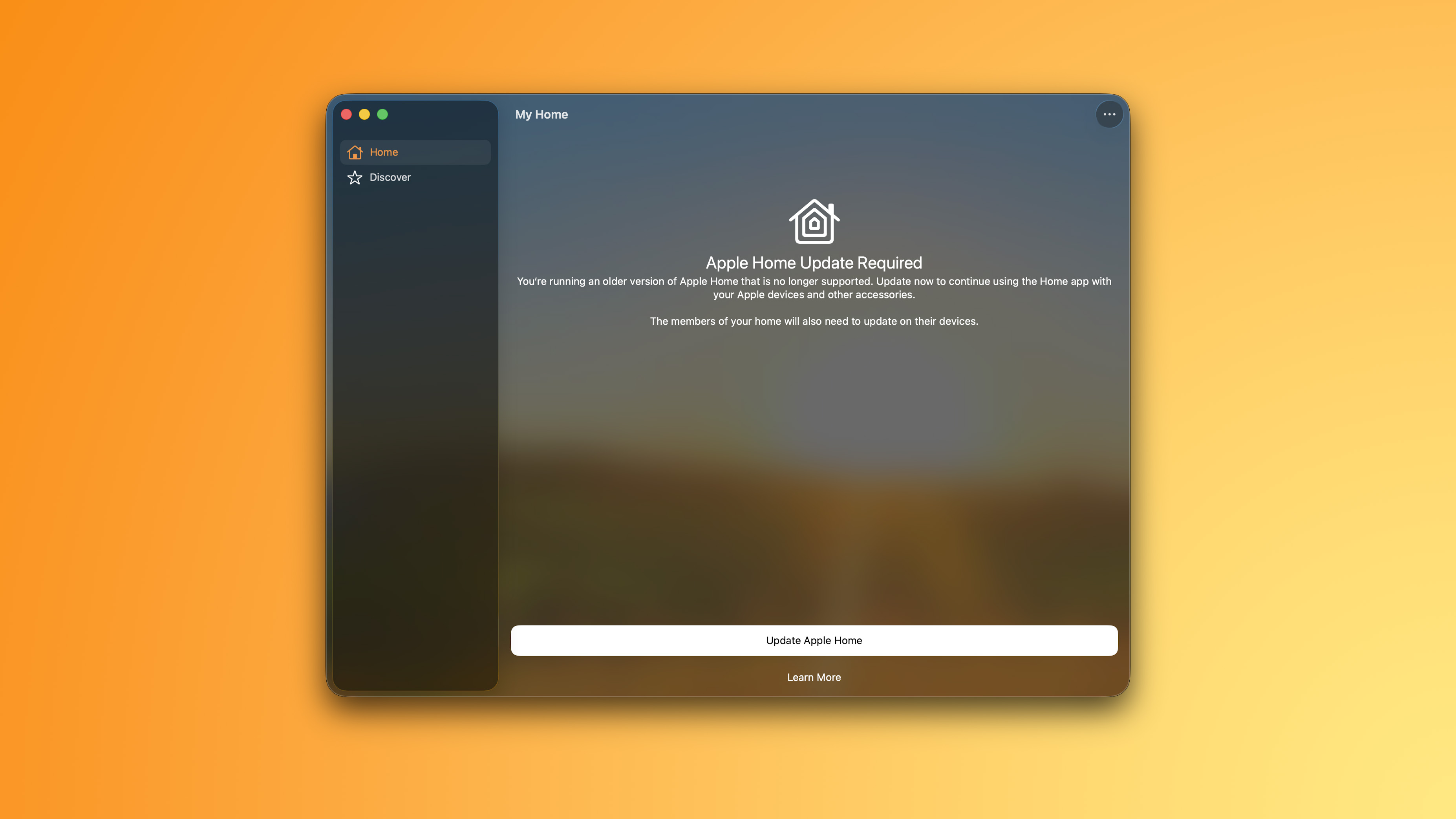
Users who did not update the app by the February 10 deadline now see this message: "You're running an older version of Apple Home that is no longer supported. Update now to continue using the Home app with your Apple devices and other accessories."

"The members of your home will also need to update on their devices," the message adds.
Home-App-Unsupported-Message-Feature.jpg

Apple said users who do not upgrade may experience issues with accessories and automations, or lose access to their smart home in the app entirely. In addition, users who do not upgrade will miss out on newer features like robot vacuum cleaner support, and they will not receive important security fixes and performance improvements.

It is still possible to upgrade the app to restore functionality.

Apple explains how to upgrade the Home app on the iPhone, iPad, or Mac:
  • Open the Home app
  • Tap or click on the three dots in the upper-right and navigate to Home Settings
  • Tap or click on Software Update
  • Tap or click Update Now, then follow the prompts. All of the homes that you own are updated at the same time.
If you see "This home and all accessories are up to date," then you are on the current version of the app and no further action is required.

Notably, the newer Apple Home architecture requires a minimum of iOS 16.2, iPadOS 16.2, macOS 13.1, tvOS 16.2, and watchOS 9.2.

More details are available in an Apple support document.

Article Link: Apple Home App Stops Working for Some Users as Update Now Required
 
Well… I had switched to the new architecture more than a year ago, but with tvOS 26 and HomePodOS 26 some devices suddenly go “unreachable” for no reason. For example today, just one HUE lamp is unresponsive according to the Home app… just one of many. It still works fine in HUE, Homekit says no. I probably have reboot every “hub” again.
 
It’s funny I updated to the new architecture when it was first available in beta.

Then they pulled it for a bit because it was shocking… 😂
I did as well, but just for the home sharing reasons. I never had a problem with the new architecture though.
 
  • Like
Reactions: b17777
The only people who "can't" update their Home app are the ones whose only iDevice for accessing home is ancient, and locked to older software. Someone complained to me that this was unfair of Apple, because their only phone is a 2016 iPhone SE that is locked to iOS 15.x.x. Yet, apparently this person actually uses and relies on HomeKit? I don't buy it, honestly. Those things don't jive. It's probably like a single nano leaf light bulb or something.
 
Well… I had switched to the new architecture more than a year ago, but with tvOS 26 and HomePodOS 26 some devices suddenly go “unreachable” for no reason. For example today, just one HUE lamp is unresponsive according to the Home app… just one of many. It still works fine in HUE, Homekit says no. I probably have reboot every “hub” again.
Unfortunately this is just par for the course with HomeKit. I have more than 50 devices in Home app, and on any given day I'll open the app to see a handful not responding.
 
The only people who "can't" update their Home app are the ones whose only iDevice for accessing home is ancient, and locked to older software. Someone complained to me that this was unfair of Apple, because their only phone is a 2016 iPhone SE that is locked to iOS 15.x.x. Yet, apparently this person actually uses and relies on HomeKit? I don't buy it, honestly. Those things don't jive. It's probably like a single nano leaf light bulb or something.
Then again, Apple just released updates for these old devices. So there must be a decent amount of users still.
 
Oh I was literally told by people on Reddit that this is an example of why you don't get into smart home, because the rug can be pulled out at anytime....
I’m glad that HomeKit apparently provides an “out” for when companies like Belkin turn off their cloud integration. All my Belkin devices still work.
 
Well… I had switched to the new architecture more than a year ago, but with tvOS 26 and HomePodOS 26 some devices suddenly go “unreachable” for no reason. For example today, just one HUE lamp is unresponsive according to the Home app… just one of many. It still works fine in HUE, Homekit says no. I probably have reboot every “hub” again.
I updated to the new architecture many years ago, and along with doing so it made my August locks all very unstable. They would randomly stop responding and had to be manually power cycled by popping a battery to get them back online. That only started right after the "upgrade" to the new architecture. I reset the locks dozens of times, removing and re-adding them from August's app and HomeKit. I contacted August and submitted Apple feedback, and never got any traction at finding someone willing to acknowledge the issue or attempt to troubleshoot with me. And of course there was never an option to revert, so there was no way to go back to reliability.

Other than that, I saw no meaningful performance or reliability improvements from upgrading. So I can't blame anyone who has put it off this whole time. At this point, if it wasn't broke, why "fix" it?

I eventually replaced those expensive smart locks because of the loss of reliability. It's a shame how little Apple cares about generating more e-waste in the name of a required "upgrade" that provided no meaningful benefit, and then won't even step up to provide resources to fix the broken software they've now forced on us.
 
  • Sad
Reactions: walkin
Other than that, I saw no meaningful performance or reliability improvements from upgrading. So I can't blame anyone who has put it off this whole time. At this point, if it wasn't broke, why "fix" it?
They needed to update it to support Matter, plus the old architecture was just slow and inefficient.

The old architecture with lots of devices was laggy. When I upgraded to the new one a few years ago, it really did feel quite a bit snappier. This sums it up.

Old Architecture - When you opened the Home app, your iPhone or iPad would manually reach out to every single device in your home one by one to ask, "Are you on or off?" If you had 50 devices, your phone had to make 50 separate requests. This is why you often saw the "Updating..." message for several seconds.

New Architecture - Your Home Hub (Apple TV or HomePod) stays "awake" and constantly tracks the status of every device in the background. When you open the Home app, your iPhone asks only the Hub for a single status update. This results in much faster response times and more reliable automations.
 
They needed to update it to support Matter, plus the old architecture was just slow and inefficient.

The old architecture with lots of devices was laggy. When I upgraded to the new one a few years ago, it really did feel quite a bit snappier. This sums it up.

Old Architecture - When you opened the Home app, your iPhone or iPad would manually reach out to every single device in your home one by one to ask, "Are you on or off?" If you had 50 devices, your phone had to make 50 separate requests. This is why you often saw the "Updating..." message for several seconds.

New Architecture - Your Home Hub (Apple TV or HomePod) stays "awake" and constantly tracks the status of every device in the background. When you open the Home app, your iPhone asks only the Hub for a single status update. This results in much faster response times and more reliable automations.
I understand how the architectures managed device status. That being said, I had more than 75 HomeKit devices and never saw a performance issue. I think the bigger problem that the new architecture masks is people's shoddy Wi-Fi and network connectivity.

I don't have a problem with Apple making the change -- it is undoubtedly more efficient. But I take issue with the way it was rolled out, with so many people having problems that they even blocked upgrades for a short time, but never actually working with the impacted users to fully understand how they broke HomeKit functionality or made any attempt to continue to fix it once they re-enabled upgrades to the new architecture.

I lived with those locks behaving that way for over a year, and through another entire major iOS version hoping that Apple would silently slip a fix into an update, as they often do. It never happened. And for that, I fully blame Apple for breaking working functionality and then walking away from the wreckage.
 
Other than that, I saw no meaningful performance or reliability improvements from upgrading. So I can't blame anyone who has put it off this whole time. At this point, if it wasn't broke, why "fix" it?
My understanding is that the only change is for those who have a home hub (Apple TV or homepod - they removed iPads as hubs as part of this change).

If you don't have a home hub, the new arch does nothing. If you do, then it changes the way it polls devices for their status. Instead of polling the devices (or device hub, such as Philips Hue) directly, it polls the home hub only. The home hub then polls, at regular intervals (for various meanings of the word regular) all the devices/external hubs.
 
No reason to wait any longer. Looks like it is stopping to work. Anyway good that Apple was giving repeated reminders. Any remaining users should update right away.
 
  • Like
Reactions: mganu
I updated to the new architecture many years ago, and along with doing so it made my August locks all very unstable. They would randomly stop responding and had to be manually power cycled by popping a battery to get them back online. That only started right after the "upgrade" to the new architecture. I reset the locks dozens of times, removing and re-adding them from August's app and HomeKit. I contacted August and submitted Apple feedback, and never got any traction at finding someone willing to acknowledge the issue or attempt to troubleshoot with me. And of course there was never an option to revert, so there was no way to go back to reliability.

Other than that, I saw no meaningful performance or reliability improvements from upgrading. So I can't blame anyone who has put it off this whole time. At this point, if it wasn't broke, why "fix" it?

I eventually replaced those expensive smart locks because of the loss of reliability. It's a shame how little Apple cares about generating more e-waste in the name of a required "upgrade" that provided no meaningful benefit, and then won't even step up to provide resources to fix the broken software they've now forced on us.

I hear ya... got similar problems with EVE devices when they started to use Matter. I have 14 EVE energy plugs. Started with bluetooth only models first. Later I got HomeKit Thread models and they all worked perfectly (fast and great wireless coverage). Then Apple started with Matter. Eve quickly adopted it too and started to bug me in their app that I had to upgrade to the new firmware. Held it off and afterwards it proved to be a good thing. Because when I bought another new EVE Energy, this one had Matter firmware on it, within the hour after I installed it, the damn thing disabled all nearby Thread devices - basically breaking a significant part of the home automation. At first I thought this particular device had a defect, but the same thing happend with a replacement from the store.
Fortunately for me removing this new EVE Energy did restore the Thread network again, but still... this isn't "it just works" anymore.

Unfortunately this is just par for the course with HomeKit. I have more than 50 devices in Home app, and on any given day I'll open the app to see a handful not responding.
I only have unresponsive devices with Matter so far. HomeKit only devices, especially using Thread, usually work fine. However, each time when there's a HomePodOS update, I have to reboot (or powercycle) every HomePod in the house a second time to avoid strange behaviour (including Siri's famous "I found some webresults..." after trying to use the intercom function or setting a scene).
Also as I posted earlier, a HomeKit network is very much relying on multicast traffic IPv4 and IPv6 on the local network. Some consumer wifi and ethernet equipment can't handle that properly and cause problems with HomeKit.
 
Last edited:
  • Like
Reactions: xpxp2002
I haven't upgraded Home yet. My Apple TV 4K is the only device I use that runs Tahoe. Looks like that device no longer works with the old Home architecture although it was working before Feb 10th. My other devices running Sequoia and earlier still work with it.

So it seems like if you don't update a device to version 26, it can't force the update on that device and the device will continue working with the old architecture (if you don't upgrade Home to the new architecture). But if you did upgrade to version 26, that device will no longer work with the old architecture.

In other words, Apple put a Feb 10th kill switch for the old Home architecture in Tahoe, but only for Tahoe. This is really ridiculous. The old Home architecture still works on older versions of macOS, iOS and tvOS, but a Tahoe system that worked with it last week no longer does (up to 26.2).

They didn't actually kill the old Home architecture, they just kneecapped Tahoe's compatibility with it starting on an arbitrary date. SMH.

Edit: They also didn't kill remote functionality. My devices still work over the Internet via my HomePod as a hub, which is running version 17.5.
 
Last edited:
Register on MacRumors! This sidebar will go away, and you'll see fewer ads.