
Become a MacRumors Supporter for $50/year with no ads, ability to filter front page stories, and private forums.


Apple shares have rallied 15 percent since their worst day on the stock market in more than a year, adding almost $600 billion in value since June 25 and returning the stock to record territory (via Bloomberg).
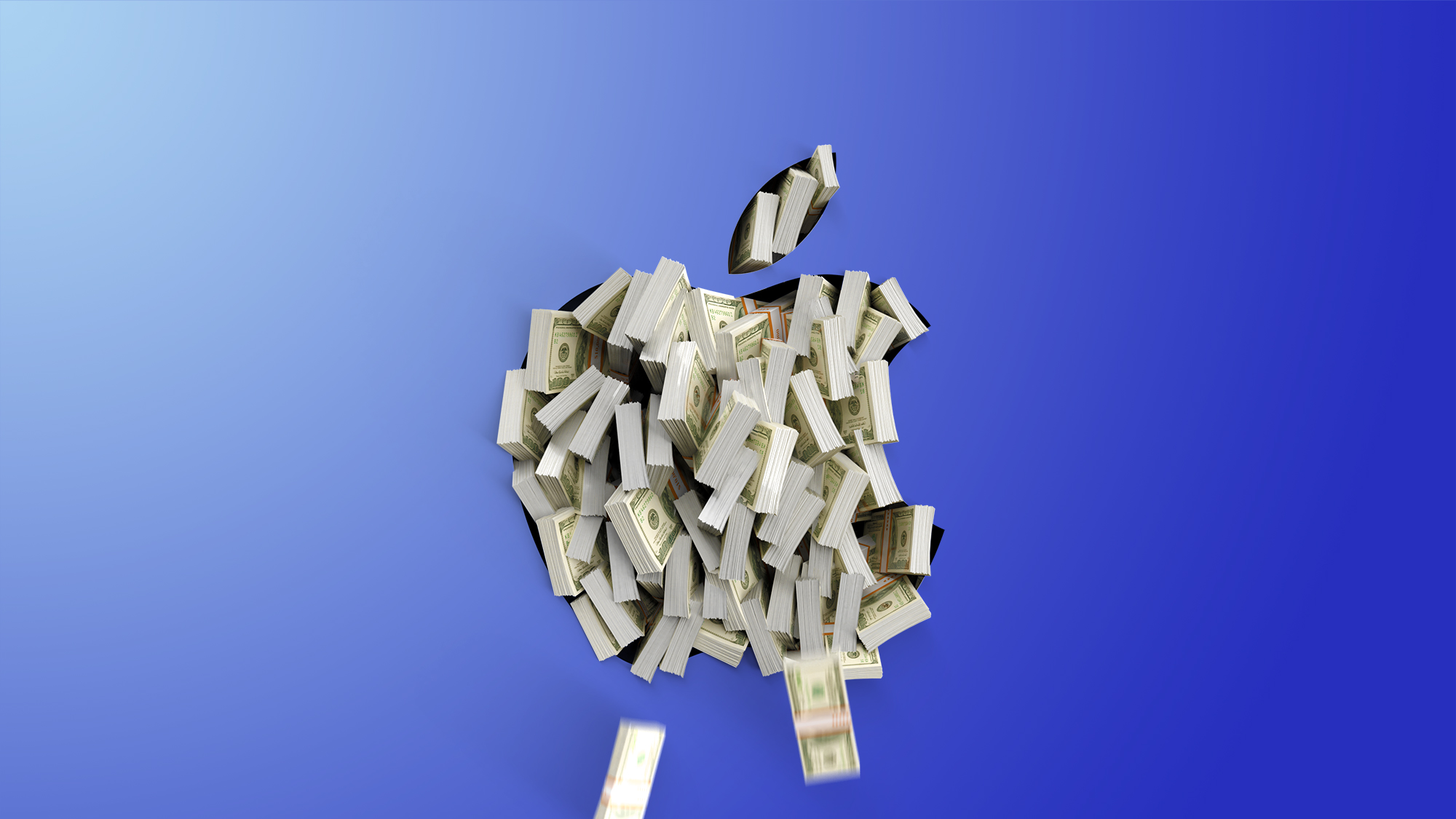
Apple-Logo-Cash-Blue.jpg

The rebound comes as investors grow uneasy about the mind-boggling sums of cash continually being poured into the AI data center buildout, despite there being no obvious indicator for when investors will get a return on their investment.

Apple's decision to sit out the data center spending spree and instead pay Google for access to its frontier AI models is being increasingly seen by traders as an asset rather than a liability. Apple is using Google's Gemini to underpin the revamped version of Siri and new Apple Intelligence features across its platforms.

Apple's WWDC presentation last month of upcoming AI features in iOS 27 and macOS Golden Gate initially sent the stock lower, but it has since rebounded in impressive fashion.

The rally has occurred in spit of the fact that Apple is facing pressure from soaring memory chip costs, which was what prompted the company to raise prices on Macs, iPads, and its Home devices on June 25. That was the move that triggered the company's worst single-day stock drop since April 2025, with shares closing at $275.15. Apple's iPhone models were spared similar price hikes, but the company has hinted that further increases could follow.

Investors are also viewing Apple's upcoming foldable iPhone, expected in September, as a potential catalyst, according to Bloomberg. Nikkei reported earlier this month that Apple told suppliers to prepare for around 10 million units this year, up from a prior forecast of seven to eight million.

Apple shares are now up 16 percent in 2026, making it the best performer among the "Magnificent Seven" tech giants, which includes Microsoft, Amazon, Alphabet, Meta, Nvidia, and Tesla. AAPL closed at $315.32 on Friday, just shy of its all-time high of $317.40 set in early June.

In the coming days, MacRumors will be speaking with a prominent technology commentator about whether Apple's decision to avoid the AI data-center arms race is actually becoming a strategic advantage. Stay tuned.

Article Link: Apple Stock Hits Record Territory as Traders Sour on AI Spending

IIRC, Scott Galway called this over a year ago -- these AI companies can fight it out for who can lose the most money building out the infrastructure for AI inference and training, and then Apple can come along later and see which of the survivors feels like paying Apple billions of dollars for the privilege of being Apple's primary AI provider. Or if it turns out that open weight models are good enough, they can just skip the whole huge buildout and use cheaper models, and leave Open AI and Anthropic to figure out who wants to buy access to a rapidly depreciating pile of GPUs.

The only surprising to me is how long it's taken for people to recognize that Apple dodged a bullet here.
 
The jury is still out on this.

As of July 2026 Gemini is now way behind OpenAI, Anthropic, and even Grok, let alone the Chinese models which are basically distilling frontier models from OpenAI and Anthropic.

Siri couldn’t get any worse, let’s be fair, but I’m not sure Gemini will be as big a success as they need it to be, given that up to a billion people worldwide are now using better AI themselves with ChatGPT and Claude directly.

Personally I would have preferred the new Siri to be underpinned by the multimodal ChatGPT 5.6 Sol model. It’s so far ahead of what Google have it’s not even comparable.
I just need it to tell me the weather
 
How many years did it take for other crashes to occur? Dot com crash? Financial crisis of 2008?
Hold and you are fine, provided you buy properly. Tech sector with IBM and Apple (for different reasons) are solid picks. At least in my day. Now I just hold through the dips and sell when necessary. Apple was my best buy ever. The iPod changed the world.
 
Bubble, bubble, toil and trouble. Don't buy junk and there is no "bubble". I've lived through dot bomb and couldn't believe the crap out there. Don't buy piles.
 
I'm pretty sure is somehow resembles the .COM bust and the Telcom bubble of the late 90's early 2000's. Lots of money will be raised through stock speculation and aggressive investing. The bubble will burst leaving massive amounts of unused infrastructure behind that will end up being the basis of the next tech build out.

This unused infrastructure that was build on the folly of overly aggressive investors will be acquired for pennies on the dollar and eventually make someone else rich and promote countless innovations.
Maybe to an extent. A lot of the cost is currently tied up in GPUs, which rots a lot faster than the fiber optic backbone they installed across the world back then. GPUs have a fixed lifespan before newer, faster, more efficient tech (and hungrier models) obsolete them. I'd argue that fiber optic backbone was far more durable and scalable than the current data center buildout, and built for a fraction of the price. What we're doing today rhymes but is different enough that I don't think the comparison fits, and the scale is out of control. It's the only reason our GDP is still positive. You just need a certain percentage of shareholders to come off of that hopium high and the circular accounting going on right now between all of these companies collapses spectacularly.

What comes next will be better, but I think the next big thing is local models. The stuff Apple, China, and some smaller western startups have been working on, the stuff that companies can keep internal and control for privacy and security reasons, and that Apple can deliver directly to consumers on-device for the same reasons. The corporate problem is the easier solve, but I could see Apple buying up a lot of these collapsed data centers to start and run their cloud models in those until the bridge can be crossed for mobile on-device without just wiping out battery life. The point will arrive (and I think we're already getting there, especially for agentic coding) where the models are good enough for most people and work tasks and there are diminishing returns for speed. That's when Moore's Law combined with software engineering and advanced battery tech allows these models to fit and run reasonably well on mobile devices. The newest iPhone can support that, and Apple can slowly phase out the cloud models and modify those data centers for other cloud services or sell the real estate, probably at a profit.
 
When people cite the "Buffett Indicator" (Willshire 5000 market cap / US GDP) to claim tech stocks are in a bubble, they are ignoring a massive denominator mismatch.

First, information technology companies derive roughly 59% of their revenue and profits overseas. Using US GDP as the baseline completely ignores their global economic exposure. You cannot accurately measure a multinational growth company's value against a single country's domestic output.

Second, GDP is a backward-looking metric; it reflects what happened last quarter, whereas the stock market prices in future growth and earnings potential.

Finally, when Warren Buffett popularized this metric over 25 years ago, was dominated by capital-intensive, asset-heavy value companies. Today’s asset-light (for now) tech giants dominate the index, meaning the structural makeup of the market has fundamentally changed. High valuations for global growth companies do not automatically signal an imminent crash.

I'd perfer the metric Blended GDP = (domestic revenue %) × US GDP + (foreign revenue %) × Rest-of-World GDP

Using goldman sacks data would indicate that we are at about 132-%150% on the modified buffit indicator which indicates we are nearing over-valued > 150% ratio.

There are several reasons (besides the obvious) as to why this popular reddit armchair investor argument is flawed and that as an otherwise rational, articulate individual you should not be so easily taken in by such things. One is that a ratio is just that. It is not a cause-effect relationship but rather it's a benchmark and it is the velocity of change of that benchmark that we are interested in. If your claim is that foreign revenue is growing at the same pace as the marginal increase in market price, then prove that. Break down the financials of every company in the Wilshire index and prove that hypothesis.

Secondly, that still doesn't explain the concomitant increases in Shiller CAPE (why specifically should the premium increase? and more importantly, what impact does that have on the prevalence of discounted securities that we should be focused on?).

Thirdly that doesn't explain changes in other indexes of non correlated assets, e.g. the Case-Shiller Home Price Index. Commodities markets. Etc.

And on a basic level it just does't pass the sniff test... Why should I as an investor say "Oh yeah I see why I should suddenly pay $500 for $1 instead of $50 for $1 when if I were a shrewd investor I should actually be paying 60 cents for a dollar." I will never understand the burning need to pay a premium instead of collecting one, except to say that P.T. Barnum was right. So was Graham.
 
Last edited:
Your brother is a logistics guy that has no insider knowledge of anything having to do with bubbles, or the lack there of.

I'm curious what information you have that makes you claim this...

EDIT: Or is this based on your misunderstanding of the word "delivery" in this context? Wait... Did you think I was talking about shipping lanes or trucks on the highway? 🤣
 
Last edited:
You're saying there's still a chance of a warm meal and no gas turbine infra noise disrupting my health. I mean, 1995 here I come.

You can buy an Nvidia 6090 and cook your meal on it while watching you Nvidia stock hit $10 trillion market cap and then you can buy a Mac Studio 1.5TB RAM with your gains. Don’t stay poooooor.
 
I think Apple has the right idea with prioritizing AI that runs on device rather than relying on data centers but the execution of that idea has yet to pan out. M4 was supposed to be an AI chip, iPhone 16 was supposed to be the AI phone… which didn’t happen.

On device AI models still requires jumping through tons of hoops to load Lama or similar. I’d like to see Apple offer their own solution for this along with making it easier for users to load their own models and add functionality.
You still need data centers to build your models. That is not happening on your device.
 
My first Apple purchase: In 2003 during the back to school deal, I bought a 12" PowerBook G4, a 3rd generation iPod, a Canon i450 printer, and a Brenthaven case.

My life could be so much different if I had bought stock instead of that.
Oh to be young again. I said the same thing when I got my first iPod with the scroll wheel. "If I was more of an adult I would buy stock in this company"

my parents didnt listen lol
 
  • Like
Reactions: cutlub
There are several reasons (besides the obvious) as to why this popular reddit armchair investor argument is flawed and that as an otherwise rational, articulate individual you should not be so easily taken in by such things. One is that a ratio is just that. It is not a cause-effect relationship but rather it's a benchmark and it is the velocity of change of that benchmark that we are interested in. If your claim is that foreign revenue is growing at the same pace as the marginal increase in market price, then prove that. Break down the financials of every company in the Wilshire index and prove that hypothesis.

Secondly, that still doesn't explain the concomitant increases in Shiller CAPE (why specifically should the premium increase? and more importantly, what impact does that have on the prevalence of discounted securities that we should be focused on?).

Thirdly that doesn't explain changes in other indexes of non correlated assets, e.g. the Case-Shiller Home Price Index. Commodities markets. Etc.

And on a basic level it just does't pass the sniff test... Why should I as an investor say "Oh yeah I see why I should suddenly pay $500 for $1 instead of $50 for $1 when if I were a shrewd investor I should actually be paying 60 cents for a dollar." I will never understand the burning need to pay a premium instead of collecting one, except to say that P.T. Barnum was right. So was Graham.
tldr
 
Register on MacRumors! This sidebar will go away, and you'll see fewer ads.