

Become a MacRumors Supporter for $50/year with no ads, ability to filter front page stories, and private forums.

MacRumors

macrumors bot
Original poster


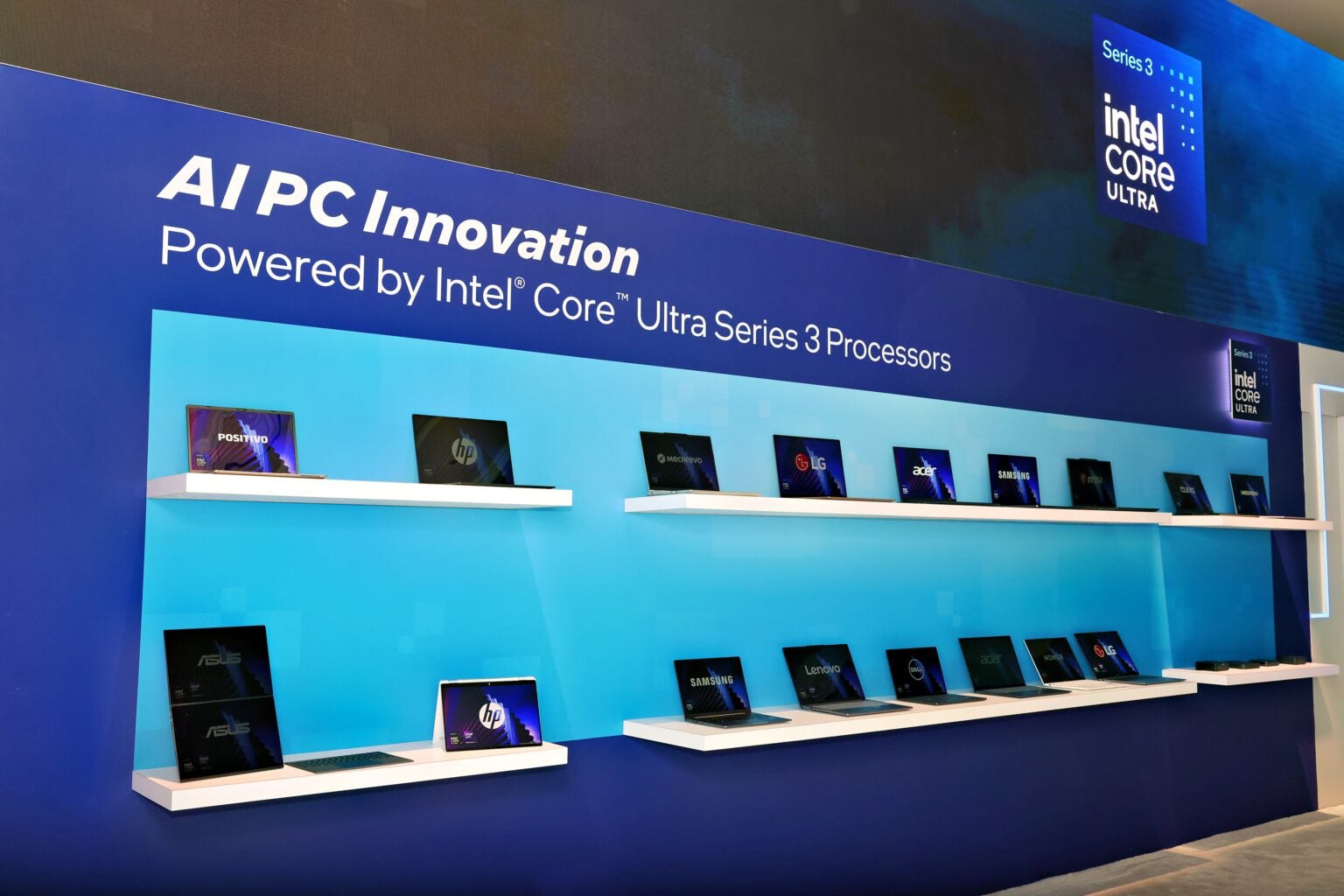
Intel introduced its latest processors at CES 2026, debuting the "Panther Lake" Intel Core Ultra Series 3. The chips are the most advanced manufactured in the U.S., according to Intel, and they are built on Intel's 18A process.
intel-core-ultra-chips.jpg

18A, or 18-angstrom, is the most advanced node Intel has designed to date, but Intel continues to trail TSMC. TSMC is developing Apple's next-generation 2nm chips, and they are expected to have higher transistor density and efficiency than Intel's 18A chips.

Intel is developing several chips in the Ultra Series 3 line for both high-end and low-end laptops, with the top SKUs offering up to 16 CPU cores, 12 Xe cores (Intel's graphics architecture), and 50 NPU TOPS. Compared to prior-generation chips, Intel claims the Ultra Series 3 processors will bring up to 77 percent faster gaming performance, 60 percent better multithreaded performance, and up to 27 hours of battery life.

Apple doesn't use Intel chips anymore, so the new Core Ultra Series 3 processors will be exclusive to PCs, but there are rumors that Intel could manufacture some Apple chips in the future. According to Apple analyst Ming-Chi Kuo, Intel will make lower-end M-series chips for Apple's Macs built on the 18A process, using Apple chip designs. Intel could begin shipping chips to Apple as soon as mid-2027.

The first laptops powered by Intel Core Ultra Series 3 chips debuted at CES 2026, with more coming throughout the first half of the year.

Article Link: CES 2026: Intel Unveils 18A-Based Core Ultra Series 3 Chips Amid Rumors of Future Apple Partnership
 
Good to see Intel & AMD continue to compete.

My primary work machines are all macOS, but there are still certain things I use Windows for.

And there’s no way in hell I’m ever going to waste money on those junk Snapdragon Windows machines.

Edited: Didn’t see it mentioned but 18 angstroms is 1.8nm.
 
Last edited:
Who believes intel by now?.
After 30 years of hearing the same story from Intel I have seldom seen any of their performance and battery duration claims ever providing try speed improvements.
From 8086 to 80386, 486 with ALU, then pentium, then nothing.
 
Nvidia tested 18A and isn't moving forward with using it.

Maybe it's good enough for Apple though?

Misleading. Yes Nvidia decided not to go forward at this time, but that doesn’t mean Intel 18A is bad. Based on reports it’s more likely Intel doesn’t have enough capacity to meet demand (yields might be too low right now). Nvidia is still using TSMC 4nm in many products. They don’t always use the best node available.

As for Apple, nobody knows. They have the most advanced ARM architecture and it would certainly perform better on 18A than x86. People shouldn’t look at power consumption (for example) fir Intel chips on 18A and conclude 18A is “inefficient”.
 
I'm interested to see how these perform, especially since Dell is bringing back the 13" XPS. I love my M4 Air, but it's always nice to see some competition.
I'm very glad they've brought back the XPS line. Their lineup was so confusing this past year! We replaced several laptops at the office and no one got a Dell this year.

I looked at the 14" and 16" models today, and then I read about the 13" making a comeback. They look like nice machines, albeit pricey! It'll be interesting to see what they do with the XPS 13.
 
  • Like
Reactions: DEMinSoCAL
Misleading. Yes Nvidia decided not to go forward at this time, but that doesn’t mean Intel 18A is bad. Based on reports it’s more likely Intel doesn’t have enough capacity to meet demand (yields might be too low right now). Nvidia is still using TSMC 4nm in many products. They don’t always use the best node available.

As for Apple, nobody knows. They have the most advanced ARM architecture and it would certainly perform better on 18A than x86. People shouldn’t look at power consumption (for example) fir Intel chips on 18A and conclude 18A is “inefficient”.

Yet, Nvidia has already committed to TSMC A16 process.

Whether Intel's 18A yield is low, process delayed, or power consumption too high, any of those results in a fail. In terms of capacity, nobody is using Intel 18A. There's plenty of capacity to meet demand. The problem is no demand.
 
  • Like
Reactions: Wx_Man
Intel has already abandoned 18A for external foundry customers. Intel is the only one using it. The nail in the coffin was Nvidia’s public rejection of this node with rumors that Apple rejected it as well for Apple Silicon chips.

18A is the rough equivalent to TSMC’s 2nm or “N2” node. However TSMC is able to pack more transistors into the roughly equivalent die space. Back before former Intel CEO Pat Gelsinger was booted out he touted 18A as the comeback node for Intel and its foundry. It was a failure and thus Gelsinger was shown the door.

Now Intel is pivoting to Intel 14A or 1.4 nm as their “big comeback” with one exception. New Intel CEO Lip-Bu Tan has publicly stated that if Intel can’t find significant outside customers to buy into 14A ( assumingly Nvidia and Apple ) then he’ll end Intel’s Foundry into new processes.

Meaning…Intel will NOT be a supplier of Apple chips going forward if Apple and or Nvidia rejects 14A as they did 18A.

14A is the last shot for Intel. Any takers on that bet at this point in Intel’s history?

 
What exactly is an 18A chip? How does that compare to the 2nm ones from TSMC? I thought we used nm normally because it stood for the name of the measurement? This article would have been helpful if it had a comparison of how these two types of chips differ.
 
Who believes intel by now?.
After 30 years of hearing the same story from Intel I have seldom seen any of their performance and battery duration claims ever providing try speed improvements.
From 8086 to 80386, 486 with ALU, then pentium, then nothing.

Regular consumers probably dont know or care but among PC Gamers, they've burnt away most of their goodwill. Too frequent socket changes, the 13th and 14th gen design flaws, the CPU's requiring obscene levels of power. AMD is king at the moment with their X3D series, AMD kept the same CPU socket relevant for a decade and the socket after that looks to be doing the same.
 
  • Like
Reactions: JohnWick1954
Ugh, the article is intermingling two units of measurement, talking about 18Å (aka 1.8nm) and 2nm (aka 20Å). Can we please migrate to Ångstroms when getting into the nitty-gritty details and keep our units of measure consistent and without extraneous decimal places. Otherwise, I would like the weight of future iPhones to be given in carats (ct) and Android in troy ounces (ozt).

This is how we lost a Martian space craft, thing of the poor aliens getting hit on the head by falling debris.
 
It's all about yields and performance at this point. It took a long time for Intel to build out the new fab in Chandler, at the opposite end of the Phoenix metro from the TSMC plant in Anthem. I hope they succeed even if they don't put out many Apple processors.

 
  • Like
Reactions: TenSeven
What exactly is an 18A chip? How does that compare to the 2nm ones from TSMC? I thought we used nm normally because it stood for the name of the measurement? This article would have been helpful if it had a comparison of how these two types of chips differ.
18A=1.8nm
But be careful comparing lithography like that doesn’t make much sense especially when the manufacturer is not the same.
It’s probably less efficient/worse yield than 2nm from TSMC in practice
 
Last edited:
Yet, Nvidia has already committed to TSMC A16 process.

Whether Intel's 18A yield is low, process delayed, or power consumption too high, any of those results in a fail. In terms of capacity, nobody is using Intel 18A. There's plenty of capacity to meet demand. The problem is no demand.

You have no idea what Intel 18A demand/capacity is or what TSMC 16A will be since they won't even be doing qualification until later this year.
 
  • Like
Reactions: Chidoro
Please, please, please Apple make a pro system that uses intel! My software requires intel. I use 3d studio max and vray (amongst other plugins) and they run like a dream on parallels on my 27” iMac - such a cool design too!
 
  • Like
Reactions: nt5672
I’d be huge surprised if the battery vs power ratio is anywhere close to what Intel says. They’ve been making and breaking promises like this for 15 years or so now.
 
Who believes intel by now?.
After 30 years of hearing the same story from Intel I have seldom seen any of their performance and battery duration claims ever providing try speed improvements.
From 8086 to 80386, 486 with ALU, then pentium, then nothing.
They’ve performed so poorly for so long, just performing slightly less bad is seen as a big comeback by some folks. 🙂 But, at the end of the day, it’s the same Intel and the only reason they currently filing for chapter 11 is because they were effectively bailed out.

If they were still around because they were finally able to produce something phenomenal that far exceeded expectations, that’d be a different story. As it is, their current existence is proof of how badly they continue to fail.
 
Register on MacRumors! This sidebar will go away, and you'll see fewer ads.