Actually, the leading is also off. On the cover page, the first 'g' in Riggall and the 'i' in Design are almost touching, while the 'architecture' tagline is not touching anywhere. The page headings are also awkward, IMO. You have some titles with descenders and some without, but then you've placed the baseline of the letters right onto the edges of the dominant picture. Which loses the descenders on any picture with a dark background. If I were you, I'd move the page titles up and either add a border to the images or a line under the title to help with the spacing.
Also, you're put 'Industrial Design' into the table of contents and then tagged the corresponding pages with 'design', although that's kind of nitpicky.
Also, the tracking is still really loose on some pages, on the cover page, it looks like the values for 'Luke Riggall' and the 'architecture' tagline are set to different values; the tracking on page 1 makes the words hard to read at a quick glance, which isn't good for a table of contents.
Overall, the typography is pretty weak. But I'm a type nerd, was head designer for my campus newspaper, so incorrect leading/tracking/kerning/use of fonts annoy me to no end.
Content-wise, your copy could definitely use some work. I'm sure you have a friend who's good in English class who'd be willing to read over the copy and help you re-work it. Barring that, maybe ask a teacher for help? I know my English teacher during my last year of high school helped a lot of us with our college essays and portfolios having a second set of eyes is always helpful.
A lot of your biography is poorly-worded and isn't backed up by material in your portfolio. One example is the first column, fourth paragraph, you talk about increasing complexity and "technicality" (which I think is the inappropriate word), but don't SHOW that. Everything in your portfolio is CAD renderings or other forms of digital stuff, none of which have complexity shown. Increasing the pages dedicated to the desk would SHOW this; especially with a pictures taken during the construction process and then the final process. Throw in some mechanical drawings (NOT RENDERINGS) and you've now shown that you can take a project to completion.
You should be using this to SHOW what you've done, not to TELL. You should be prepared to talk about any piece you've included, so you might want to think about decreasing the number of pieces included
None of the pieces you've included clearly state what media/programs you used to create them. Or a size. Doesn't need to be fancy, or large, but it's unclear on the art pieces, especially on pages 15 & 16, whether they're photos of projects you did off the computer, or just presentations of a digital project.
Also, and this is getting more into semantics, none of your 'architecture' pages really feel... like architecture. Design, yes, and it shows your skill with a CAD rendering program, but architecture is more than just throwing together an outline and putting some pretty textures on it. (Note: I am not an architect, but two of my roommates and several really close friends are. I'm around it a lot...)
One example of this is on page 6, the 'honeycomb house concept'. The description does not go with what you've actually shown. You have some renderings and an ariel view of the house's roof, but nothing to show that the shape actually 'works' as a house no plan of what module serves what purpose, where additional walls would be placed, where walls between hexagons would be removed, where a bathroom or a kitchen would be placed.
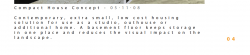
Similar thing on pages 4 & 5, you mention "basement storage" but don't actually show it; on page 4, you talk about being able to drive directly into the basement, but the render clearly shows a car aboveground. Seems to be just sitting in the living room.
None of this is meant to sound unduly harsh, and I apologize if it does. But this portfolio seems to be important (you mentioned scholarships), so you definitely want to present yourself in the best way possible. IMO, the portfolio would be much stronger if you decreased the amount of work and increased the amount of information on each piece. SHOW the reader through the process for the desk. SHOW the reader something more in depth on ONE of your architecture pieces. SHOW the process of developing the Lamborghini render (and give credit for the cheetah, if you didn't model it...). And then maybe pick another 2-3 pieces, to include with less showing. And be prepared to talk about those.