Become a MacRumors Supporter for $50/year with no ads, ability to filter front page stories, and private forums.
That isn't quite true. Currently, H264 provides better quality. You can throw as much bitrate at an H265 encode but the end result will still not look as good as a similarly high bitrate H264 encode. It's certainly more efficient, which is why content providers who rely on streaming are excited about it, but the quality isn't up to H264 standards...at least not yet. Worryingly, they haven't improved much on this aspect of it since it was introduced years back.


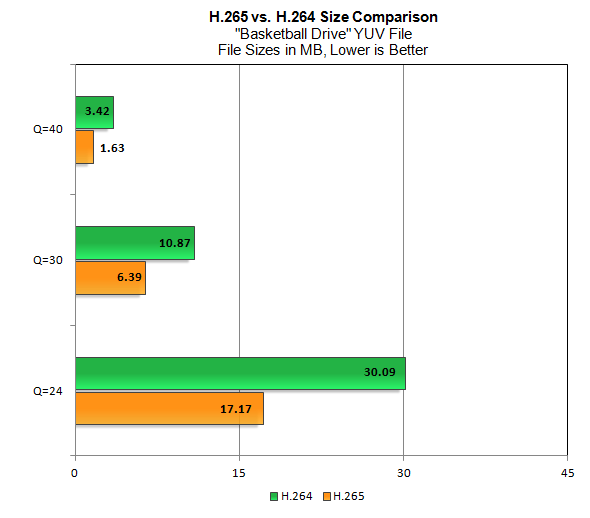
H265-264FileSize.png

"This gives a good basic idea of what sorts of benefits H.265 can offer compared to H.264. While it’s not hitting 50% bandwidth savings in most cases, it’s close — quantizer 24 is 57% the size, q=30 is 59%, and q=40 is just 47%. Granted, at a quantizer of 40, the final output is wretched — but it’s wretched at less than half the bandwidth."​
Source: http://www.extremetech.com/computin...eneration-video-codec-live-up-to-expectations

So, even rounding up to saying that an H.265 file is 60% the size of an equivalent H.264 file, that's still a pretty good reduction in file size. Others have shown that with some tweaking it can be dialed into the 50%, or half, range.

That article also compares picture quality as well, and I think shows that H.265 is the same if not a tad bit better quality than H.264.

I agree with the above sentiments though, that as a format is seems like a non-starter unless it is open to use. It might not be fair, but that's just the way it is with internet formats. The money should be made similar to how money is made with Linux development - consulting, customizing, support, and implementation.

 
H265-264FileSize.png

"This gives a good basic idea of what sorts of benefits H.265 can offer compared to H.264. While it’s not hitting 50% bandwidth savings in most cases, it’s close — quantizer 24 is 57% the size, q=30 is 59%, and q=40 is just 47%. Granted, at a quantizer of 40, the final output is wretched — but it’s wretched at less than half the bandwidth."​
Source: http://www.extremetech.com/computin...eneration-video-codec-live-up-to-expectations

So, even rounding up to saying that an H.265 file is 60% the size of an equivalent H.264 file, that's still a pretty good reduction in file size. Others have shown that with some tweaking it can be dialed into the 50%, or half, range.

That article also compares picture quality as well, and I think shows that H.265 is the same if not a tad bit better quality than H.264.

I agree with the above sentiments though, that as a format is seems like a non-starter unless it is open to use. It might not be fair, but that's just the way it is with internet formats. The money should be made similar to how money is made with Linux development - consulting, customizing, support, and implementation.

I wasn't questioning the efficiency, more the quality. My own experiments, and those of other far more technically proficient encoders, show that grain reduction and blurring are impossible to correct, to the same degree, as you can with x264. This is using x265, by all accounts HEVC is similar, at least on a consumer level - as mentioned by Rigby, professional codecs he has seen, are proving more successful, but until I can encode at home, to the quality I expect of x264 i.e. indistinguishable from Blu-ray source, then it won't be for me, as space is not an issue.

I can see why Netflix et al are keen to embrace it, as, as your graphs show, the file size reductions are majestic, but streaming services have never been about optimal quality, rather a compromise, which, at the moment h265 is. It's only a few years old though, so I'm sure advances will be made.

Here is a brief thread discussing it, which echoes my own experiences

http://forum.doom9.org/showthread.php?s=1f1f372cebe347538f0ee49a71683531&p=1732572#post1732572

And here:

http://forum.doom9.org/showthread.php?t=170986
 
Last edited:
This is using x265, by all accounts HEVC is similar, at least on a consumer level
I think there may still be a misunderstanding between codecs and encoding standards. The HEVC/H.265 standard basically just describes the format of the video stream and the encoding "tools" that are available. It does not describe a specific encoding algorithm. That's completely up to the programmer of the codec. That's why two different codecs using the same standard can and usually will produce different results, depending on the quality and maturity of the implementation and the tradeoffs chosen by the programmer. x265 is just one of several existing implementations of HEVC.
 
Isn't the other new video codec VP9 supposed to be somewhat more efficient than h.265, and already much more widely adopted? YouTube already supports VP9, but has never supported h.265/HEVC uploads.
 
Isn't the other new video codec VP9 supposed to be somewhat more efficient than h.265, and already much more widely adopted? YouTube already supports VP9, but has never supported h.265/HEVC uploads.
Well, this is not surprising given that Google developed VP9 and Youtube is owned by Google. 😉 But apart from Youtube and Android TV, VP9 isn't really used anywhere else, while H.265 is supported by all major VoD providers like Netflix and Amazon, smart TVs, UHD Blu-ray etc. VP9 will probably play its role in web video (which will also ensure a certain level of hardware support), but H.265 will likely dominate.
 
Register on MacRumors! This sidebar will go away, and you'll see fewer ads.