Become a MacRumors Supporter for $50/year with no ads, ability to filter front page stories, and private forums.
Quad Core Mobile By Summer 2007

DavidCar said:
Hannibal on ArsTechnica just posted his comments on the early introduction of Woodcrest, along with a link to some great slides on the next two generations of architecture over the next four years.

http://arstechnica.com/news.ars/post/20060502-6729.html

http://www.xbitlabs.com/news/cpu/display/20060428162855.html
Thanks David. Great find. Very helpful.

Hannibal at Ars Technica said:
I hesitate a bit to speculate on exactly what will happen here, because things are already such a mess. As you may recall, WWDC was pushed back to August from its normal June date, presumably to coincide with Intel's Q3 rollout of Woodcrest, Conroe, and Merom. But Intel just keeps bumping up the intro dates for these parts in response to a number of factors (competitive pressure from AMD, profit shortfalls, internal restructuring), a fact that probably drives Apple nuts. Imagine the wrath of Steve if he really did delay WWDC from June to August in order to make it coincide with what was at the time an already accelerated Woodcrest rollout, only to have Intel move the Woodcrest launch date even further ahead into June! Such are the woes of being a relatively small fish in the very large pond of the x86-based PC market.
Looks like Steve's postponement of the WWDC may have been a mistake in terms of jiving with Intel's aggressively unpredictable release "pattern". But I think the Leopard news will still be the star of that SteveNote and he'll be able to brag about how quickly the transition went by then - which may in fact be complete in way amazing record six month's time. March to September. Worst case he can announce the Mac Pros at WWDC. Likely sooner. NOTE - although announced in early January, 15" MBP didn't really arrive in quantity until early March.

I found this X-bit labs mid-April piece on a Quad Core Mobile Processor shipping by Summer 2007 equally interesting.
 
Multimedia said:
...how quickly the transition went by then - which may in fact be complete in way amazing record six month's time. March to September. Worst case he can announce the Mac Pros at WWDC. Likely sooner. NOTE - although announced in early January, 15" MBP didn't really arrive in quantity until early March.
The transition officially started 6 June 2005. That's when the first Intel-based Apples were shown and announced, with delivery shortly after.

LOL that you can claim that delivering a system two months late can be called "speeding up" the transition. :eek:
 
devman said:
Um, so the current quad G5 is not a pro machine according to you. And only because an app that needs the address space or numerics from 64bit and that must also be a GUI app, needs to be two communicating processes.

*sigh* No. If the chip is already pretty well architected so that the jump from 32 to 64 bit only provides address space and numerics, then all the processes that don't need the address space or numerics will take a hit if all of OS X is made 64bit. (note: this is solely in relation to the G5).

Geez. Do all the pointers in Cocoa need to be 64bit for example. Do you need a 64 bit pointer to a button, to a text field, to a radio button, to everything...

To be honest, although the G5 is the best that apple can do right now, it's not a completely pro machine if apps running on it are limited to 4 gigs of ram. A true "pro" solution wouldn't have that limit. And I realize that in theory, GUI apps can use a hack to get around memory limits. I just think it's pretty obvious from the lack of apps that actually do that, it's not

Note that I haven't insisted that Apple make all of OSX 64 bit. I'll be happy if they just make it possible for some apps to take advantage of 64 bits (mainly for RAM usage). If the rest of the OS stays 32 bits along with apps that don't need more, I'm fine with that. You think I don't understand the topic, but from what you've written it sounds like you just aren't understanding my posts.

Sighing and other drama queenery aside, if going 64 bit takes a performance hit on apps that don't need it, it sounds like the G5 isn't "pretty well architected". Sounds like their 64 bit implementation wasn't really thought out and they shouldn't have bothered with it until they figured out a solution without such a big down side.

I would hope you wouldn't need a 64 bit pointer to every little trivial thing. If there's no way to take the OS to a point where apps can run 64 bit without requiring that, it looks like somebody dropped the ball, either on the chip side or the OS side.

So I guess you agree that the current 64 bit situation for OSX is pretty lame, you just blame the chip and not the OS?
 
janstett said:
In summary, Microsoft is already doing the 64-bit thing and it isn't quite the panacea people would think it is. It actually has a number of drawbacks and many people just run the mainstream 32-bit OS on the 64-bit hardware. I don't think it would be any better for OSX.

But some of us need apps to access more than four gigs of ram. I don't really care if the whole OS goes 64 bit (maybe there are advantages to not doing it). But I need the increased ram support, Apple needs to do something to make that possible. The lame hack they propose now obviously isn't cutting it. How many apps can currently access more than 4 gigs of ram on a G5?

AidenShaw said:
The transition officially started 6 June 2005. That's when the first Intel-based Apples were shown and announced, with delivery shortly after.

LOL that you can claim that delivering a system two months late can be called "speeding up" the transition. :eek:

The first macs were shipped in January. Only dev kits were released before that, and you can't really call those a released mac.

What was two months late? Wit the exception of the MPB running about a week late, the rest of the transition has been WAY ahead of the announced schedule. They're going to be close to finishing the hardware transition around the time they originally announced they'd be starting.
 
milo said:
But some of us need apps to access more than four gigs of ram. I don't really care if the whole OS goes 64 bit (maybe there are advantages to not doing it).
Agree that the "whole OS" question is not important.

Someone might say, sake of example "Windows x64 isn't true 64-bit because Notepad is still a 32-bit app". I find that to be unimportant - I don't care if every single executable on the kit is 64-bit.

What I care is that I can build a 64-bit app (either because I want the extra speed, or because I need more than 4 GiB of RAM in my single app) and not be forced into using a small subset of the capabilities of the system.

Mac OSX fails that test on 10.4, but Windows/Linux/Solaris/... pass.


milo said:
What was two months late? Wit the exception of the MPB running about a week late, the rest of the transition has been WAY ahead of the announced schedule.
Actually, if you check the threads here, you'll see that shipping didn't really start until the last half of Feb, and it was spotty into March.

The rest of my post makes more sense in the context of MultiMedia's post that it is a reply to.

milo said:
The first macs were shipped in January. Only dev kits were released before that, and you can't really call those a released mac.
I can claim that it's the *start* of the transition, though. MultiMedia's post implies that volume shipment (not "first", but "volume") of MBPs marked the start.

milo said:
They're going to be close to finishing the hardware transition around the time they originally announced they'd be starting.
Please, The Steve said that systems would be shipping *by* June (or August) - not *starting in* June.

Yes, it's going well. Apple is right there with every other vendor who is taking Intel's Yonah CPU and chipsets and shipping products. (In other words, give Apple credit where it's due - but don't give Apple credit for Intel's good execution on the NGMA transition!)

Apple will have Conroe (new mini-tower form factor) and Merom (laptop/mini/iMac) systems at the same time as everyone else - that's pretty much a given.

Woodcrest - not so sure. Quad towers and XServes are clearly "pro" machines, but one could argue that it's premature to shift these to Intel until the pro software situation improves. What good is new hardware if the software that the high end customers needs doesn't run well on the new kit?

Of course, Apple could build and ship both PPC and Woodcrest machines for a while - but so far they've been killing PPC systems as soon as the Intel arrives. (with some "while supplies last" overlap)
 
AidenShaw said:
Actually, if you check the threads here, you'll see that shipping didn't really start until the last half of Feb, and it was spotty into March.

I can claim that it's the *start* of the transition, though. MultiMedia's post implies that volume shipment (not "first", but "volume") of MBPs marked the start.

Please, The Steve said that systems would be shipping *by* June (or August) - not *starting in* June.

Yes, it's going well. Apple is right there with every other vendor who is taking Intel's Yonah CPU and chipsets and shipping products. (In other words, give Apple credit where it's due - but don't give Apple credit for Intel's good execution on the NGMA transition!)

Woodcrest - not so sure. Quad towers and XServes are clearly "pro" machines, but one could argue that it's premature to shift these to Intel until the pro software situation improves. What good is new hardware if the software that the high end customers needs doesn't run well on the new kit?

Apple's first announcement of the MBP said that it would ship in February, and it did, didn't it? That would make it on time, not two months late. Apple never announced that MPB would ship in the beginning of January, did they?

You can define "the start of the intel transition" however you want, it sounds like this has just turned into a semantics game. Apple started the transition internally years ago, what matters to the consumer is when WE get to participate in the transition. The important part is the public portion of the intel transition, and that has been generally ahead of the deadlines Apple initially announced.

In any event, it makes no sense to call the shipment of MPB's the start of the transition since intel iMacs started shipping weeks earlier in January. Those were some of the first core duo machines shipped, weren't they?

Of course I'm aware that he said starting BY June. I don't think that makes it any less impressive that they shipped machines six months earlier than that date. And I think apple does deserve credit for getting these machines out when they have, there's definitely more involved for Apple to ship these than just swapping in a new CPU (both on the hardware and software side).

I'd love to see apple ship intel towers as soon as they can. Yes, there are people using third party apps that haven't been ported yet. But there are plenty of us using apple pro apps and other apps that are already universal, it would be silly to artificially delay the machines because photoshop isn't ready. At my job, we're looking to get at least two new tower machines in the next few months, I'd much rather get intels than get G5's this late in the game.
 
How 'Bout 17" MBP As Short Term G5 Tower Substitutes?

milo said:
Apple's first announcement of the MBP said that it would ship in February, and it did, didn't it? That would make it on time, not two months late. Apple never announced that MPB would ship in the beginning of January, did they?
No. I meant that they only arrived in quantity and on display at the Apple Stores in early March. I never said they were two months late. In fact I don't think they were late at all. You must have me confused with someone else. It took 'til then to eleminate the queue for them just like it's probably going to take until June to eleminate the 17" MPB queue. I don't think they are late either.
milo said:
At my job, we're looking to get at least two new tower machines in the next few months, I'd much rather get intels than get G5's this late in the game.
Buy a pair of 17" MBPs instead. According to tests I've seen, they perform similarly to or better than Dual 2 GHz G5 towers and support 30" external screens. Depends on what apps you mainly use. If it's all about Adobe CS2, then a pair of G5 Quads would have to tide you over. But if the fact is you can wait into Summer, then you should do that. :)
 
Multimedia said:
No. I meant that they only arrived in quantity and on display at the Apple Stores in early March. It took 'til then to eleminate the queue for them.

Buy a pair of 17" MBPs instead. According to tests I've seen, they perform similarly to or better than Dual 2 GHz G5 towers and support 30" external screens. Depends on what apps you mainly use. If it's all about Adobe CS2, then a pair of G5 Quads would have to tide you over. But if the fact is you can wait into Summer, then you should do that. :)

Even if you count shipping in quantity as "really shipping", early march is only a week or two later than the announced February ship date. That's a couple weeks late, not two months late.

A laptop isn't really an option. We need at least 4 gigs of ram, dual big monitors, internal hard drives would be nice, and a laptop doesn't fit the form factor of our offices. Not to mention that we'll want power comparable to the Quad, not the duals. If the first batch of towers only replaces the dual G5's, (and who knows, based on these announcements?), we'll be waiting for the next gen. The machines we're looking at replacing are dual G5's.

As I said, we're using mainly apple pro apps, so the software we need is mostly good to go.
 
Merom's pin-compatible with Yonah - what about Conroe?

The past few days I've been reading stuff on the net which suggests that if ("if") Apple decided to go with Woodcrest in some or all of the Intel replacements for the current PowerMac PPC, that Apple might/could slip Conroe into the iMac instead of Merom...

My question is this: If Merom was pin-compatible with Yonah, so that people like me, who bought the iMac Core Duo, could replace the Yonah cpu with a Merom chip;... does the same apply to Conroe? I know that Woodcrest, Conroe and Merom are all based on the same Core Microarchitecture, but I haven't come across any info on whether the Conroe and Merom share the same pin-structure (if that's the correct non-geek term for it).

I'd probably hold off 'til 2007 anyway - fear of doing something to void my AppleCare warranty - but it would be interesting to see what kind of performance gains I'd acquire off replacing the 2GHz Yonah with either of the new chips.
 
Norse Son said:
The past few days I've been reading stuff on the net which suggests that if ("if") Apple decided to go with Woodcrest in some or all of the Intel replacements for the current PowerMac PPC, that Apple might/could slip Conroe into the iMac instead of Merom...

My question is this: If Merom was pin-compatible with Yonah, so that people like me, who bought the iMac Core Duo, could replace the Yonah cpu with a Merom chip;... does the same apply to Conroe? I know that Woodcrest, Conroe and Merom are all based on the same Core Microarchitecture, but I haven't come across any info on whether the Conroe and Merom share the same pin-structure (if that's the correct non-geek term for it).

I'd probably hold off 'til 2007 anyway - fear of doing something to void my AppleCare warranty - but it would be interesting to see what kind of performance gains I'd acquire off replacing the 2GHz Yonah with either of the new chips.
I doubt it. But even if it is, it will run too hot for your iMac's cooling system. Merom is the one you want in there. Cooler and faster.
 
sshhhhh!!!!

Multimedia said:
I doubt it. But even if it is, it will run too hot for your iMac's cooling system. Merom is the one you want in there. Cooler and faster.
...and quieter.

Merom (and Yonah) are designed for the power and cooling requirements of a laptop - which makes them ideal for the iMac where the CPU is (literally) in your face.

Conroe probably would work without a lot of effort - but its design goal is to use more power to deliver more performance. It would probably need bigger fans (or at least would run the current fans faster and more often).

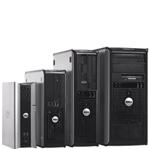
That's not really a good fit for an all-in-one, but it will be great for the new form factor mini-tower that Apple will introduce with Conroe in July. (Single socket, dual-core, 8 GiB RAM, PCIe x16 graphics, dual optical....)
 
AidenShaw said:
That's not really a good fit for an all-in-one, but it will be great for the new form factor mini-tower that Apple will introduce with Conroe in July. (Single socket, dual-core, 8 GiB RAM, PCIe x16 graphics, dual optical....)
And where does this assertion come from, might I ask? Apple is obviously consolidating its laptop line from 2xiBook + 3xPowerBook to 1 MacBook + 2xMacBook Pro. I don't see any room between the iMac and "Mac Pro" line, if that's what you are thinking. Maybe a low end Mac Pro with Conroe, but the same enclosure as the high end model. Who knows?
 
daveL said:
And where does this assertion come from, might I ask? Maybe a low end Mac Pro with Conroe, but the same enclosure as the high end model. Who knows?
  • Intel charges much more for dual-socket and multi-socket capable CPUs/chipsets
  • This would make a Woodcrest system much more expensive than a Conroe system
  • Apple would need to increase the price of the maxi-tower by probably $500 to $800 to maintain their high margins
  • This widens the gap between the mini and the maxi - the only two systems without monitors
  • This puts the price of the only expandable Mac much higher (separate PCIe graphics, disks, PCIe slots)
  • Many people do not want an all-in-one, and others don't like the huge case of the maxi-tower

Finally, HP/Lenovo/Dell/... will all have dual-core Conroe mini-towers in that gap. A potential switcher might be faced with choosing between 3 Apples that he doesn't really want (mini too restricted, iMac is an all-in-one, maxi too big and expensive), or a Windows system that fits his price range and needs.

Apple can no longer operate like they're in a vacuum - the other companies understand that customers want choice, including a choice of form factor.

optix_149x149.jpg
 
If Apple doesn't come up early on with a dual Woodcrest machine, it will give up it's claim to having cutting edge destop computers. I don't think there are any acceptable excuses for not doing this.

It would be interesting to estimate the relative performance of a PPC application on a PPC Quad versus the performance on Rosetta on a Woodcrest Quad, using a Woodcrest chip at a speed which sells at a price comparable to the 970MP chip. I would think there was a chance that the performance of the PPC application on Rosetta would be better, and a chance that such a Woodcrest machine would sell at a similar price to the PPC Quad. I posted a list earlier of estimated Woodcrest chip prices. I don't know what the 970MP sells for. I don't know how well speed comparisions between the current Core Duo and an 970MP could be extended to make predictions for Woodcrest.

(Also, I've noted the MacRumors chatter about a possible Woodcrest Quad is a lot different from last year's chatter about a then possible 970MP Quad. )

Also, wouldn't it be possible, in theory, for Apple to sell a chipless MacPro Tower, with sockets for two Woodcrests/Clovertowns, and have that be the top of the line for the next year? As long as the chipset FSB was 10333 Mhz, the buyer could install whatever the best chip was at that moment, maybe even just one chip, from a 1.8 Ghz Woodcrest to a 3.0 Ghz four core Clovertown due in January?
 
Apple is never going to sell a do-it-yourself Mac...

DavidCar said:
Also, wouldn't it be possible, in theory, for Apple to sell a chipless MacPro Tower, with sockets for two Woodcrests/Clovertowns, and have that be the top of the line for the next year? As long as the chipset FSB was 10333 Mhz, the buyer could install whatever the best chip was at that moment, maybe even just one chip, from a 1.8 Ghz Woodcrest to a 3.0 Ghz four core Clovertown due in January?
Get Real David. Apple is never going to sell a do-it-yourself Mac without processors installed and tested before shipping. You realize how easy it is to blow a processor installation?

What have you been smoking David? :eek: :confused: :rolleyes:
 
Multimedia said:
Get Real David. Apple is never going to sell a do-it-yourself Mac without processors installed and tested before shipping. You realize how easy it is to blow a processor installation?

What have you been smoking David? :eek: :confused: :rolleyes:

That's why I said "in theory". I'm not interested in whether users should install processors, only about how easy it would be for Apple to create one motherboard to be used in all versions for the next year. The underlying question I don't understand is how the clock frequency of the chip relates to the design of the motherboard.

And there is a lot of talk lately about end users upgrading chips, even if Apple never sold a chipless MacPro. So could the slowest possible Woodcrest Mac Pro be in theory upgradable to the fastest new chips, or is there a limit in the motherboard somewhere.
 
AidenShaw said:
Apple can no longer operate like they're in a vacuum - the other companies understand that customers want choice, including a choice of form factor.
So how does that explain the consolidation of the laptop lines? Maybe a UMPC-type Mac is coming to fill the low end spot?

In any case (no pun intended :), Apple has made a point of limiting the number of models and configurations they offer, and I would be surprised to see that change. We'll find out by WWDC, I expect.
 
DavidCar said:
That's why I said "in theory". I'm not interested in whether users should install processors, only about how easy it would be for Apple to create one motherboard to be used in all versions for the next year. The underlying question I don't understand is how the clock frequency of the chip relates to the design of the motherboard.

And there is a lot of talk lately about end users upgrading chips, even if Apple never sold a chipless MacPro. So could the slowest possible Woodcrest Mac Pro be in theory upgradable to the fastest new chips, or is there a limit in the motherboard somewhere.
The MB and chipset should work within a range of CPU clock speeds. I have a Tyan server that will accept 2 Opteron CPUs from 1.8 GHz and up, including dropping in dual core CPUs.

The biggest problem is that the user has to get the heat sink installed correctly. If you f*ck it up, you can smoke your several hundred dollar CPU. Apple has had some problems with incorrectly applied thermal paste on early MBPs. In short, you have to know what you're doing.
 
Multimedia said:
Get Real David. Apple is never going to sell a do-it-yourself Mac without processors installed and tested before shipping. You realize how easy it is to blow a processor installation?

What have you been smoking David? :eek: :confused: :rolleyes:
While Apple will probably not sell a processor-less system, I don't see any major technical or logistical problem with selling a partially-filled motherboard. Provide 2 sockets and leave one empty. Let the user plug in a compatible processor later.

End-users add memory onto their motherboard by slipping in a DIMM module, so what's the problem with slipping in a new processor? Customers who are reluctant to do this by themselves could take their box to an Apple Store.
 
daveL said:
And where does this assertion come from, might I ask? Apple is obviously consolidating its laptop line from 2xiBook + 3xPowerBook to 1 MacBook + 2xMacBook Pro. I don't see any room between the iMac and "Mac Pro" line, if that's what you are thinking. Maybe a low end Mac Pro with Conroe, but the same enclosure as the high end model. Who knows?

Why not? There's not much difference between a pro and consumer laptop at the same screen size. But there's definitely room for a small tower with a slot or two, and more modest expandability than a full blown tower. Especially since they're getting most of their technology from intel, they could easily do a basic, budget, small tower that's *cheaper* than the mini.

People have long complained that the 12" powerbook and ibook weren't really that different. I suspect one far outsold the other. People have the opposite complaint on the desktop side.

Mainly for people doing gaming and graphics. Power tower is overkill, but you can't swap the graphics card in a mini or iMac.

I doubt apple would release a machine with an empty processor slot, but I'd love to see them offer configs with no ram or hard drive. I'm getting tired of taking out Apple ram and throwing it in a drawer.
 
daveL said:
So how does that explain the consolidation of the laptop lines?
That's easy - the 12" PB has always been an odd duck. Popular, but an odd duck.

I've always assumed that the 12" PB was a prototype for a G4 iBook that got Steve'd as an iBook replacement - but instead was brought in as a more portable model of PB.


daveL said:
Maybe a UMPC-type Mac is coming to fill the low end spot?
I'd expect that a 10" subnotebook is more likely.
 
Lets wait for 2008. More on the next generation of processors. While this is not in the Xeon line, it is said to be socket compatible, I assume with the 2008 version of the Xeon line, so I expect similar features. On die memory controller. Inter processor interconnect, torus topology.

http://arstechnica.com/news.ars/post/20060506-6766.html

http://www.realworldtech.com/page.cfm?NewsID=361&date=05-05-2006#361

As for a Mac Pro with one empty socket, wouldn't there be an economic advantage over such a machine vs a Conroe flavored low end Mac Pro, as no additional motherboard version required? I think processor expandability would be a selling point.

As for a mini tower, I wouldn't expect such a machine to have the same form factor as everyone else's mini tower. I would think it would be as small as possible while still having a few features of the PowerMac size version.
 
DavidCar said:
Lets wait for 2008.
2008 will be fun - but I'll have a couple of years of enjoying my Conroes and Woodcrests by then (and the big systems at work).


DavidCar said:
As for a Mac Pro with one empty socket, wouldn't there be an economic advantage over such a machine vs a Conroe flavored low end Mac Pro, as no additional motherboard version required? I think processor expandability would be a selling point.
When has Apple supported adding a CPU in a recent machine? The single socket PMG5 systems are not expandable in the CPU department (and some have been crippled in other dimensions).

Note that Apple no longer has to design custom chips for a new mobo - they buy off-the-shelf stuff from Intel/TI/Philips/Siemens and stick it on a mobo. This is very different from the G4/G5 era, when Apple had to design its own northbridge and southbridge chips.

This makes it much cheaper to add a different motherboard. Couple that with the higher price of Woodcrest CPUs and chipsets, and it should be cheaper to use Conroe in the mid-range than to use a single chip Woodcrest.

HP/Lenovo/IBM/Dell have always had Pentium 4 towers for the mid-range. The Xeon workstations might be available with only one chip, but a single Xeon would never have been cheap enough for the mid-range. So they've always had "Conroe-class" single socket systems in addition to the Xeon workstations.

"Processor expandability" is not important to the market. By the time you need a second processor, there's probably a new model that's more interesting - and you replace rather than put more money into the now outdated model. It's pure opinion, but I would expect that the number of "add-on" CPUs sold is a tiny fraction of the number of 2nd CPUs included in the original purchase. I buy way over a million dollars worth of systems a year, and the only time I've "added" a CPU was when I needed to play a budget game (buy a couple of dozen single CPU systems in March, and buy the add-on CPUs in April on the new quarter's budget).


DavidCar said:
As for a mini tower, I wouldn't expect such a machine to have the same form factor as everyone else's mini tower. I would think it would be as small as possible while still having a few features of the PowerMac size version.
After my previous post, I've become more convinced that a pizza-box that matches the form factor of home audio/video components is a more likely configuration. This will be the Media Centre Edition for Apple.

It might be convertible so that it can be placed on edge - but Apple must have an MCE.
 
AidenShaw said:
Woodcrest - not so sure. Quad towers and XServes are clearly "pro" machines, but one could argue that it's premature to shift these to Intel until the pro software situation improves. What good is new hardware if the software that the high end customers needs doesn't run well on the new kit?

Well, since Final Cut Studio and Shake are ready, that's two very good reasons to ship Quad towers. Not sure if that's enough to support the market, but it's enough for me to buy! There is no way that Apple is going to hold up the Intel systems (woodcrest) to wait for Adobe! But of course, that's probably not what you are implying...:D
 
THX1139 said:
Well, since Final Cut Studio and Shake are ready, that's two very good reasons to ship Quad towers. Not sure if that's enough to support the market, but it's enough for me to buy! There is no way that Apple is going to hold up the Intel systems (woodcrest) to wait for Adobe! But of course, that's probably not what you are implying...:D
If Apple brings out Woodcrest, but keeps the Quad G5 in the lineup until next summer, that would probably satisfy most people.
 
Register on MacRumors! This sidebar will go away, and you'll see fewer ads.