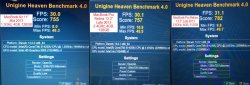
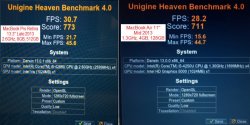
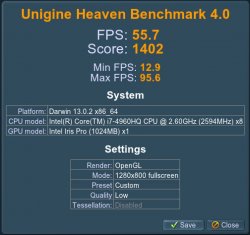
Two issues:
-A chip will exceed TDP if its thermal conditions allow it. So unless the system heats up into the 90's and is unable to bring the temperature down with its fans, the chip will continue to draw more than 15W as long as the software asks for that much power (which games and benchmarks basically always do unless they're frame capped).
What we may actually be seeing is that the cooling on the Air and rMBP 13" isn't as different as the designs would suggest. Personally I wasn't aware until recently that older MBPs (pre-underside vents) actually already drew air through the ports instead of just exchanging at the hinge only, which should also be what the Air does.
-Benchmarks like this basically only tax the GPU, unlike real games where the CPU may also have lots of work to do (handling networking and interpolation/predicton, running AI routines, physics, etc.).
There are some interesting benchmarks out there which show the i7 Air as being in between the 2.6 and 2.8 options on the rMBP, but this only applies to single core performance. When the system tries to load both cores the rMBP CPUs pull ahead, though even the 2.8 only has like 10% on the Air's i7. In full dual core load it basically matches the 13" rMBP's 2.4.
In general it seems like the ULV chips are really impressively efficient. I think Intel's entire CPU lineup this year is being marketed a little deceptively; The Air's i7 "1.7" chip is really very close to the rMBP's i7 "2.8" chip in reality. Of course if we want to talk reality they are physically the same chip with different binning and TDP regulation. We might discover that the ULVs are actually better chips with a major under clock and more aggressive power limits, which is how they produce such amazing battery life (higher binned chips hit the same clocks at lower voltages).