Amiga was a spectacular computer in it's day.
It crushed monochrome DOS-based PCs and was priced well below the "expensive" Macintosh that were still mostly viewed as monochrome (and tiny screens) too. The local computer store carried all 3 platforms and it appeared to be so far ahead with color graphics, sound and animation.
With both PCs and Macs monochrome, Amiga was like color TV
for lower cost rolling out to compete with Black & White TVs. Just the variable of "color" was enough to be the "killer app" when comparing it to the more established players at the time... but the Amiga was so much more than PC-DOS (no Windows yet) or the Mac OS in color.
The "bouncing ball" demo amazed...
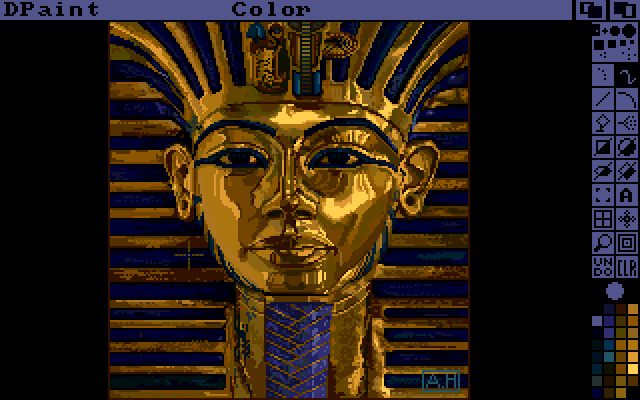
The (32-color) King Tut image from Deluxe Paint was a mesmorizing, digital Mona Lisa at that time. Not only could one create such graphics IN COLOR, but the palette was big enough to offer this crazy thing called painting in color
GRADIENTS...
At the time, one might see spot color in print, such as adding one shade of red to a B&W print ad. On Amiga, you could make that same ad and if red was all you needed, you could use 30 (THIRTY!) variants of red. Crrrrrrrazy.
Then, this thing called "halfbrite" mode (I think) upped that to 64 colors, and then "hold & modify" mode opened up 4096 colors. At school, PC screens were still generally green or amber (insert Ford paraphrase: "
you can have any color on a PC as long as it is green or amber"). The Mac labs had tiny-screened Macs with only shades of gray... superior to PCs for at least having a range of colors... but they were color
less.
I remember the same King Tut image being recreated on a Mac... in grayscale... and while it looked great on a Mac too, grayscale vs. color was a "what's the point?" moment for anyone looking to buy a computer at that time.
Amiga's "hold & modify" mode could be used for animations too. When exploited, it whammed anyone interested in color graphic animation from a computer with the ray-traced "Juggler" demo in 4096 colors (a mind-blower at the time). Looking back at it now...
...it doesn't look so special but back then it was basically showing a computer could create a new world, what appeared to be 3D characters in that world (that even cast shadows) and have them moving around with
sampled sound
choreographed with on-screen actions. Juggler begged for concepts like Ray tracing and similar to come to the masses in apps and several good ones quickly followed. Could the inspiration and then implementation of a Pixar be very far behind?
It had a voice long before the others had much of anything that way. It could speak and with a voice one could understand. Every time I hear the Steven Hawking "voice" (even today) I recognize that as one of the voices of Amiga. I suspect that's where HE got it (but don't know that for sure).
It had standardized file formats so that one could share files between apps made by many different companies. The explosion of creative arts software to take advantage of Amiga was really helped along by being able to do some stuff in one app and then move the project into any number of other apps. It all "just worked."
Deluxe Paint and Deluxe Music Construction Set were very early killer apps. I remember taking an elective "arts" course in college and bringing in some original music I had created on an Amiga. DMCS let you compose in music notation and then print the music. I remember the music teacher being shocked when he found out I couldn't play a musical instrument but had written some original music anyway. "You wrote this on a computer?" By the end of that semester, I still couldn't play any instrument but got an "A" anyway on the strength of that (and probably lingering shock).
Games rivaled arcade machines at the time. I think some Amiga games made it into Arcade machines. And game developers really pushed that hardware to stand out from rivals. Arcade translations tended to look & sound just like the arcade games
without compromises (except the insatiable hunger for quarters). Those games typically (& entirely) fit into 880K (yes "K") or less. They were tiny files but funnnnnnnnnnn games that looked & sounded great. One didn't have to spend hours or days (or dollars) building a character/car/plane/etc- we just ran the game and played it. Fun. Uncomplicated. Classic arcade without quarters.
If one wanted to learn to code, the native language with Amiga was C (I think well before the other platforms got there). The OS was loaded with callable routines to do relatively complex stuff in graphics, sound, animation, etc without having to know physics or calculus. Stock code libraries were a treasure trove for anyone wanting to code something interesting themselves.
Hardware offloaded complex tasks in graphics, sound & animation to coprocessors well before the others were doing that.
It had a terrific, real multitasking, icon/windows/mouse-based OS that entirely fit in 256K (later 512K) Yes that's "K." The whole OS was so compact that it was built into ROM and thus offered "instant on."
Early computer animators, graphic designers, etc could simply do much more with an Amiga than the other platforms at the time. For gamers, there was pretty much nothing better. Atari ST tried to be a poor man's Amiga and they all competed for gamers against platforms like Atari 5200 and Colecovision. Friends were always impressed with Amiga games and then soon owned an Amiga themselves.
Personally, I wish it could have made it. I'd love to see what a 2017 Amiga would be like.