
Become a MacRumors Supporter for $50/year with no ads, ability to filter front page stories, and private forums.

mbosse

macrumors 6502a
Original poster
Hi,

I have the following issue with a Synology DS216j running on the latest DSM 7.3.2-86009 Update 3: I can use it as a Time Machine backup destination on a Macbook with macOS Monterrey 12.7.6, but using the same credentials on an iMac running on macOS Sequioa (macOS 15.7.7) does not work no matter how often I try.

The error I am getting is:
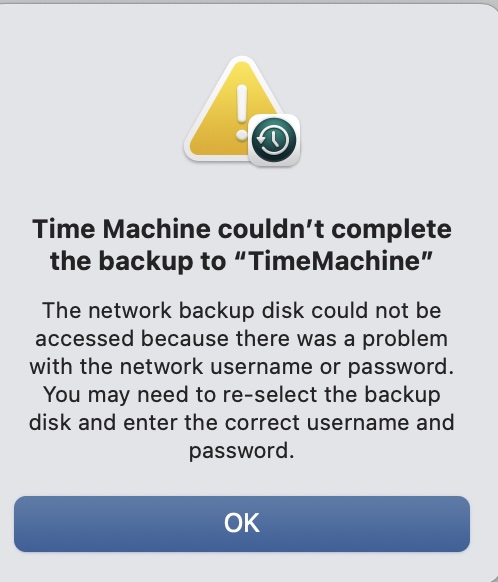
Synology Time Machine issue.jpg


"Time Machine couldn't complete the backup to "TimeMachine". The network backup disk could not be accessed because there was a problem with the network username or password. You may need to re-select the backup disk and enter the correct username and passwort."

However, as I said I am using the very same credentials for a non-admin user which only has read/write access to the backup folder. Are there any characters I should not use with newer macOS versions? I faintly remember there was a thing...

Thanks,

Magnus
 
Last edited:
  • Like
Reactions: BradleyinDC
Now one of the two drive slots tends to loose its drive after some time, regardless of what drive is in there, so I guess the DS is past its best days...
 
Last edited:
Maybe it's the SATA cable or its connection. Maybe you or someone could open up the Synology and replace it pretty easily.
 
So, back to square one: I now set up a Synology DS116 from new and still cannot create TM backups on the iMac. Same error message! as if the iMac is cursed...
 
I had this issue a while ago - don't remember which version.

There were bugs in some of the betas, and maybe even a final version, where TM simply failed with that error.

There were also others with that issue, not related to this particular bug, where the fix was to rename their server to something without special characters in it.

You can delve into forums for help, for example:
Thanks, but I have no betas installed anywhere, and there are also no special character whatsoever in either Synology server, user or TM backup folder name...
 
  • Like
Reactions: adrianlondon
Hi,

I have the following issue with a Synology DS216j running on the latest DSM 7.3.2-86009 Update 3: I can use it as a Time Machine backup destination on a Macbook with macOS Monterrey 12.7.6, but using the same credentials on an iMac running on macOS Sequioa (macOS 15.7.7) does not work no matter how often I try.

The error I am getting is:

View attachment 2637675

"Time Machine couldn't complete the backup to "TimeMachine". The network backup disk could not be accessed because there was a problem with the network username or password. You may need to re-select the backup disk and enter the correct username and passwort."

However, as I said I am using the very same credentials for a non-admin user which only has read/write access to the backup folder. Are there any characters I should not use with newer macOS versions? I faintly remember there was a thing...

Thanks,

Magnus
I fought with this for a while with my (then) new Mac Mini vs a MBP I've had for years, both running Sequoia. Time machine on my Synology worked on the MBP but not on the Mini. Finally found the solution here:


The specific fix you want is "Bug A". Be sure to replace nas.local with the name of your NAS.

The reason it worked on my MBP was because I set up Time Machine on it years ago when it was running Catalina, and Sequoia inherited the correct setting while upgrading. The Mac Mini came with Sequoia and never had the correct setting.
 
  • Like
Reactions: eyoungren
I fought with this for a while with my (then) new Mac Mini vs a MBP I've had for years, both running Sequoia. Time machine on my Synology worked on the MBP but not on the Mini. Finally found the solution here:


The specific fix you want is "Bug A". Be sure to replace nas.local with the name of your NAS.

The reason it worked on my MBP was because I set up Time Machine on it years ago when it was running Catalina, and Sequoia inherited the correct setting while upgrading. The Mac Mini came with Sequoia and never had the correct setting.
Many thanks - I also found this fix on Reddit but I honestly have no idea how I implement this. It sounds like voodoo to me although I know to some extend how to use terminal. I do not even know where to find the error messages/diagnostics the guy is referring to... the commands look incomplete to me.
 
Many thanks - I also found this fix on Reddit but I honestly have no idea how I implement this. It sounds like voodoo to me although I know to some extend how to use terminal. I do not even know where to find the error messages/diagnostics the guy is referring to... the commands look incomplete to me.
It can be scary if you're not familiar with the command line. But like I said, it's "Bug A" that you want... the other bug, "Bug B" is the one that is really scary, but you don't need to do it. At least, I didn't.

There's literally just one command to run. Just use this below, but be sure to replace "nas.local" with the name of your Synology (the name you use when connecting to it):

Code:
sudo /usr/libexec/PlistBuddy -c 'Add :nas.local bool true' \
    '/private/var/root/Library/Group Containers/group.com.apple.NetworkAuthorization.ServerMarkers/serverMarkers.plist'

This is definitely voodoo if you don't know what's going on. "plist" files are how MacOS stores configuration. They're usually in a format that's unreadable to people, but they can be converted back and forth between this format and text pretty easily. The command above is adding ("-c 'Add ...") an entry to the "serverMarkers.plist" to set your Synology ("nas.local") to true ("bool true"). The very long bit with a lot of slashes is just the path to the .plist.

* edit - I should add "sudo" means "become an administrator". You cannot change the file as a regular user, so becoming an admin is necessary. This command will ask you for your password. That is normal.

The 1000' view of that is it's telling your Mac that it's fine to use cached credentials when connecting to your Synology for Time Machine.
 
Last edited:
  • Like
Reactions: mbosse
It can be scary if you're not familiar with the command line. But like I said, it's "Bug A" that you want... the other bug, "Bug B" is the one that is really scary, but you don't need to do it. At least, I didn't.

There's literally just one command to run. Just use this below, but be sure to replace "nas.local" with the name of your Synology (the name you use when connecting to it):

Code:
sudo /usr/libexec/PlistBuddy -c 'Add :nas.local bool true' \
    '/private/var/root/Library/Group Containers/group.com.apple.NetworkAuthorization.ServerMarkers/serverMarkers.plist'

This is definitely voodoo if you don't know what's going on. "plist" files are how MacOS stores configuration. They're usually in a format that's unreadable to people, but they can be converted back and forth between this format and text pretty easily. The command above is adding ("-c 'Add ...") an entry to the "serverMarkers.plist" to set your Synology ("nas.local") to true ("bool true"). The very long bit with a lot of slashes is just the path to the .plist.

* edit - I should add "sudo" means "become an administrator". You cannot change the file as a regular user, so becoming an admin is necessary. This command will ask you for your password. That is normal.

The 1000' view of that is it's telling your Mac that it's fine to use cached credentials when connecting to your Synology for Time Machine.
So what I have to do is in Terminal execute this command:

sudo /usr/libexec/PlistBuddy -c 'Add :NAME-OF-MY-NAS.local bool true' \<br>    '/private/var/root/Library/Group Containers/group.com.apple.NetworkAuthorization.ServerMarkers/serverMarkers.plist'

Thanks,
Magnus
 
So what I have to do is in Terminal execute this command:

sudo /usr/libexec/PlistBuddy -c 'Add :NAME-OF-MY-NAS.local bool true' \<br>    '/private/var/root/Library/Group Containers/group.com.apple.NetworkAuthorization.ServerMarkers/serverMarkers.plist'

Thanks,
Magnus
Looks like some HTML formatting snuck in there. You can leave out all that "\<br>    " stuff. The only reason there's a backslash in the command is so you can paste it in as two lines.

".local" is part of the Synology name. If you don't use it when you connect, leave it out here. For example
 
I had the same error message "Time Machine couldn't complete the backup to "TimeMachine" The network backup disk could not be accessed because there was a problem with the network username or password. You may need to re-select the backup disk and enter the correct username and password.".

I was running Sequoia 15.7.7. I just couldn't back up to a (new to me) DS420+ whereas the existing DS220J would back up fine.
My other mac at that location, still running Ventura, worked fine.
I tried many suggested fixes e.g. deleting of keychains, passwords, connecting via finder first using the TimeMachine username and password (where I could read / write files) and then doing backup, selecting the synology by IP address rather than bonjour...

Synology suggested upgrading to Tahoe because "necessary fixes to Time Machine made it to Tahoe but not Sequoia". And that Mac could run Tahoe. It worked. I'm not keen on Tahoe but I guess I'll have to get used to it.
 
  • Like
Reactions: mbosse
I had the same error message "Time Machine couldn't complete the backup to "TimeMachine" The network backup disk could not be accessed because there was a problem with the network username or password. You may need to re-select the backup disk and enter the correct username and password.".

I was running Sequoia 15.7.7. I just couldn't back up to a (new to me) DS420+ whereas the existing DS220J would back up fine.
My other mac at that location, still running Ventura, worked fine.
I tried many suggested fixes e.g. deleting of keychains, passwords, connecting via finder first using the TimeMachine username and password (where I could read / write files) and then doing backup, selecting the synology by IP address rather than bonjour...

Synology suggested upgrading to Tahoe because "necessary fixes to Time Machine made it to Tahoe but not Sequoia". And that Mac could run Tahoe. It worked. I'm not keen on Tahoe but I guess I'll have to get used to it.
I am thinking about the same. I wanted to skip Tahoe though... seems like I have to reconsider that decision. Thanks for sharing.
 
Register on MacRumors! This sidebar will go away, and you'll see fewer ads.