Yeah, that's what I was saying.
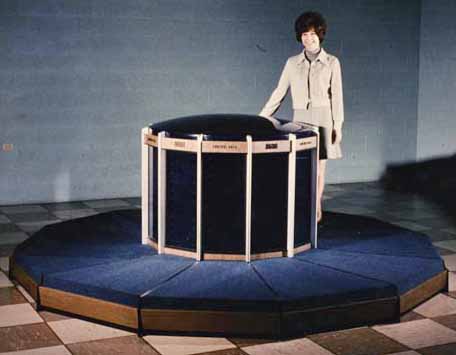
The early Cray machines were basically wired up by hand, which is why you always see a mass of wiring on one side of those machines (typically on the inside of the torus) and why there always seems to be an excess of wiring- it's because each wire within each cluster of wires were all the same length (and beyond that, each cluster of wires within each layer of the torus were all typically the same length as well), irregardless of the minimum physical length required to go from point A to point B.
At the same time, back then longer wires meant slower speed- so the whole point of Cray's famous torus design was to shorten the distance of wiring between components, for which the fastest components were positioned near the centre of the torus (decreasing the collective wire length) and the slower components placed furthest from the centre of the torus (where a slightly longer wire length didn't matter as much).
Which is why his statement puzzles me. To the best of my knowledge, there were no delay circuits- anything of the kind would absolutely murder your performance. That issue was solved by using precise wire lengths, and the machine was further accelerated by bending the entire configuration into a torus.
Even in modern day electronics, as you point out- they keep the trace lengths the same to avoid this issue. I've never, ever heard of or seen a "delay circuit" being used to solve the issue of a signal propagation delay being unequal across a bus. I can't even begin to imagine how complex and quirky that kind of setup would be, especially when the solution is so simple (keep the trace lengths the same).
-SC