


Apple last week announced two new Mac Studio models, with one built around the M5 Max chip and one around the all-new M5 Ultra chip, replacing the M4 Max and M3 Ultra models that had been on sale since March 2025.
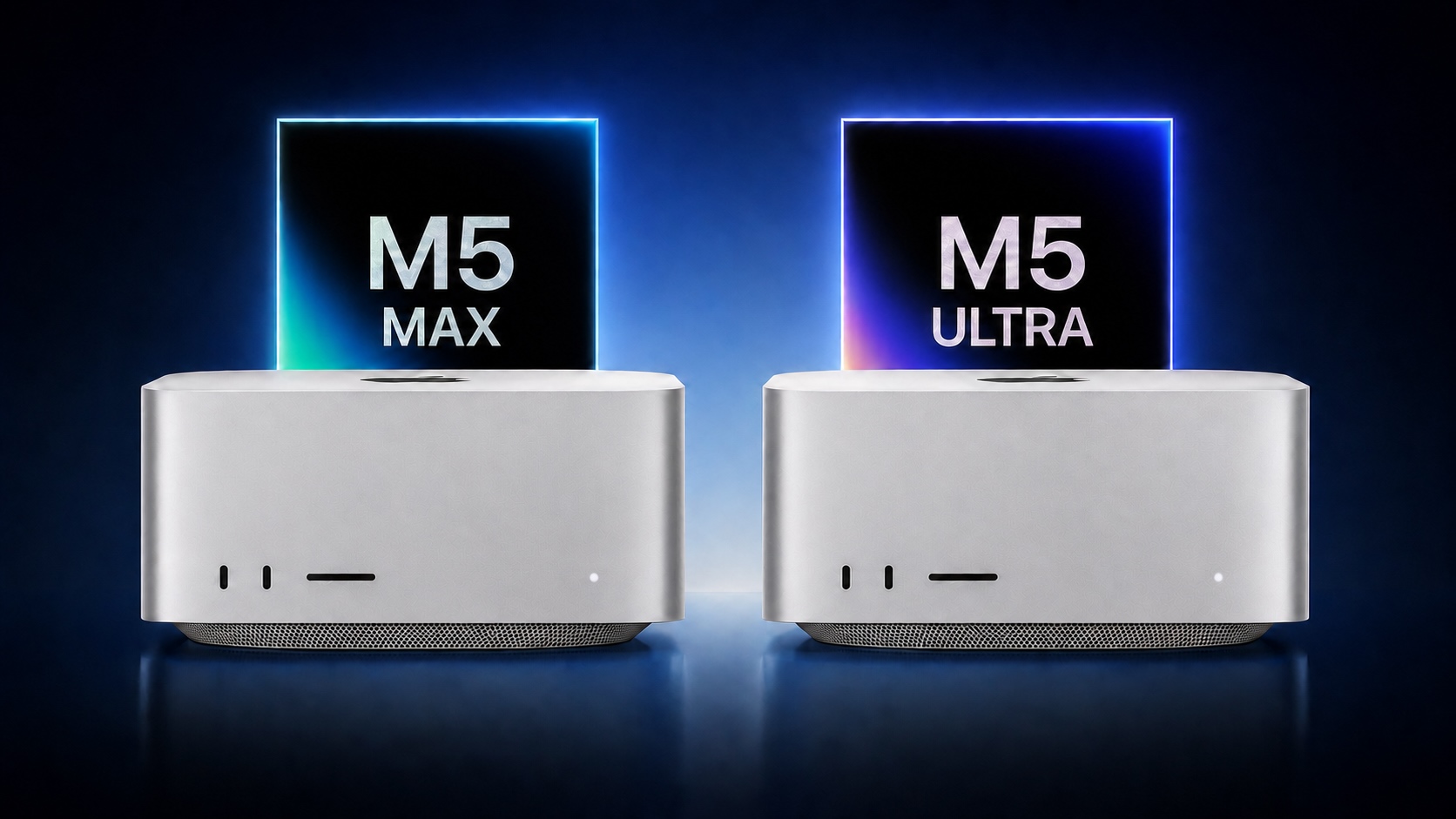
The gap between the two is unusually wide this time. Mac Studio with M5 Max starts at $2,499, holding the price Apple set when it raised Mac prices in June, while Mac Studio with M5 Ultra starts at $5,499, a further $200 increase on the post-June M3 Ultra price and $1,500 above what the M3 Ultra cost at launch.
That makes the premium $3,000 before any configure-to-order options, and memory and storage upgrades are more expensive than usual because of the memory chip shortage. Our guide helps to answer the question of how to decide which of these two Mac Studio models is best for you. The shared features include:
- An identical enclosure measuring 3.7 inches tall and 7.7 inches wide
- Neural Accelerators built into every GPU core, and hardware-accelerated ray tracing
- Hardware-accelerated H.264, HEVC, ProRes, and ProRes RAW, plus AV1 decode
- A next-generation SSD architecture that Apple says is up to twice as fast as before
- Thunderbolt 5 with up to 120Gb/s of bandwidth, and clustering of multiple systems using RDMA (remote direct memory access)
- 10Gb Ethernet, HDMI, and an SDXC card slot (UHS-II)
- Wi-Fi 7 and Bluetooth 6 via the N1 chip, both new to the Mac Studio
- Genlock over USB-C for synchronization with professional camera capture
- A 3.5mm headphone jack with support for high-impedance headphones
- macOS 27, Apple Intelligence, and Siri AI
Here is everything that differs between the two models:
| Mac Studio (M5 Max) | Mac Studio (M5 Ultra) |
|---|---|
| Starts at $2,499 | Starts at $5,499 |
| M5 Max chip | M5 Ultra chip |
| 18-core CPU with 6 super cores and 12 performance cores | Up to 36-core CPU with 12 super cores and 24 performance cores, from 30 cores |
| Up to 40-core GPU, from 32 cores | Up to 80-core GPU, from 64 cores |
| 16-core Neural Engine | 32-core Neural Engine |
| Up to 614GB/s memory bandwidth | 1.2TB/s memory bandwidth |
| 36GB, 48GB, 64GB, or 128GB of unified memory | 96GB, 256GB, or 512GB of unified memory |
| 512GB, 1TB, 2TB, 4TB, or 8TB of storage | 1TB, 2TB, 4TB, 8TB, or 16TB of storage |
| Up to 3.9x faster AI performance than M4 Max | Up to 4.3x the peak AI compute performance of M3 Ultra |
| Up to 50% faster graphics than M4 Max | Up to 1.8x faster graphics than M3 Ultra |
| One video decode engine and two video encode engines | Two video decode engines and four video encode engines |
| Two ProRes encode and decode engines | Four ProRes encode and decode engines |
| Four Thunderbolt 5 ports, two USB-C ports, and two USB-A ports | Six Thunderbolt 5 ports and two USB-A ports |
| Support for up to five 4K displays, four 6K displays, or two 8K displays | Support for up to eight 4K displays, eight 6K displays, or four 8K displays |
| 6.0 pounds (2.7 kg) | 8.0 pounds (3.6 kg) |
For the overwhelming majority of buyers, including most professionals, the M5 Max is the more appropriate choice. An 18-core CPU, up to 40 GPU cores with Neural Accelerators, up to 128GB of unified memory, and up to 614GB/s of bandwidth cover workflows such as multi-stream 4K and 6K editing, large Logic sessions with real-time plugins, compiling substantial codebases, and most 3D and motion work.
Apple's own figures support this, with up to 3x faster Magic Mask performance in Blackmagic Design DaVinci Resolve Studio and 1.4x faster scene rendering in Maxon Redshift compared to M4 Max, and graphics that are up to 50% faster than the previous generation. Since memory cannot be added later, the sensible approach is to spend more on unified memory at the point of purchase rather than on the higher chip tier.
You should only choose the M5 Ultra if you anticipate running into a performance ceiling the M5 Max cannot clear. The most obvious use-case is local AI inference, where the whole model needs to be resident in memory. 256GB and 512GB configurations paired with 1.2TB/s of bandwidth allow models with hundreds of billions of parameters to run on the machine itself, which keeps sensitive material on-device and eliminates the recurring cost of paying for cloud inference.
The other workflows that can take advantage of the M5 Ultra include studios finishing 8K material from several cameras at once, where the doubled Media Engine and its four encode engines earn their keep, research and simulation work that needs an enormous memory pool, and anyone who specifically needs six Thunderbolt 5 ports or more than five displays.
There is a notable catch in how the two memory ladders overlap. The M5 Ultra begins at 96GB, which is less than the 128GB you can configure on the M5 Max, so paying the premium at the entry configuration buys you more cores and more bandwidth, but less memory. The Ultra only separates itself at 256GB and above, and Apple limits the 512GB option to the 80-core GPU model, which means the configurations that justify the machine sit far above its starting price.
This is where the price proximity argument becomes noticeable. Configuring an M5 Max with memory and storage narrows the gap considerably, and at that point the Ultra becomes worth pricing alongside it, because it roughly doubles GPU cores, Neural Engine cores, memory bandwidth, and Media Engine capacity in one step. If your workload sits comfortably inside 128GB, though, that money is better spent on storage and displays than on the chip.
Both models support clustering over Thunderbolt 5 and RDMA, and Apple says four Mac Studio systems working together deliver up to 3x faster AI inference than a single machine, so scaling inference does not necessarily mean buying the most expensive configuration outright.
If the M5 Max still looks like more performance than you need, the new Mac mini with the M5 Pro chip starts at $1,699 with up to... Click here to read rest of article
Article Link: Mac Studio Buyer's Guide: M5 Max vs. M5 Ultra
- Article Link
- https://www.macrumors.com/guide/m5-max-vs-m5-ultra/


