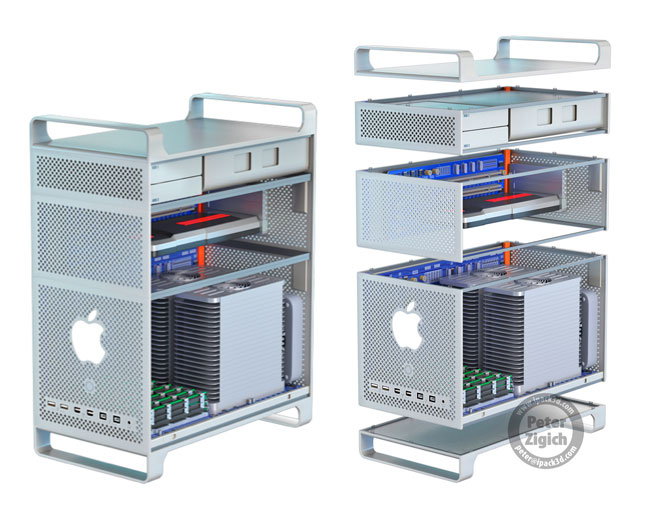
In a way, all the PowerMac towers since G3 up with Cheesegrater MP all had an "internally modularized" approach. The MP 1,1 had it the most, even RAM modules were on daughter cards, and then a 90 degree front and back panel I/O cards, internal enclosures for optical 5" bays, SATA 3.5" bays, even the fan assembly is a pullable unit. The main difference distinct of this from the stack approach is that everything is still inside of a case, sharing the same PSU, utilizing the same thermo exhaust.
While I do agree that using any external interface that is not on board is inevitably going to create unnecessary complication and loss in efficiency. The conventional tower case or the cheesegrater did it with a combination of internal PCI slots and then a bunch of standard I/Os at the same time. I am guessing that the mMP may at least do the same in some form, so there should be legit room for full length PCI cards, while retaining certain Apple-native expansion units. TB3 may not cut it for GPUs or intensive professional or scientific hardware, but it is plenty enough for everything else.
One thing we know for sure is that there will be an Apple Display again. So if we take some hint from the Thunderbolt disyplay line, the fact that they also acted as a thunderbolt I/O hub, with its cable having even a MagSafe connector, one can consider this being a modular unit of a collection among Mac desktop and laptop computing units inside one cluster. In fact, the LG 5K is already a single cable module version of this. Regulating power and heat distribution with full preparation in its design should not be a big problem, as opposed to the nMP case where almost everything you plugged into the TB2 ports were made by someone other than Apple, each with its own crappy power brick made in China.