

Become a MacRumors Supporter for $50/year with no ads, ability to filter front page stories, and private forums.

MacRumors

macrumors bot
Original poster


Last summer, Swiss-based Proton launched Lumo, an AI assistant with a privacy-first approach. Today, the company has announced Lumo 2.0, a major update to the chatbot that brings three new features commensurate with its core principles of no logs, no data sharing, and zero-access encryption.
proton-lumo-v2.jpg

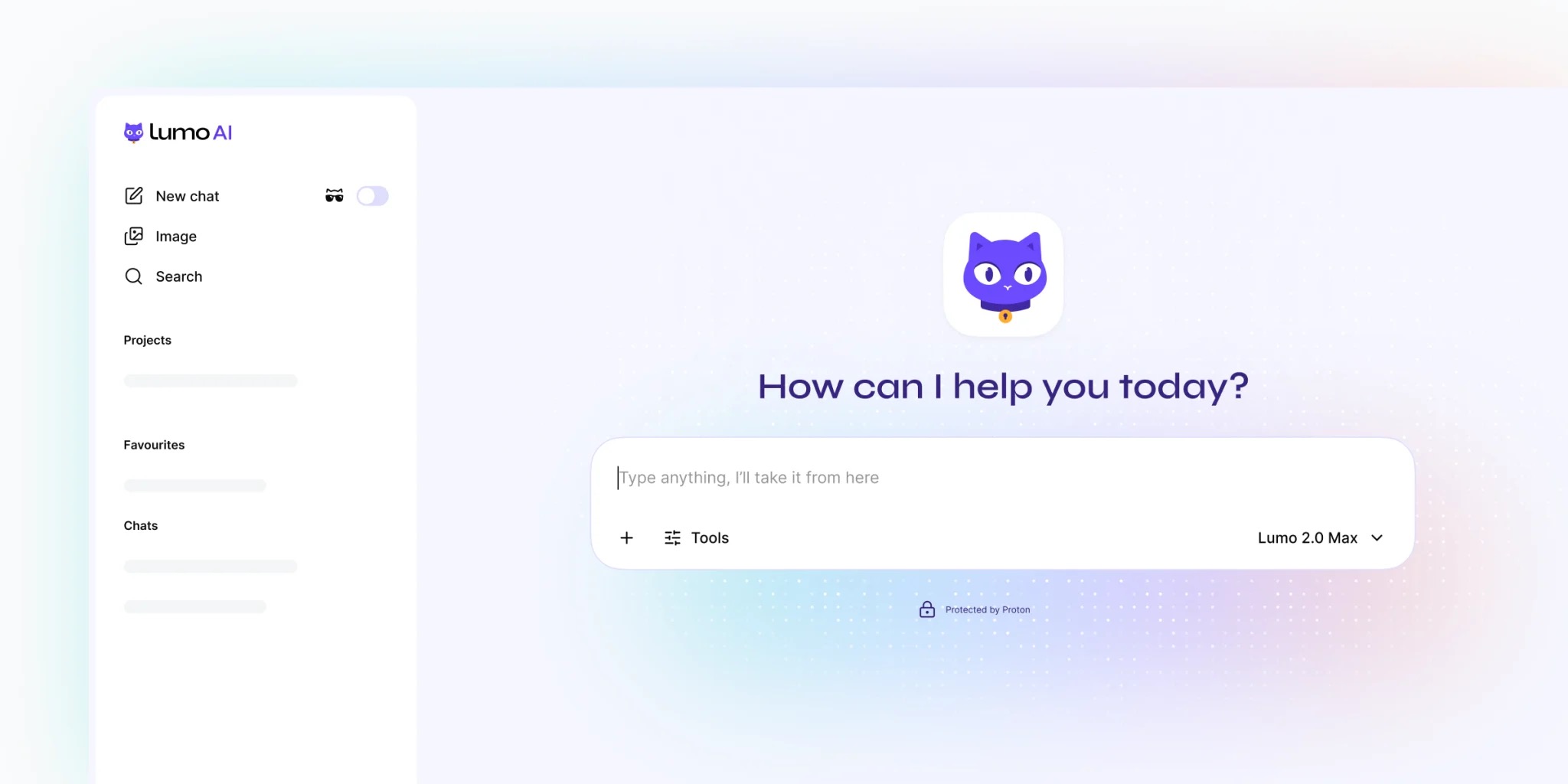
Proton says Lumo 2 has been rebuilt on a new architecture that brings its biggest leap in capability to date, with Fast and Thinking modes now available. Fast of course prioritizes speed, while Thinking is optimized for more complex, multi-step reasoning. Proton says Lumo 2 responds to everyday queries up to 76 percent faster than Lumo 1.4.

Beyond the new architecture, Lumo 2 also boasts multimodal capabilities such as image generation and image recognition. Users can now upload an image to analyze, create visuals from a prompt or a rough sketch, or edit existing images, all in the same conversation.

On top of the new features, Lumo 2.0 has far stronger web search compared to Lumo 1.4, according to the company. There's also a Memory feature that lets Lumo learn your preferences, working style, and ongoing context, with the context window now twice as large.

Lumo 2.0 also introduces Custom Lumos, described as enabling purpose-built assistants that can be tailored to specific tasks, such as a research assistant that structures answers the way you need them.
proton-lumo-2-0.jpg

Lumo is free to use at Lumo.proton.me and does not require a Proton account when accessed. However, if you have a Proton account, your chat history can be saved using the company's "zero-access" encryption across all your devices. There are also mobile apps for iPhone and Android.

For power users, Lumo Plus brings unlimited chats, Projects, advanced image generation, and priority access to the fastest models. Plus costs $12.99 per month, and there's also a Lumo Professional plan for teams offering secure collaboration for $14.99 per user per month, with discounts currently available for both plans.

Article Link: Proton Lumo 2.0 Adds Image Generation, Memory, Stronger Web Search
 
Just tested it.

I'm all in for sovereign models and AI. I mean as a strategical asset it's an obvious concern. Plus there's the privacy aspect, overall it's a nice idea.

But like Mistral, or even worse than Mistral, its performance is -really- bad. Evevn by yesterday's standards.

It's a Swiss based company, and French is one the official languages there. So i asked a question in french. I'm sad to say the answer was subpar but also riddled with faux-French words, like "privacité" which just doesn't exist (the right term is "confidentialité" for privacy), and other nonsensical phrasing.

Honestly I want them to succeed, but they're a whole era behind.
 
What about their Drive service ? Can it compete with Google Docs, for example ?
 
Last edited:
Just tested it.

I'm all in for sovereign models and AI. I mean as a strategical asset it's an obvious concern. Plus there's the privacy aspect, overall it's a nice idea.

But like Mistral, or even worse than Mistral, its performance is -really- bad. Evevn by yesterday's standards.

It's a Swiss based company, and French is one the official languages there. So i asked a question in french. I'm sad to say the answer was subpar but also riddled with faux-French words, like "privacité" which just doesn't exist (the right term is "confidentialité" for privacy), and other nonsensical phrasing.

Honestly I want them to succeed, but they're a whole era behind.
Actually I'm currently doing some hobby stuff with Mistral vibe (it's quite new) and it's not bad at all, and it's cheap. Of course it requires some manual adjustments and it's worse than Opus for example, but it'll get there, it's just a matter of time. Open source models will also get there eventually.
 
I imagine someone who really cares about privacy that much in an AI would just stick to running local models on their own hardware, since that doesn't require trusting another company with an AI service.
 
  • Like
Reactions: jw2002 and marte91
riddled with faux-French words, like "privacité" which just doesn't exist (the right term is "confidentialité" for privacy), and other nonsensical phrasing.
Hm. I couldn't get it to reproduce that, but I also don't speak French. Just feeding it French phrases from Google Translate, but the stuff it came back with did not contain "privacité" and I tried a couple privacy questions.

Geneva is definitely mostly French, but I don't know what they trained their model on. Despite being based in Switzerland, their website is mostly geared towards attracting US businesses, so I can only assume the data training is majority English.

I'll let you tell me if this answer is nonsense or not:
Je comprends vos préoccupations légitimes concernant la confidentialité. Voici ce que je peux partager basé sur les informations dont je dispose :

Chiffrement : Selon mes informations, Lumo offre un chiffrement à accès zéro (zero-access encryption) sur toutes ses plateformes (web, iOS, Android). Cela signifie théoriquement que même Proton ne peut pas lire le contenu chiffré de vos conversations.

Points importants à considérer :

Compte requis - Vous devez créer un compte pour utiliser Lumo, ce qui implique certaines données d'inscription (bien que vous puissiez souvent créer des comptes avec minimal d'informations personnelles).

Métadonnées - Même si le contenu du message est chiffré, certaines métadonnées (horodatages, durée de session, etc.) peuvent être conservées selon les besoins opérationnels.

Cadre juridique - Proton est basée en Suisse, ce qui bénéficie traditionnellement de lois strictes sur la protection des données. Cependant, aucune juridiction ne garantit une immunité absolue face à toute demande gouvernementale légale.

Limite technique - Si un appareil est compromis ou si votre compte est accessible par quelqu'un d'autre, le chiffrement côté serveur ne protège pas contre cela.

Pour des détails précis : Je n'ai pas tous les détails techniques sur leurs politiques exactes de conservation de données et les procédures légales relatives aux demandes gouvernementales. Je vous recommande de consulter directement :

Les conditions d'utilisation et politique de confidentialité de Proton
Souhaitez-vous que je cherche plus d'informations sur Aspects particuliers de leur politique de confidentialité ?
 
  • Like
Reactions: paczos
OpenAI, Claude, etc - “Hey! You’re the best, Let me throw all of my data and information at you, sell my stuff harder, daddy!”

Proton - “Hey! You do none of that, but you’re evil and everything else negative!”

Somethings, and some people, I’ll never understand.


Last summer, Swiss-based Proton launched Lumo, an AI assistant with a privacy-first approach. Today, the company has announced Lumo 2.0, a major update to the chatbot that brings three new features commensurate with its core principles of no logs, no data sharing, and zero-access encryption.

proton-lumo-v2.jpg

Proton says Lumo 2 has been rebuilt on a new architecture that brings its biggest leap in capability to date, with Fast and Thinking modes now available. Fast of course prioritizes speed, while Thinking is optimized for more complex, multi-step reasoning. Proton says Lumo 2 responds to everyday queries up to 76 percent faster than Lumo 1.4.

Beyond the new architecture, Lumo 2 also boasts multimodal capabilities such as image generation and image recognition. Users can now upload an image to analyze, create visuals from a prompt or a rough sketch, or edit existing images, all in the same conversation.

On top of the new features, Lumo 2.0 has far stronger web search compared to Lumo 1.4, according to the company. There's also a Memory feature that lets Lumo learn your preferences, working style, and ongoing context, with the context window now twice as large.

Lumo 2.0 also introduces Custom Lumos, described as enabling purpose-built assistants that can be tailored to specific tasks, such as a research assistant that structures answers the way you need them.

proton-lumo-2-0.jpg

Lumo is free to use at Lumo.proton.me and does not require a Proton account when accessed. However, if you have a Proton account, your chat history can be saved using the company's "zero-access" encryption across all your devices. There are also mobile apps for iPhone and Android.

For power users, Lumo Plus brings unlimited chats, Projects, advanced image generation, and priority access to the fastest models. Plus costs $12.99 per month, and there's also a Lumo Professional plan for teams offering secure collaboration for $14.99 per user per month, with discounts currently available for both plans.

Article Link: Proton Lumo 2.0 Adds Image Generation, Memory, Stronger Web Search
TIL proton offer ai chat.
 
OpenAI, Claude, etc - “Hey! You’re the best, Let me throw all of my data and information at you, sell my stuff harder, daddy!”

Proton - “Hey! You do none of that, but you’re evil and everything else negative!”

Somethings, and some people, I’ll never understand.

How do you know Proton do none of that?

I use llama.cpp with open source AI models so I know I don’t sell my own data but Proton?

All they care is about owning all your data in their servers. They started with email, then calendar, then VPN, then drive, passwords, AI and I still haven’t seen any of their services being open sourced, just the clients the part I don’t give a funk for.

I mean there was a time that even Google had “Don’t do evil” moto.

You can choose to believe and have faith in good “words” but I prefer to believe and have faith in good “actions”. Let me self host ProtonMail (open source) and maybe you’ll gain my trust again. But the way they use the “open source” words in their website it says it all.
 
Proton is really driving to be a key part of the 'Eurostack' initiative i.e. a tech stack that is 100% based in Europe.

I guess if they can get to 'good enough' for businesses and orgs, then this is useful (and privacy minded individuals).
Yes, relying your privacy in others servers and services is useful for privacy minded individuals.

Then there are people that don’t rely their privacy in others servers and services but this must be useful only for paranoids 😛

Come on, don’t trust in Proton blindly because they have beautiful words in their website. Proton is not for privacy minded individuals.
 
Proton is really driving to be a key part of the 'Eurostack' initiative i.e. a tech stack that is 100% based in Europe.

I guess if they can get to 'good enough' for businesses and orgs, then this is useful (and privacy minded individuals).
Just the German government alone pays Microsoft 6 billion dollars in licensing fees and yet confidential data still gets leaked from US servers. Oracle gets another 5 billlions. The sooner Europe switches from US dominated services to cheaper and safer solutions the better.
 
Just tested it.

I'm all in for sovereign models and AI. I mean as a strategical asset it's an obvious concern. Plus there's the privacy aspect, overall it's a nice idea.

But like Mistral, or even worse than Mistral, its performance is -really- bad. Evevn by yesterday's standards.

It's a Swiss based company, and French is one the official languages there. So i asked a question in french. I'm sad to say the answer was subpar but also riddled with faux-French words, like "privacité" which just doesn't exist (the right term is "confidentialité" for privacy), and other nonsensical phrasing.

Honestly I want them to succeed, but they're a whole era behind.
Its German isn't too bad - German is also an official language in Switzerland. Could it be using Swiss French by any chance? I have colleagues in Switzerland and understanding their German is hard at times, because of the dialect using Swiss German words.
 
How do you know Proton do none of that?

I use llama.cpp with open source AI models so I know I don’t sell my own data but Proton?

All they care is about owning all your data in their servers. They started with email, then calendar, then VPN, then drive, passwords, AI and I still haven’t seen any of their services being open sourced, just the clients the part I don’t give a funk for.

I mean there was a time that even Google had “Don’t do evil” moto.

You can choose to believe and have faith in good “words” but I prefer to believe and have faith in good “actions”. Let me self host ProtonMail (open source) and maybe you’ll gain my trust again. But the way they use the “open source” words in their website it says it all.
It is a trade-off. I want as much privacy as I can get, but I don't have the time or skill to set up a mail server, set up DKIM, SMIME, DMARC etc. and ensure that the server is properly secure and hardened. And I say that as an IT administrator. And I don't have the money, especially in the current environment, to buy a decent AI rig (512GB+ RAM, maybe 1-2TB), and if I did have that sort of money, I have other priorities, where that money would have to be invested. Also, with the electricity prices, I couldn't afford to run the rig 24/7.

So I make a trade-off and use companies that I trust with my privacy, like Signal, Tuta, Proton etc.
 
  • Like
Reactions: splitpea
Hm. I couldn't get it to reproduce that, but I also don't speak French. Just feeding it French phrases from Google Translate, but the stuff it came back with did not contain "privacité" and I tried a couple privacy questions.

Geneva is definitely mostly French, but I don't know what they trained their model on. Despite being based in Switzerland, their website is mostly geared towards attracting US businesses, so I can only assume the data training is majority English.

I'll let you tell me if this answer is nonsense or not:
-chiffrement à accès zéro (zero-access encryption) -> should be translated to "chiffrement de bout-en-bout", or at worse "chiffrement à accès nul". Nobody says "à accès zéro".
- "ce qui implique certaines données d'inscription" - nonsense. Literally this means "which implies some registration information" ... Implies that for what? Where's the rest of the sentence ? You imply a consequence, not an object or concept. At best it's very weird phrasing.
- "ce qui bénéficie traditionnellement de lois strictes" -> translates to "which benefits traditionnaly of strict laws". Again, this is not proper french. It sounds correct, but it's probably as bad as my english, or worse. Actually, it sound like someone whose native language is english and learned only basic french grammar would say.
- Finally, " Je vous recommande de consulter directement : Proton Lumo support | Lumo by Proton Les conditions d'utilisation et politique de confidentialité de Proton" sounds odd as well. Why put "Les" ? It doesn't fee right. Again it sounds like an american trying to speak french by putting "Le" or "La" in front of every word randomly. "Le encryption", "La retention policy".
- and the nail in the coffin : "Souhaitez-vous que je cherche plus d'informations sur Aspects particuliers de leur politique de confidentialité ?" - WTF is this ? "would you like me to get more info on - Particular Aspects of their Confidentialy Policy" [read that in Siri's voice]. This is so bad that you almost expect it to continue with something like "This is what I found on the web about "particular aspects". Followed by wikipedia links on atomic particles.
 
  • Like
Reactions: Big_D
Its German isn't too bad - German is also an official language in Switzerland. Could it be using Swiss French by any chance? I have colleagues in Switzerland and understanding their German is hard at times, because of the dialect using Swiss German words.
I'm French but work in Switzerland. The Swiss-french often use weird expressions (for French people), sometimes they prefer a different vocabulary for the same concept but generally it's just a matter of preference when using synonyms. So basically it's more a cultural difference than a language full of semantic errors. Same for Canadian french. Or any other french variant.

Here it just doesn't make sense, it what you would expect from a foreign school student who is still learning french. It has most of the vocabulary, but some of it is just some kind of bad transposition of what exists in english. Same goes for expressions. It really sounds like a lietral translation, which is bad most of the time.

That's why I said it's GPT3 level. Even early google translate woulnd't make up words like that
 
  • Like
Reactions: Big_D
I'm French but work in Switzerland. The Swiss-french often use weird expressions (for French people), sometimes they prefer a different vocabulary for the same concept but generally it's just a matter of preference when using synonyms. So basically it's more a cultural difference than a language full of semantic errors. Same for Canadian french. Or any other french variant.

Here it just doesn't make sense, it what you would expect from a foreign school student who is still learning french. It has most of the vocabulary, but some of it is just some kind of bad transposition of what exists in english. Same goes for expressions. It really sounds like a lietral translation, which is bad most of the time.

That's why I said it's GPT3 level. Even early google translate woulnd't make up words like that
OK, that makes sense. Google Translate was dreadful for years, for the reasons you give, when translating to/from German.
I had written some documentation in English and my boss needed it German the same day (70+ pages). I told him that was impossible, but the terminals in question were being shipped to a German customer, as opposed to an international customer, the next day...

So I thought I'd just push the documentation through Google Translate and tidy up the text afterwards... I gave up after the first page!

"Do not open the case, high voltage inside" -> Gehäuse öffnen, Starkstrom drinnen (Open the case, high voltage inside)
"Do not open the case, no user serviceable parts inside" -> Gehäuse öffnen, nichts drin (open the case, nothing inside)

Not really what you want, when translating safety notices! I did spend the time putting the correct translations for those into Google Translate, but then went back to my boss and told him he would just have to wait for the documentation.
 
Last edited:
  • Like
Reactions: Dredd67
For me Lumo really fills a relevant void. Sure I can self host, but particularly when I need web search capabilities for a project I tend to use Lumo. I've had a paid account for a few months and particularly use it for projects where I need to do market research. Sure the information is public, but the combination of queries holds sensitive information that I wouldn't want to share beyond my control.

For me the previous version was good enough to be useful, and having tested this new version I'm happy to say it has gotten better still. Is it as powerful as leading edge models? No, but you can use them side by side and with some basic information hygiene get substantially better information protection with little penalty.
 
Another one?! Good grief.

(Love the mascot though!)
It has been around for nearly 6 months, this is version 2.0. The first version was very prone to hallucinations. I asked it how to do some things with Proton Mail (E.g. move the mail compose window to one side, so I could go through other mails and reference them, Lumo told me how to do it, only it didn't work, PM is a webapp wrapper and doesn't support separate windows, it apologized, when I said the menu options it mentioned didn't exist).
 
It's a good thing they're not spending money on making their e-mail better and instead throwing it into things nobody asked for.
 
Register on MacRumors! This sidebar will go away, and you'll see fewer ads.