Intel and Apple Silicon both have the same RAM to CPU bottleneck. There are some small quantitative differences, but you can safely ignore them most of the time, even if you are writing performance-critical software. The high frequencies of Intel CPUs are unrelated to the bottleneck. Intel simply does it because it's possible and beneficial in some consumer applications.
I agree both have bottlenecks. Intel's one is a lot smaller compared to AS, and Intel's problem is that their CPUs has to cater to a lot of variations, and therefore cannot freely reduce the bottlenecks compared to AS. Apple can go wild, only limited by physics and cost. Increasing CPU clock frequencies only benefits workloads that fits into L1, L2 and L3 cache. Once you need more, you're hit with the RAM to CPU (i.e. L3 cache) bottleneck. When a 3.2 GHz processor can process more data than a CPU running at 5GHz, it shows that there bottleneck with the 5GHz CPU.
Engineering is always about trade offs.
The primary effect of the PCIe bottleneck is the programming model where the CPU and the GPU are effectively separate computers connected over a fast network. That's not a real problem in many applications, because they have to scale to multiple systems anyway. Other applications would benefit from the simplicity and performance of shared memory. The bottleneck doesn't increase the need for memory bandwidth, but it may increase the need for the amount of memory.
Programming models can be abstracted from the underlying implementations. APIs can be written to masked away the RAM to PCIe transfer, but it doesn't mean the bottleneck is not there. Let take this hypothetical scenario. Let's say we load a 10MB texture that's required by the GPU. In the UMA case, it's loaded into RAM, and the SLC cache already have a copy of that texture. The GPU doesn't have to wait for it anymore and access it directly. The higher AS RAM bandwidth go, the better the performance. And again Apple's GPU doesn't need to clock as high to maintiain the same performance, like the CPU case. Now with the M1 Max, Apple's GPU have access to more than 40GB of data to process.
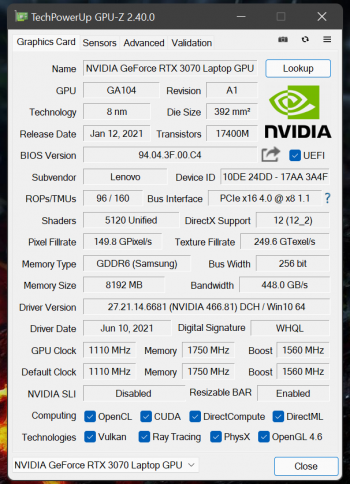
In the case of dGPU with VRAM, transfer is limited by it 32GB/s limit. So to mitigate this, the VRAM has to go as fast as possible to feed data to the GPUs. PCIe is great for expansion, but not so good for extreme bandwidth data transfers.
Upgradeability is more about providing cost-effective devices to many different use cases rather than upgrading systems that are already in use. Tight integration makes sense when you are an average user or close to it. A modular architecture quickly becomes more competitive when one user requires a lot of RAM, another needs several high-end GPUs, and yet another needs a lot of local disk space.
Which is why Apple doesn't go into every market there is. They choose to play in the market they think they can make a profit. Apple most likely decided that they market they want to play in doesn't value upgradeability. I don't see anything wrong with that.
We still have not seen what Apple's AS Mac Pro looks like, but again, Apple is playing in a niche segment of the market here. Definitely not in the enthusiasts market.