

There is this really big misconception about the design of phones, which have been used countless times in arguments for which phone is better etc, and that is the idea that:
The bigger the display, the better the phone looks. (In terms of percentage screen area)
Or even:
The bigger the display, the better the phone.
This is just utterly wrong, there is nothing intrinsically good about having a big display. Now if you don't understand what an intrinsic good is, here's a short explanation. Money is not an intrinsic good, it is an instrumental good because it is an instrument you can use to buy other things, like iPhones or food, or services. You wouldn't want money if you can't use it to buy other things. However some things are intrinsically good, the specifics of which can differ from person to person but examples can include happiness, safety, beautiful gem stones, music, love, success, etc...
For this reason, one cannot say that a bigger display makes the phone better. Because display size is not an intrinsic good. One can argue that a more beautiful design always makes a phone better (all else being equal) because beauty is an intrinsic good.
It also makes no sense to connect any measurable objective fact with aesthetics, because nobody has been able to come up with such an example. You can't say that a phone looks good because it is thin, because there are thin phones that are not good looking, in fact there are phones that would look better if they were thicker. You can't say that a painting is good because it has lots of red, because there will be lots of other paintings that have too much red, even though they don't have as many as the previous one.
And for this second reason, it makes no sense to say that a phone looks better because it has a bigger display, it could happen to be the case, it could often be the case, but screen size is no evidence for better looks. Just like you can't prove to me that a painting is better because it has more red in it, or that a statue is better because it is more expensive.
====================However====================
There are many good reasons to have a bigger display, or a bigger display could give you other good things that are themselves intrinsic, for example:
The Samsung Galaxy S8 has a "bezel-less" display just like the iPhone X, but the Samsung actually has more screen percentage than the iPhone X. Some people might begin to argue that because of this, the S8 is better.
But if you look at the fundamental reasons to have a bigger display like I have listed above, it's not so convincing any more. This is because the iPhone ears house the status icons, the entire area of the screen underneath the notch is usable. Where as the S8 has a status bar, and a row of software buttons, neither of which are as flexible, or show more content, compared to the iPhone X.
This isn't a sincere argument against the Galaxy S8, just an example to show how the logic works. Since the differences in screen area we are talking about here are just microscopic, regardless of who has the upper hand. But it is always important to be clear about what you really want, and what is really offered by each product.
====================Aesthetics==================
I think the reason people often mistake screen size with aesthetics, as if one imply the other, is because screen size often implies something else, and people mistake that for aesthetics.
Screen size implies shock value, big screens are visually striking because they have historically been difficult to do so you haven't seen many of them. Their attractiveness comes from your lack of exposure, and not their aesthetic contribution.
What's the difference? here are two cars:


A lot of people would say that the first looks better, my mom would. Is it because the first car is more beautiful more aesthetically pleasing? I don't think so. It's because the first is more striking, more fresh, more curves and designs that haven't been possible in the past.
The difference is, 30 years from now, we would consider the first car to be old, and average looking, for old cars. But the second car will still be a classic design and beautiful in its own way.


You see where I am getting at here?
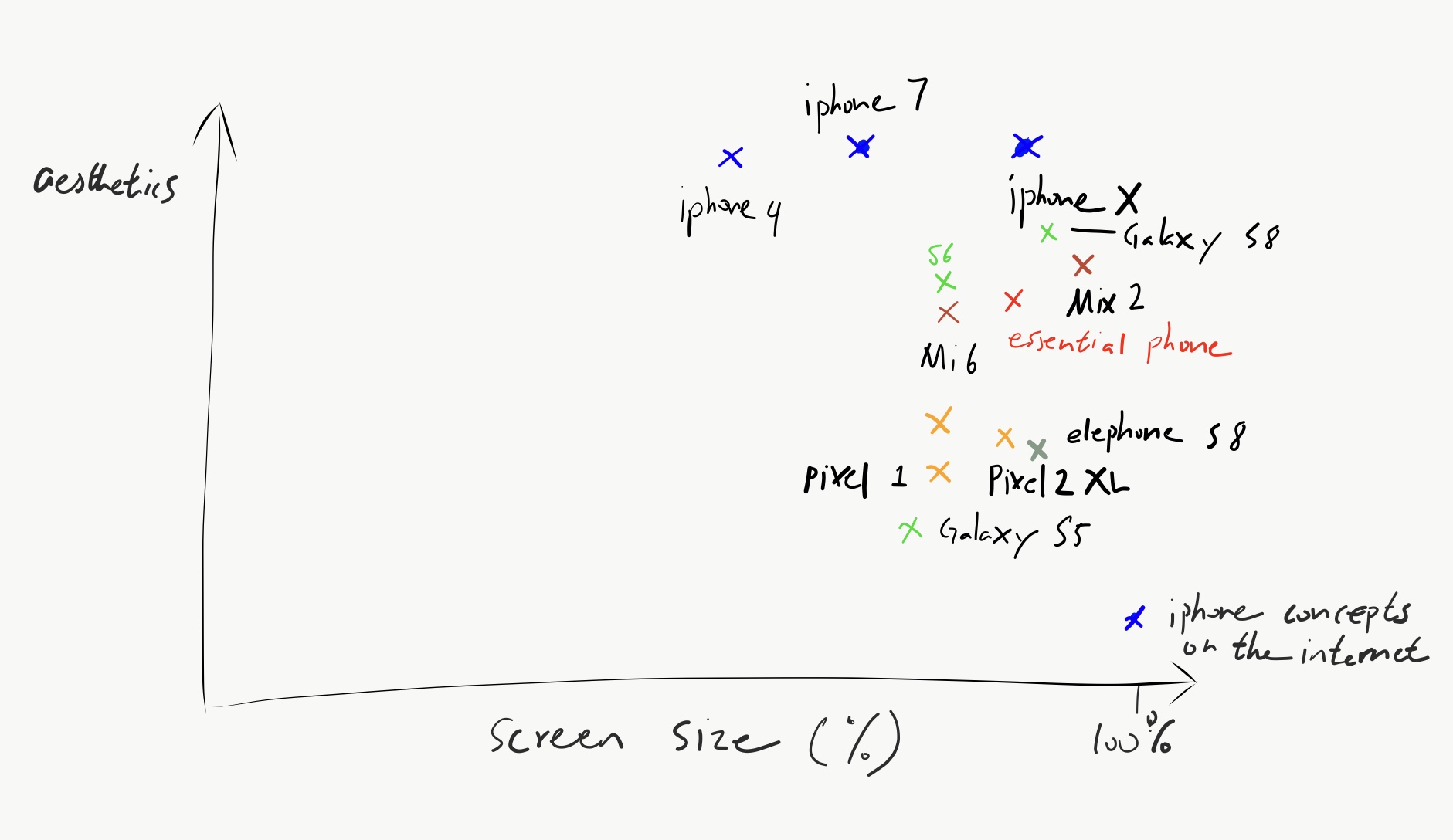
Obviously I do not have a final say on which phones look good and which do not, this is just my opinion. All I am trying to say here is that screen size and aesthetics are two different independent concepts. A phone can have a huge screen and still look horrible (like the idiotic iPhone concepts we keep seeing), while other phones can have small screens and still look great (iPhones before X).
Maybe I’m being a little too harsh on the Pixel here, I think they still look a bit better than the Elephone S8, that giant chin is just ridiculously ugly. Still, the Pixel phones are vastly inferior to the Samsung and LG offerings.
The bigger the display, the better the phone looks. (In terms of percentage screen area)
Or even:
The bigger the display, the better the phone.
This is just utterly wrong, there is nothing intrinsically good about having a big display. Now if you don't understand what an intrinsic good is, here's a short explanation. Money is not an intrinsic good, it is an instrumental good because it is an instrument you can use to buy other things, like iPhones or food, or services. You wouldn't want money if you can't use it to buy other things. However some things are intrinsically good, the specifics of which can differ from person to person but examples can include happiness, safety, beautiful gem stones, music, love, success, etc...
For this reason, one cannot say that a bigger display makes the phone better. Because display size is not an intrinsic good. One can argue that a more beautiful design always makes a phone better (all else being equal) because beauty is an intrinsic good.
It also makes no sense to connect any measurable objective fact with aesthetics, because nobody has been able to come up with such an example. You can't say that a phone looks good because it is thin, because there are thin phones that are not good looking, in fact there are phones that would look better if they were thicker. You can't say that a painting is good because it has lots of red, because there will be lots of other paintings that have too much red, even though they don't have as many as the previous one.
And for this second reason, it makes no sense to say that a phone looks better because it has a bigger display, it could happen to be the case, it could often be the case, but screen size is no evidence for better looks. Just like you can't prove to me that a painting is better because it has more red in it, or that a statue is better because it is more expensive.
====================However====================
There are many good reasons to have a bigger display, or a bigger display could give you other good things that are themselves intrinsic, for example:
- Flexibility of content or function.
- Can view more content faster, less scrolling.
- Without having to deal with a bigger body.
The Samsung Galaxy S8 has a "bezel-less" display just like the iPhone X, but the Samsung actually has more screen percentage than the iPhone X. Some people might begin to argue that because of this, the S8 is better.
But if you look at the fundamental reasons to have a bigger display like I have listed above, it's not so convincing any more. This is because the iPhone ears house the status icons, the entire area of the screen underneath the notch is usable. Where as the S8 has a status bar, and a row of software buttons, neither of which are as flexible, or show more content, compared to the iPhone X.
This isn't a sincere argument against the Galaxy S8, just an example to show how the logic works. Since the differences in screen area we are talking about here are just microscopic, regardless of who has the upper hand. But it is always important to be clear about what you really want, and what is really offered by each product.
====================Aesthetics==================
I think the reason people often mistake screen size with aesthetics, as if one imply the other, is because screen size often implies something else, and people mistake that for aesthetics.
Screen size implies shock value, big screens are visually striking because they have historically been difficult to do so you haven't seen many of them. Their attractiveness comes from your lack of exposure, and not their aesthetic contribution.
What's the difference? here are two cars:
A lot of people would say that the first looks better, my mom would. Is it because the first car is more beautiful more aesthetically pleasing? I don't think so. It's because the first is more striking, more fresh, more curves and designs that haven't been possible in the past.
The difference is, 30 years from now, we would consider the first car to be old, and average looking, for old cars. But the second car will still be a classic design and beautiful in its own way.
You see where I am getting at here?
Obviously I do not have a final say on which phones look good and which do not, this is just my opinion. All I am trying to say here is that screen size and aesthetics are two different independent concepts. A phone can have a huge screen and still look horrible (like the idiotic iPhone concepts we keep seeing), while other phones can have small screens and still look great (iPhones before X).
Maybe I’m being a little too harsh on the Pixel here, I think they still look a bit better than the Elephone S8, that giant chin is just ridiculously ugly. Still, the Pixel phones are vastly inferior to the Samsung and LG offerings.
