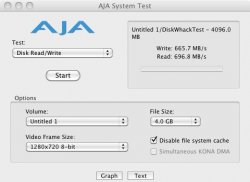
I have an 8-core MP 2008 with 4 x 1 TB Raid0 as my boot drive. I was a bit sloppy, choosing disks, but with a current 75% disk usage, it'll still do 300 MB/s, and is way faster than working on a single drive. I can feel a difference in booting and in disk heavy applications. I work with very heavy movie files (4K Red raw), 3D apps loading huge libraries from disk, etc. I use a four drive raid0 as Time machine disk, connected via a Sonnet 4 port eSata controller (very good).
Apparently you've been fine with a stripe set for a backup source, but I don't trust it for that and don't recommend it (i.e. primary array dies, gets fixed, and the backup array dies during data restoration
😱).
Not pretty.
🙁
I'm able to connect the Time Machine raid via FW800 if I need restoring. Btw. that's important! 😉 That way I have better safety than raid01 and even raid5, because I have the history from Time Machine. Works like a charm. I've had to replace one drive in the past year, and my Mac is running 24/7...
You may have lost me here...
Is the box you're using an eSATA + FW800 unit (would make sense to me)? Or do you have more than one backup of the same data?
As per the FW800 restoration, if it's a stripe set, then it's not safer than 10 or 5 (not even equivalent to RAID 5, which is only has a redundancy = 1 member can be lost without losing data). A 10 array (safer than 0+1) has a redundancy = 2.
...I read Nanofrog's point about something called ICH. I tried Googling it, but can't seem to find it.
It's only been with the increasing use of SSD's that it's even gained the attention of the public, as Intel never published this information. Even now, it's not all that commonly known from what I see/hear.
Many are surprised to discover this bit of information.
🙁 What you need to keep in mind however, is when the ICH was originally designed, there were no SSD's, so it was designed for mechanical disks. Once SSD's came on the scene, they couldn't fix it, as the design uses DMI to connect it to the chipset (1GB/s up and down), and had they increased it's alloted bandwidth, it could choke the other data from reaching the system. So they were stuck with it.
The next revision of the ICH should contain 6.0Gb/s SATA ports, so this issue will be addressed (it will have to connect via a faster bus than DMI, so it will be a substantial re-design from what's currently used, though still evolutionary).
And does it bottleneck at 660 MB/s?
ICH = I/O Controller Hub, which contains the SATA, USB, and Ethernet controllers.
The Southbridge term was done away with when Intel introduced the Nehalem architecture, but the actual ICH used was released earlier in Q3 2008 (ICH 10; ICH10R = Q4 2008, and isn't used in the MP's).
Unfortunately, it's the source of the throughput cap, and it exists in all Intel MP's (this has been around awhile).