
Got a tip for us?
Let us know
Become a MacRumors Supporter for $50/year with no ads, ability to filter front page stories, and private forums.
Transition Time = Time for a new Cube...?
- Thread starter Boil
- Start date
- Sort by reaction score
You are using an out of date browser. It may not display this or other websites correctly.
You should upgrade or use an alternative browser.
You should upgrade or use an alternative browser.

Unregistered 4U
macrumors G5
I think they can physically be different AND the same simultaneously. If the goal was to design a “Frame” that could have multiple uses over time (recoup the R&D on the internals separately from the frame), then they’ve currently got a flexible framework that lends itself to modularity. CPU section attached at the bottom would be small and relatively cool because their ASi solutions don’t use that much power or generate that much heat, then a proprietary very wide connector that would attach to modules that would stack on top of it, enabling designs that are fit to purpose. This would be even MORE expensive to design from Apple’s standpoint, but, as it’s the future, they could recoup the R&D costs over time.I have some serious doubts that the next iteration of the Mac Pro will be (physically) much different than the 2019 Mac Pro. They spent a considerable amount of time in researching and designing the 2019 Mac Pro, albeit still a cheese grater, that one would wonder why they would introduce it in the first place only to have it superseded approximately 2 years later.
That’s, of course IF they ever decide to do anything like the Mac Pro going forward. The market of “anything outside of mobile” is shrinking every day and it’s going to be harder and harder to recoup development costs on an ever shrinking market.

I do wonder if well see a redesigned Mini, but not sure they'd do anything drastically different.
Think AppleTV. I truly hope it doesn't, but I think this is the way Apple will go for the mini.
I think you are right if they can distinguish them enough. And I also have to agree that I’m a bit concerned the Mac Pro, as we know it, is becoming more and more of a extremely niche product. This is based on speculation and uncertainty of the unknown to be sure but my confidence in some of Apples decision is dwindling.I think they can physically be different AND the same simultaneously. If the goal was to design a “Frame” that could have multiple uses over time (recoup the R&D on the internals separately from the frame), then they’ve currently got a flexible framework that lends itself to modularity. CPU section attached at the bottom would be small and relatively cool because their ASi solutions don’t use that much power or generate that much heat, then a proprietary very wide connector that would attach to modules that would stack on top of it, enabling designs that are fit to purpose. This would be even MORE expensive to design from Apple’s standpoint, but, as it’s the future, they could recoup the R&D costs over time.
That’s, of course IF they ever decide to do anything like the Mac Pro going forward. The market of “anything outside of mobile” is shrinking every day and it’s going to be harder and harder to recoup development costs on an ever shrinking market.

dmccloud
macrumors 68040
The Core-i/Xeon distinction may or may not have a direct analog in Apple silicon. ECC is something a Mac Pro will need but an Air won't - but making that an exclusive "xeon" feature is Intel's artifice. It will be interesting to see how Apple presents the processor choices in the new range (it seems unlikely that there will be a "one size fits all" ASi processor for everything from a MacBook Air to a Mac Pro - even with "binning" or disabling cores) - they may invent some analog of Intel's "i3/5/7/9" notation and/or "Apple Silicon" vs. "Apple Silicon Pro" but that is all, ultimately, branding who's relation to actual features changes with each generation.
I've been wondering how Apple might name their AS processors for the Mac to distinguish them from their iOS processors, and I think that the answer may already be right in front of us. For purposes of discussion, I am going to refer to the upcoming AS processor as an "M1." Apple could have the M1 in the Macbook and possibly MacBook Air, an M1 Pro for the Macbook Pro, and an M1 Pro Max for the iMac Pro and Mac Pro. That would give them product lines equivalent to the dual-core CPUs used in the MBA, the quad-core and higher used in the MBP lineup, and the Xeons used in the iMac Pro and Mac Pro. They could differentiate the three variants by core counts, graphics capabilities, PCIe lanes, ECC, and other factors. Assuming that Apple follows a similar model to what I have outlined, that would give an easy way for both the press and the public to identify the differences between the product lines. Using a different naming convention for the Mac processors also alleviates the potential confusion over Apple using a "phone processor" in a Mac.
theluggage
macrumors G3
I've been wondering how Apple might name their AS processors for the Mac to distinguish them from their iOS processors, and I think that the answer may already be right in front of us.
Yes, your regular (ultraportable), Pro (high-end portable/mid-range desktops) and possibly Pro super-maxi-double-plus-something (Apple Silicon XDR!?) for the Xeon replacement sounds convincing - then each of those could come in ~3 variants via "binning", disabling cores etc. I'm sure their ideal would be to do it all with the fewest actual die designs plus "binning" but 2-3 physically different chips to cover the range between Macbook and Mac Pro sounds about right.
For overall branding, my guess is that they're going with "Apple Silicon" for the Mac-grade processors and just Axx for iDevices. I base this wild guess on the way that the Mac-related parts of WWDC were all about "Apple Silicon" while they're not using that in the blurb about tne new iPhones.
All speculating about branding of course - no technical significance.
dmccloud
macrumors 68040
I think that "Apple Silicon" is just being used at this time to distinguish these new processors from both the A-series in use on iPhones and iPads as well as the Intel CPUs currently used in the Mac lineup. Once they officially announce a new Mac running on Apple Silicon, that is when we'd get some insight into their naming convention for the Mac side of the equation. One massive benefit of licensing the ARM IP and being able to iterate on that when designing your own processors is that creating new designs with different core counts is actually more like playing with LEGOs than it is redesigning a processor from scratch. AMD has taken a similar approach to Apple with its Zen (now Zen 2) architecture in terms of adopting a model that allows for modularity in the designs. Binning will always play a role in determining what each processor is ultimately sold as, but it will be far most cost-effective to design systems with modularity in mind, since you're just adding cores to a base design rather than creating a new design from the ground up for each variant in core count.
A new Cube Boil is longing for after all?
As part of the transition to Apple Silicon, Apple is designing a new Mac Pro that has a smaller form factor, reports Bloomberg. The new Mac Pro is said to have a design that looks like the current design, but in a more compact enclosure that's "about half the size."
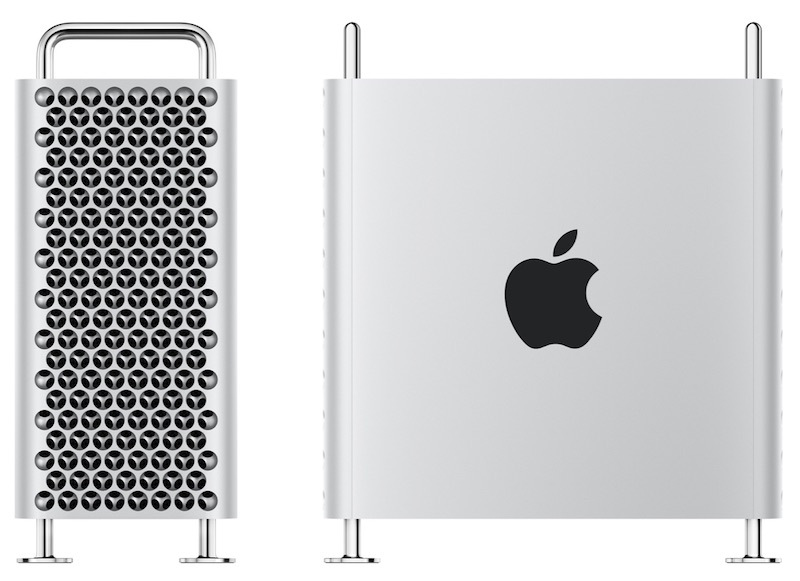
It is not known if the new Mac Pro will replace the current model or will be sold alongside the current Mac Pro, which was introduced last year. From Bloomberg:The new Mac Pro is not set to come out in 2020 and will presumably be released in 2021 or 2022. Apple is planning to move all of its Macs to Apple Silicon chips instead of Intel chips, but the company expects that process to take two years.
Next week's event is expected to see Apple unveil a 13-inch MacBook Pro, a 16-inch MacBook Pro, and 13-inch MacBook Air, all of which will be equipped with Apple Silicon chips.
Article Link: Apple Working on Redesigned Mac Pro With Smaller Form Factor and Apple Silicon Chip

erich.j.k
macrumors regular
I would consider buying a Cube or the "small" Pro, but the pricing might be way off for small businesses (like mine, software development).
My Mac Mini 2018 is pretty good albeit it lacks graphics power. I like using it on an any day basis and it's powerful enough for most of my use cases.
My Mac Mini 2018 is pretty good albeit it lacks graphics power. I like using it on an any day basis and it's powerful enough for most of my use cases.

Can you not deduct the cost of the computer over X years on your taxes, since it is for business use (software development)...?I would consider buying a Cube or the "small" Pro, but the pricing might be way off for small businesses (like mine, software development).
My Mac Mini 2018 is pretty good albeit it lacks graphics power. I like using it on an any day basis and it's powerful enough for most of my use cases.
erich.j.k
macrumors regular
Yes I could. But the revenue wouldn't justify the cost of the cMP (e.g.). So it depends on the price.Can you not deduct the cost of the computer over X years on your taxes, since it is for business use (software development)...?