Become a MacRumors Supporter for $50/year with no ads, ability to filter front page stories, and private forums.

MacRumors

macrumors bot
Original poster


Last November, Google announced a cross-platform feature that allows Google Pixel 10 and Apple device users to share files directly via Quick Share-AirDrop interoperability. Now, Google has confirmed that the feature is set to expand to Android phones more generally this year.
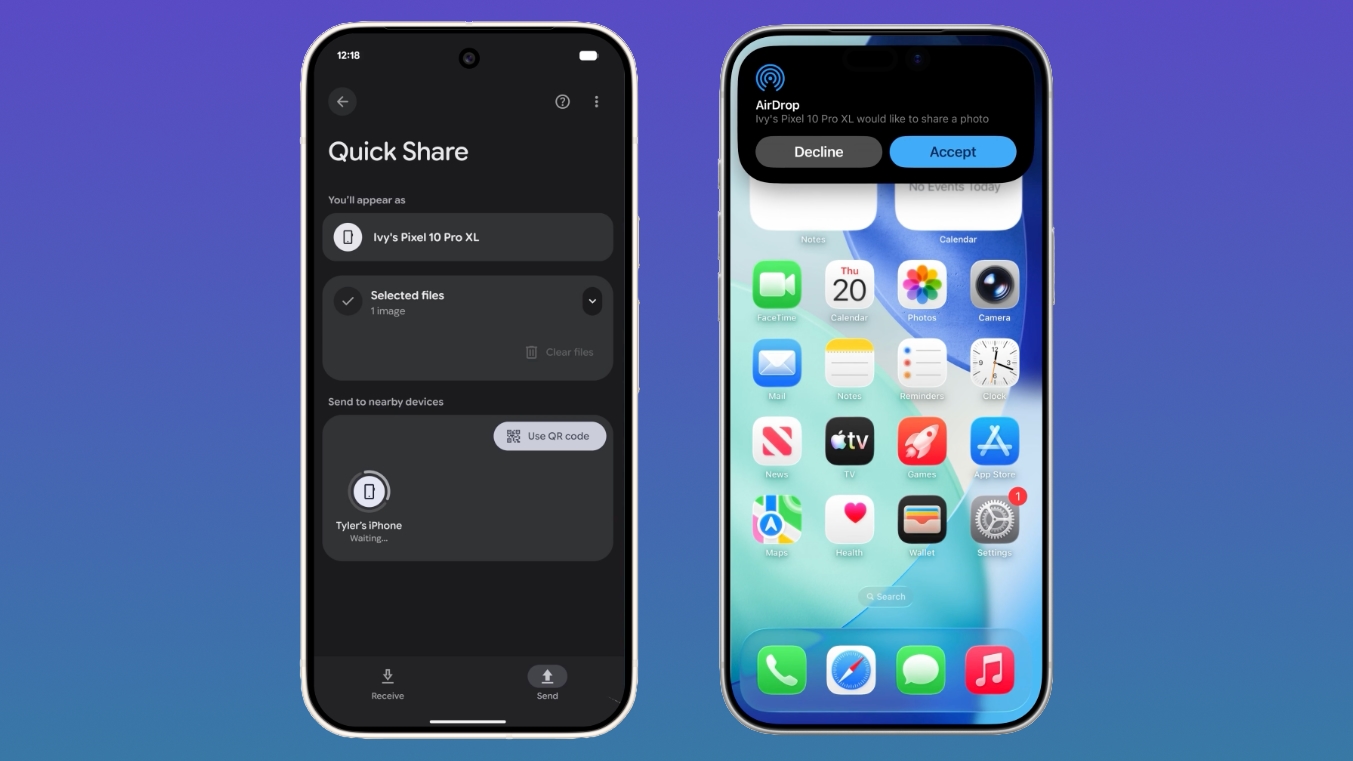
android-iphone-airdrop-quickshare.jpg

"Last year, we launched AirDrop interoperability," said Eric Kay, vice president of engineering for the Android platform, speaking during a recent Pixel Labs tour at Google's Taipei office. "In 2026, we're going to be expanding it to a lot more devices."
"We spent a lot of time and energy to make sure that we could build something that was compatible not only with iPhone but iPads and Macs. Now that we've proven it out, we're working with our partners to expand it into the rest of the ecosystem, and you should see some exciting announcements coming very soon," he added.
The comments were reported by Android Authority's Adamya Sharma, who attended the press briefing.

The file sharing option currently works on Apple devices including ‌iPhone‌, iPad, and Mac, along with the Pixel 10, Pixel 10 Pro, Pixel 10 Pro XL, and Pixel 10 Fold.

Google has not said which specific devices are next in line to get the AirDrop interoperability via Quick Share, but Sharma notes that Kay's comments strongly suggest it will no longer be a Pixel-exclusive feature.

Technical aspects of Google's implementation also appear to signal its intent. Rather than tying AirDrop interoperability to a Pixel-only system component, Google enabled the feature by turning the Quick Share extension from a stub system app into a full APK distributed via the Play Store.

This change makes the feature easier to update and deploy across different manufacturers' devices, strongly indicating that AirDrop interoperability is intended to become a broader Android feature rather than remain limited to Pixel hardware.

Indeed, Nothing has already confirmed that it is working to bring the feature to its phones, while Qualcomm has recently hinted that it also has Quick Share–AirDrop interoperability support in development for Snapdragon-powered phones.

Google says the Quick Share-AirDrop interoperability uses a multi-layered security model, including an encrypted transfer channel, built-in platform protections on both Android and iOS, and an explicit consent step before any file is received.

Currently, the feature only works in the "Everyone for 10 Minutes" AirDrop and Quick Share sharing modes, but Google says that it would like to work with Apple to support "Contacts Only" mode in the future.

Article Link: AirDrop-Quick Share Interoperability Expanding to More Android Phones
 
Last edited:
Good. In the old days Apple would have been a commital member of an industry standards consortium to get this to more products like they were with WiFi and USB-C.

The current edition of Apple would have had to have been told by the EU to release iTunes for Windows rather than seeing it as a sensible business decision.
 
What about older pixels? I have a 9a with a M1 MacBook Air. It would be good to have this feature working
 
Good. In the old days Apple would have been a commital member of an industry standards consortium to get this to more products like they were with WiFi and USB-C.

The current edition of Apple would have had to have been told by the EU to release iTunes for Windows rather than seeing it as a sensible business decision.
Then, it won’t surprise you to know that Apple contributed elements of its AWDL technology to the Wi-Fi Alliance, which helped form the basis of the Neighbor Awareness Networking (NAN) standard, branded as "Wi-Fi Aware". So, it’s been out there.

The current edition of Apple would have had to have been told by the EU to release iTunes for Windows rather than seeing it as a sensible business decision.
The current edition of the EU would have forbidden Apple to release iTunes for Windows as they have a monopoly on iTunes OR would have forced them to make FairPlay available to everyone for free. 🙂
 
  • Like
Reactions: Sergio The One
Google says the Quick Share-AirDrop interoperability uses a multi-layered security model, including an encrypted transfer channel, built-in platform protections on both Android and iOS, and an explicit consent step before any file is received.
I’m guessing that this is why no vendor has bothered to adopt it previously as it requires additional levels of security that every iPhone has, but most Android phones don’t ship with, (Pixels do). Wondering if the announcements will be around new devices specifically?
 
AirDrop needs its industry standard moment. Further, AirDrop should also work in brining two phones close together cross-platform with a quick pop-up sharing list including sending cash, making sending money cross-platform to any smartphone in person as easy as possible. This feature should also take into account what's on screen on each phone, putting it at the top of the share list, allowing for easy sharing of a photo, your contact, or whatever you might have on screen. Scroll down the list for more sharing options. This sharing method should be second nature for in person close proximity sharing of data, with quick face or finger print authentication. There may be some security concerns regarding the simplicity, but these are secondary to be handled by counties, states and law enforcement. There are ways of tracking back to whom shared with whom should the need arise. The feature can also work ad-hoc without phones close by within a certain rage from a menu as we see today (but standard cross-platform).
 
Last edited:
Google doing Apple’s work once more…
Maybe Apple is not legally allowed to open AirDrop due to patent issues just like FaceTime.

Jobs originally announced FaceTime will be an open standard and it was pure p2p. That got patent trolled and we all know what happened after.

Now Apple has not involved into this AirDrop interoperability implementation they are free of any possible legal actions.
 
  • Like
Reactions: chazwatson
EU didn't have anything to do with this. Google did it on their own, and Apple doesn't seem to be (publicly) bothered by it.
How do you know it wasn’t pressure on them caused by the EU, like them adding RCS support? Why now, if there wasn’t some outside influence?
 
How do you know it wasn’t pressure on them caused by the EU, like them adding RCS support? Why now, if there wasn’t some outside influence?

Outside pressure on whom? Google created this (and detailed how they did it), with Apple playing no part..they haven't even commented on it. At best, Apple hasn't "fixed" the issue, because they are under the microscope around the world. Google, more-or-less, reverse engineered AirDrop.

RCS was added because China passed a rule requiring it for all 5g-capable phones to be sold in their country, no exceptions. It wasn't the EU.
 
Last edited:
Outside pressure on whom? Google created this (and detailed how they did it), with Apple playing no part..they haven't even commented on it. At best, Apple hasn't "fixed" the issue, because they are under the microscope around the world. Google, more-or-less, reverse engineered AirDrop.

RCS was added because China passed a rule requiring it for all 5g-capable phones to be sold in their country, no exceptions. It wasn't the EU.
Maybe because Apple isn’t suing them into oblivion? They should care a great deal but their silence speaks volumes
 
Maybe because Apple isn’t suing them into oblivion? They should care a great deal but their silence speaks volumes

What are they going to sue for? Google didn't do anything illegal, nor did they breach any contracts, agreements or regulation. Also, Apple isn't going to sue their golden goose "into oblivion"...don't forget that Google cuts them a $20billion/year check, for doing absolutely nothing, except setting a default search engine.

As I said above, Apple not fixing the issue, if that is even possible, is the best show of countries including, but not limited to the EU, putting pressure on them. Apple is skating on thin-ice around the world, not just in the EU.
 
Last edited:
AirDrop needs its industry standard moment. Further, AirDrop should also work in brining two phones close together cross-platform with a quick pop-up sharing list including sending cash, making sending money cross-platform to any smartphone in person as easy as possible. This feature should also take into account what's on screen on each phone, putting it at the top of the share list, allowing for easy sharing of a photo, your contact, or whatever you might have on screen. Scroll down the list for more sharing options. This sharing method should be second nature for in person close proximity sharing of data, with quick face or finger print authentication. There may be some security concerns regarding the simplicity, but these are secondary to be handled by counties, states and law enforcement. There are ways of tracking back to whom shared with whom should the need arise. The feature can also work ad-hoc without phones close by within a certain rage from a menu as we see today (but standard cross-platform).
Apple DID submit the underlying tech to the Wi-Fi Alliance a long time ago.
 
What are they going to sue for? Google didn't do anything illegal, nor did they breach any contracts, agreements or regulation. Also, Apple isn't going to sue their golden goose "into oblivion"...don't forget that Google cuts them a $20billion/year check, for doing absolutely nothing, except setting a default search engine.

As I said above, Apple not fixing the issue, if that is even possible, is the best show of countries including, but not limited to the EU, putting pressure on them. Apple is skating on thin-ice around the world, not just in the EU.
Something something walled garden?

Anyway I agree, and it’s absolutely pressure from someone causing this. I vote EU
 
Maybe because Apple isn’t suing them into oblivion? They should care a great deal but their silence speaks volumes
They’re not suing because Google are just using the technology that Apple submitted to the Wi-Fi Alliance awhile back. A lot of what we do wirelessly today is because Apple’s been developing and submitting tech to standards bodies so that, with a solution readily available for use by anyone, that coincidentally works with Apple devices, companies will build devices that include support for Apple. Self-serving, absolutely, but it still ends up with better wireless functionality for everyone.
 
  • Like
Reactions: CarAnalogy
Apple DID submit the underlying tech to the Wi-Fi Alliance a long time ago.
Interesting. My LLM convo just now. Finger crossed.
Short answer: If it happens, likely 2027–2029 — and only if Apple and Google fully align.
The technical pieces (Wi-Fi Aware, NFC, UWB, EU pressure) are falling into place, but a true cross-platform tap-to-share standard would require coordinated rollout and UX agreement.

It’s possible within a few years — but not guaranteed.
Smartphone users would benefit greatly from a standardized tap-to-share. One can hope instant cash sending and on-screen awareness are included as part of said hypothetical tap-to-share standard. Sending cash or a digital photo should be easy like giving physical cash or a physical photo. Here > done.
 
Last edited:
EU didn't have anything to do with this. Google did it on their own, and Apple doesn't seem to be (publicly) bothered by it.
Yeah we can just pretend the EU had zero impact due to prior interactions and current and developing legal precedent. Let’s go with that.
 
Yeah we can just pretend the EU had zero impact due to prior interactions and current and developing legal precedent. Let’s go with that.

I didn't say that zero impact, but they didn't affect the RCS decision. That was China, and it's been well documented and reported:


The current edition of the EU would have forbidden Apple to release iTunes for Windows as they have a monopoly on iTunes OR would have forced them to make FairPlay available to everyone for free. 🙂
I get your second paragraph is supposed to be sacrascm, but it’s the exact opposite. The EU is trying to end proprietary hardware (lightning) and software with the Digital Markets Act (DMA). It wants interoperability (which putting iTunes on Windows does) and ceases being proprietary.
 
  • Like
Reactions: System603
I didn't say that zero impact, but they didn't affect the RCS decision. That was China, and it's been well documented and reported:


How does airdrop have to do with RCS?
 
Register on MacRumors! This sidebar will go away, and you'll see fewer ads.