Become a MacRumors Supporter for $50/year with no ads, ability to filter front page stories, and private forums.
Well, the fact that my 2019 Mac Pro with a 400$ GPU still outperforms the M3 Ultra with 80-Cores says enough about how well Apple Silicon GPUs are. They're not.

I'm not trying to get into benchmarkology, but, is there a particular well-known benchmark that reflects your own requirements? How fast is your (model?) GPU on this benchmark compared to the M3 with 80 cores? What is it that the Mx GPU graphics is slow at?
 
Why bother when 3rd parties are going to do it? Apple doing a Thunderbolt enclosure would only inhibit drawing more players to fill that role.

You completely misunderstood.

I explicitly do not want an additional external box (with an additional likely super-noisy fan) with an additional power brick and additional power cable and additional connection cable between the Mac and that external box.

All must be one single box. Exactly like with a Mac Pro. No external power bricks and just one power cable for the Mac and all. Otherwise you are comparing Apples with Oranges. Or a large truck with a sedan plus car trailer if you like - not the same thing at all.

For the Mac Studio this means either an enclosure "extension" that merges flawlessly with the core Mac Studio into one solid tower unit (with additional internal power supply, PCI and HDD slots and all internal power connections).

Or Apple offers the Mac Studio in two sizes, with and without PCI + HDD internal extensions.


SSDs did come down in $/TB. Apple never priced their own that way. They kept the $/TB the same and used storage to pad margins. HDDs have disappeared from most consumer PC devices.

Really? Last I looked 3.5" internal HDDs come in sizes up to 28 TB (!) quite readily available for $600.
While SSDs have been stuck for years at 8 TB for $1,600 or more.

People who deal with a lot of media files, cannot use meager 8 TB HDs. Far too little. You take as much storage as you can get.
And if you want it all internally, then 4 x 28 TB = 112 TB is a godsent. Apart from the fact that 112 TB in SSDs would still break the bank for most people.
SSDs have not really come down in price. Not as much as people had projected they would 10 years ago.


And I am not even talking about backing up all this data. Including off-site backups.
For that purpose 3.5" HDDs are still the way to go. And most internal HDD systems these days come with easy caddy-style mounts, some even hot-swappable.

That's the kind of tech that (ex) Mac Pro users want.
 
Last edited:
Since Apple Silicon does not allow GPU upgrades, the Mac Pro was pointless at $7,000. You knew it was doomed when Apple abandoned it with the M2 Ultra.
Well, there was a point if you, for example, have a rack full of audio equipment in a recording studio and you want a neatly mountable Mac with PCIe slots for your audio cards and SSD. But this is pretty much the only use case where it makes sense.
It offered everything that a minitower should offer. It fixed everything wrong with the 2013 Trashcan. But, Apple did jack up the price on that one too, starting at $5K. Twice as much as the previous Mac Pro, just for Jony Ive's design.
But it wasn't a minitower, it was ...an Iveorytower.
The $800 wheels just proved how out of touch Jony Ive was with reality. Apple's best Pro desktops were the Power Mac G3, G4, G5, and 2006 to 2012 Intel Mac Pros. Apple Silicon Macs are blazing fast and efficient, but a big zero for expansion capabilities.
100% 👍🏼 (I still have the most beautiful tower ever produced, the PowerMac G4 MDD, in a closet somewhere)

I think the rational thing to do is manufacture a 19" rack mounted PCIe enclosure (with 5-6 card slots) and a slot for a Mac Studio. Fitted with some baffles and large, quiet fans. A sleek, aluminium front panel where the Studio front is exposed for easy access to ports and SD card slot. Sadly, the market for such a product is probably in the dozen units. 😅
 
I explicitly do not want an additional external box (with an additional likely super-noisy fan) with an additional power brick and additional power cable and additional connection cable between the Mac and that external box.

All must be one single box.

For storage, or, for other connections? I understand the attraction of having a superfast large RAID internal. But, I don't see how this works with, e.g., analog audio. If there are a hundred mics somewhere, there are going to be messy cables connecting them somewhere. I assume that you don't have 100 mic ports on PCI boards? Maybe you could post a picture of what your setup looks like?

And if you want it all internally, then 4 x 28 TB = 112 TB is a godsent. Apart from the fact that 112 TB in SSDs would still break the bank for most people.

112TB. Going once, going twice, ... How is this structured now? As a single RAID0 ? How fast is it?
 
For storage, or, for other connections? I understand the attraction of having a superfast large RAID internal. But, I don't see how this works with, e.g., analog audio. If there are a hundred mics somewhere, there are going to be messy cables connecting them somewhere. I assume that you don't have 100 mic ports on PCI boards? Maybe you could post a picture of what your setup looks like?

112TB. Going once, going twice, ... How is this structured now? As a single RAID0 ? How fast is it?

I used my Mac Pro mainly for 3D computer graphics. Not for audio. No mic ports involved.

I have tons and tons and tons of very large render files (multi-layer .exr files) that need storage and preservation. Plus Final Cut Pro / After Effects / Maya / Blender / Houdini / Nuke projects.

The HDDs are not really about speed. You use the fastest internal SSDs as your primary work area, 8 TB is fine here, and the largest 3.5" HDDs you can find for project storage and backups.
2 HDD bays in a RAID0 or even JBOD is fine for current and most recent project storage, plus another 2 HDD bays, preferably easily swappable, for backups, archiving and off-site backups.
 
Jonathan Ive probably met his design brief to make slick & futuristic hardware,

Good design, in Apple's products context, focuses on making things better for the user, not how cool it looked.

the engineering side dragged their feet with hot & slow Intel.

Alternatively, the designers failed to take into account limitations with the avaiable existing technology in making their design decisions.

All of Ive’s designs are before their time.

I'm sure he won an award.

If Apple and Nvidia both pulled their heads out of their asses they could make some of the best desktop workstations, but well.

Apple isn't really interested in that market, it's not where the money is for them; for a number of reasons. For example:

  • It's a small market so there isn't a lot of profit and there are a number of entrenched competitors
  • It often requires specialized software that may not exist for MacOS
  • Workstation buyers are unlikely to buy other things in Apple's ecosystem such s subscription and storage options
Apple likely feels the Studio and existing software is best tailored for markets they target, so a workstation is just a waste of resources.
 
The rift with Nvidia is what killed the Mac Pro more than anything else.
I think this was the first nail in the coffin.

But the second and IMHO even bigger nail was Apple Silicon, as it does not allow for CPU, RAM or GPU upgrades.

Everything now is prepackaged and no longer user-upgradable. Which was the big draw of the original Mac Pro. Start out with your minimum RAM and GPU and upgrade later depending on needs. Some even upgraded their CPUs.

Now you have to spend top $$$ for the highest configuration, as it is no longer upgradable later - which is the opposite of what you want when you are starting out with a new business.
For start-ups it is preferable to get the smallest possible system, and upgrade it later for a reasonable investment if more business comes in.
Buying a new Mac Studio every time you need to upgrade your system, even when returning the old one for some cash back, is not a reasonable investment path for startup businesses. At least in my opinion.
 
Last edited:
Well, the fact that my 2019 Mac Pro with a 400$ GPU still outperforms the M3 Ultra with 80-Cores says enough about how well Apple Silicon GPUs are. They're not.

If Apple and Nvidia both pulled their heads out of their asses they could make some of the best desktop workstations, but well.


I still do not understand why Apple has this obsession with making things "efficient". Like sure, it makes sense on a battery powered MacBook, but I really don't care about efficiency or power usage on a 10,000$ desktop.

It doesn't really matter if you consider it old or not, the M3 Ultra will be prefectly fine for normal users for the next 10 years. And if had a way to install Linux on these, they would be good to go for probably the next 30 years.
I understand your point of view. ARM based SoC changed all working hardware workflow. Personally i have macmini with M4 Pro and it's more than enough. For be true, for more most diary tasks that i do actually: use of browser, email, office, sublimetext, and 4K movies simple edition (iMovie), even a base M2 or M3 are more than enough. And i believe for most people are the same. For having speed storage thunderbolt external drives are capable. The only thing that internal GPU's M chips are not full capable it's for games. For that, every time i try in a windows or linux computers with external PCI GPU's (nvidia or Radeon) not even are close to playstation 5 experience.
 
The rift with Nvidia is what killed the Mac Pro more than anything else.

I think this was the first nail in the coffin.

Admittedly a side issue, but, Apple has used both Nvidia and AMD over the years. In 2011-2013 or whatever it was, I fried one each of Nvidia and AMD in MBPs. Today's GPUs are 4x (?) as fast in mixed graphics and orders of magnitude faster for certain things than the AMD GPUs used in the "trash can" Pro. So, what is the big deal with Nvidia per se? It seems to me that the real problem with a Pro model with lots of PCIe slots is the drivers (&etc software) issue. It has been a problem with Windows since forever. Company X builds a card, a programmer writes drivers, moves on, moves elsewhere, the OS evolves, and eventually the card stops working right, and everyone looks to M$ or Apple to fix it. Anybody can build a card in their garage and write drivers. But, who is going to support that over ten years?
 
  • Like
Reactions: turbineseaplane
The rift with Nvidia is what killed the Mac Pro more than anything else.

My theory is that Apple didn't want CUDA on the platform, or cross-platform Pro apps would have used it in preference to Metal, which would then never take off. Worse, Nvidia would have Apple over a barrel, since any Pro Mac would essentially require an Nvidia GPU. Plus, as the underdog, AMD could be squeezed for discounts in a way that Nvidia couldn't. Mac customers take what they're given, so Apple keeps the $$.

I know everyone thinks it comes down to do some dodgy MBP GPUs in 2007, but that affected other PC OEMs too, and everyone else moved past it. That's what lawyers are for.
 
  • Like
Reactions: turbineseaplane
I still do not understand why Apple has this obsession with making things "efficient". Like sure, it makes sense on a battery powered MacBook, but I really don't care about efficiency or power usage on a 10,000$ desktop.
Many companies are using laptops only now and the vast majority of sales for personal use are laptops. The desktop is basically dead for home use, laptops are that good now. Why would Apple spend the $ on configurable desktops (Mac Pro) when it doesn't sell in good enough numbers to make any money on it? They're a FOR profit business, not a charity. Money is all in portables so this is why they focus so much on power efficiency.
 
Apple isn't really interested in that market, it's not where the money is for them; for a number of reasons. For example:

  • It's a small market so there isn't a lot of profit and there are a number of entrenched competitors
  • It often requires specialized software that may not exist for MacOS
  • Workstation buyers are unlikely to buy other things in Apple's ecosystem such s subscription and storage options
Apple likely feels the Studio and existing software is best tailored for markets they target, so a workstation is just a waste of resources.

Also: Apple Silicon is way outside its comfort zone in this scenario. Being iPhone-derived, it excels at power efficient mobile usage. It's just not built for loads of PCIe lanes, PCIe GPUs etc. Sure, Apple could make an AS-based chip that was, but that would be a completely custom design for a tiny subset of users. It makes much better business sense to just let these Mac users go elsewhere.
 
I still have my 2004 Power Mac G5 and companion Apple Display. Still boots up and fully functions as a 2004 Apple product. I can’t part with it. I now consider it a historical piece of technological art.
 
The $800 wheels just proved how out of touch Jony Ive was with reality. Apple's best Pro desktops were the Power Mac G3, G4, G5, and 2006 to 2012 Intel Mac Pros.
The 2012 Intel Mac Pro's have to be some of THE best aging Macs out there. There are still plenty of people that still use them to this day. I mean, just look at the Mac Pro forums.
Although the 800$ wheels (which I have right next to me on my Mac Pro) were not out of touch. It was simply a way of Apple making sure that they are still somewhat considered a "luxury" or "premium" brand.

While SSDs have been stuck for years at 8 TB for $1,600 or more.
Really, is that in the US? I can get an 8TB NVMe in Germany for around 1,000$ give or take.

That's the kind of tech that (ex) Mac Pro users want.
Exactly. I do not want a billion cables and power supplys and adaptors and all that stuff. My Mac Pro in its current form has everything I need, completely built in.

The rift with Nvidia is what killed the Mac Pro more than anything else.
True. I still do not understand this arrogance that both of them have. A Mac Pro, capable of running the latest Nvidia and AMD GPUs AND being able to run Bootcamp again would almost certainly sell very well.

Good design, in Apple's products context, focuses on making things better for the user, not how cool it looked.


Alternatively, the designers failed to take into account limitations with the avaiable existing technology in making their design decisions.


I'm sure he won an award.


Apple isn't really interested in that market, it's not where the money is for them; for a number of reasons. For example:

  • It's a small market so there isn't a lot of profit and there are a number of entrenched competitors
  • It often requires specialized software that may not exist for MacOS
  • Workstation buyers are unlikely to buy other things in Apple's ecosystem such s subscription and storage options
Apple likely feels the Studio and existing software is best tailored for markets they target, so a workstation is just a waste of resources.
I mean, the Studio IS a workstation. That did not need to exist I may add, I still don't get the appeal of a Mac Studio to other professionals. Is it the size? Because I really don't know what kind off professional user cares that much about the size of their system.

I understand your point of view. ARM based SoC changed all working hardware workflow. Personally i have macmini with M4 Pro and it's more than enough. For be true, for more most diary tasks that i do actually: use of browser, email, office, sublimetext, and 4K movies simple edition (iMovie), even a base M2 or M3 are more than enough. And i believe for most people are the same. For having speed storage thunderbolt external drives are capable. The only thing that internal GPU's M chips are not full capable it's for games. For that, every time i try in a windows or linux computers with external PCI GPU's (nvidia or Radeon) not even are close to playstation 5 experience.
Yes. My dad's employees were still using iMac M1's until around two weeks ago, when we replaced them with Mac mini M4s. The performance is incredible.
I just despise how limited it is. No upgrades (except SSDs on the Studio and Mini), no expandability, no Bootcamp (Windows) anymore, no Linux except for like very few models, no GPUs. It is all soldered.
It was just great when I could buy a brand-new iMac Pro and then upgrade it later as my workload increased.
Well, maybe the EU will someday make a new legislation that forces Apple to make their Macs upgradeable. THey already did that with batterie replacements and USB-C, so it's not that far-fetched.
 
  • Like
Reactions: turbineseaplane
It was just great when I could buy a brand-new iMac Pro and then upgrade it later as my workload increased.
Well, maybe the EU will someday make a new legislation that forces Apple to make their Macs upgradeable. THey already did that with batterie replacements and USB-C, so it's not that far-fetched.

Dude, just buy a Dell (or any other PC)!
 
  • Disagree
Reactions: Rokkus76
I understand your point of view. ARM based SoC changed all working hardware workflow. Personally i have macmini with M4 Pro and it's more than enough. For be true, for more most diary tasks that i do actually: use of browser, email, office, sublimetext, and 4K movies simple edition (iMovie), even a base M2 or M3 are more than enough. And i believe for most people are the same. For having speed storage thunderbolt external drives are capable. The only thing that internal GPU's M chips are not full capable it's for games. For that, every time i try in a windows or linux computers with external PCI GPU's (nvidia or Radeon) not even are close to playstation 5 experience.
Oh and about the gaming aspect, Apple killed this huge piece of marketshare (if they could bring gamers, which are quite a lot, to Mac) all by themselves. I may list:

  1. Not making an equivalent to Proton found on Linux
  2. Banning Epic Games developer account because their own greed could not accept the fact that some devs don't wanna pay 30% to them.
  3. Not making Macs repair- and upgradeable
  4. Dropping support for 32-bit titles, effectively killing a whole lot of huge games, such as GTA San Andreas and Call of Duty.
  5. macOS not supporting Vulkan
  6. And well, the most obvious ones, no eGPU support and removing Bootcamp entirely.

But hey, at least they presented Assassin's Creed Shadows at WWDC, which is so insanely unoptimized that it's not even funny anymore lmao
 
However, what I did not understand is what the hell Apple was thinking in 2023. The Mac Pro still had such insane potential, they could have released an M2 Extreme version, or combined two M2 Ultras, or give it like 512/1024GB of unified memory for the ever growing AI industry.

But instead, they completely **** the bed. They basically put the Studio in a big case, and gave it PCIe slots. That's 3,000$ extra for ya.

So obviously nobody bought it, because why would anyone?? It is the first Mac Pro that was completely non-upgradeable, it only had 192GB of unified memory compared to the Intel MP, even though they had more than enough space for more memory. And if they did price it on par with the Mac Studio, I'm almost certain it would have sold better than the Studio.

I don't understand why they didn't repurpose the Mac Pro for AI. There are lots of people in AI now building Mac Studio "clusters", so the market would absolutely be there for an AI supercomputer that would be even more powerful than the Mac Studio.

I don't understand this decision. Why did they even release the Mac Pro in 2023 in the way they did? If they were planning on killing it off anyways, why bother bringing it over to Apple Silicion?

They just kept the Mac Pro around because Apple had commitment for U.S. investment so they picked a low yield ultra high end computer like the Mac Pro which was built in Texas and now they are going to build Mac Minis which coincides at the same time the Mac Pro is killed off. https://www.apple.com/newsroom/2026/02/apple-accelerates-us-manufacturing-with-mac-mini-production/


M2 Extreme version would have been too much money to produce which is why they scrapped it. Apple was having enough issues trying to keep up demands as it was with their chips so its much more complex than most people realize; "M2 Extreme chip was facing production complexity challenges and cost concerns. By not going forward with it, it also frees up silicon fab TSMC to use the chip production capacity on higher-volume chips for mainstream Apple products."


Trust me Apple definitely would have done it as a halo product to show off at WWDC if it was reasonable enough. Apple will keep pro products around if they can use them for marketing which is why the 2013/2019 Mac Pro and 32" Pro Display XDR existed....these were products that were shown to a massive audience where 99%+ of the people were never going to buy them but they made news headlines all over the place. I remember the 2019 Mac Pro was water cooler talk at company at the time which is all Windows/Linux. No one had any attentions of buying it but people were talking about it because it was cool to spec out a $50,000 computer.


Now Apple Silicon has killed this off since in order to get these 'super chips' they can't just order some workstation stuff from Intel. Apple now has to produce this themselves and they clearly are seeing there are too many issues trying to pull it off as mentioned earlier about how that silicon fab TSMC would impact their other chips.


It would have been nice if they just would have some how kept the Mac Pro with the same chips as the Studio just to keep their foot in the door for pro workstation users even if it didn't sell much at all but like I mentioned earlier if Apple can't utilize it for marketing then they don't have much use for it at all.
 
This little bit of of huge computer news (apple no longer selling overpowered desktop computers) comes about a week after they released a laptop driven by a phone.

Apple no longer sells dedicated power computers, but their best selling new laptop is literally a phone.

It's enough to make you want to smoke marijuana.
 
  • Sad
Reactions: wyliej
I used my Mac Pro mainly for 3D computer graphics. Not for audio. No mic ports involved.

I have tons and tons and tons of very large render files (multi-layer .exr files) that need storage and preservation. Plus Final Cut Pro / After Effects / Maya / Blender / Houdini / Nuke projects.

The HDDs are not really about speed. You use the fastest internal SSDs as your primary work area, 8 TB is fine here, and the largest 3.5" HDDs you can find for project storage and backups.
2 HDD bays in a RAID0 or even JBOD is fine for current and most recent project storage, plus another 2 HDD bays, preferably easily swappable, for backups, archiving and off-site backups.

Exactly. I do not want a billion cables and power supplys and adaptors and all that stuff. My Mac Pro in its current form has everything I need, completely built in.

I'm not trying to be argumentative. Seriously. But, is it really that annoying to have one enclosure with 10-100 TB of storage and one TB4/5 cable? Or, how about 100 GbE NAS?

I did the tower thing for a long time, but, one or two boxes seem pretty manageable. Granted, there is the Parallels/VM/Windows/Linux thing, but, when everything is ARM instead of x86, maybe we can have all that back again if we want it. Or, just run the old stuff on some of the old, hot, x86 stuff we all have lying around. A bonus is that it warms your room in the winter, too. In the meantime, I like my cool, quiet, ARM-based stuff that is replacing the hot, noisy, inefficient x86 stuff. It didn't have to be ARM, it could have been some other of the RISCs, including PPC, but, ARM is what stuck.
 
Last edited:
Apple discontinuing the 2023 Mac Pro without a follow-up makes them having announced it to begin with all the more puzzling. If you weren't going to update the damn thing, and you weren't going to charge a more competitive price, let alone charge $3000 over the Mac Studio equivalent and only provide PCIe slots that can't accomodate GPU boosts or upgrades and two extra Thunderbolt ports as a feature bump, then what the hell were you even releasing it for?

There were better ways to market that Mac such that folks would want to buy it and they just...didn't do it.

If Apple had planned to move to an M5 Extreme or some other upper tier Mac SoC, the M2 Ultra Mac Pro would've made some sense as a transition product. But to be the last one? It was a lame note to end on and I think it would've made way more sense to just end it with the 2019 model; especially if the whole idea is that the Mac Studio is the future. Hell, they could've launched the Mac Studio with a Thunderbolt breakout box, left the 2019 Mac Pro to be sold up until 2024 and then cut it off there and it would've made way more sense.

Now that we know how the Mac Pro's story ends, it really deserved better writing.
I am assuming the Extreme chip that never happened was also planned to have a way to properly integrate PCI Graphics cards but it never ended up happening.

So they ended up having to release a hamstrung tower, which had poor sales, and even by M5 had not solved (or had given up on solving) the Extreme problem.

While chip companies can create extreme chips for bragging rights and proof of concept, Apple as a holistic company can’t devote the resources to that. Chip companies can also continue to sell previous generation chips for a very long time because they are profitable and somebody wants them, Apple has a limited window to have their partners manufacture their chips. They can’t make the M1 forever or the M2 Ultra, or the A16, or whatever and they can’t waste production on low yield chips either.


Apple has discontinued the Mac Pro and has removed the machine from its website, reports 9to5Mac. Apple said it does not plan to design a new version of the Mac Pro, and no new model will be coming in the future.

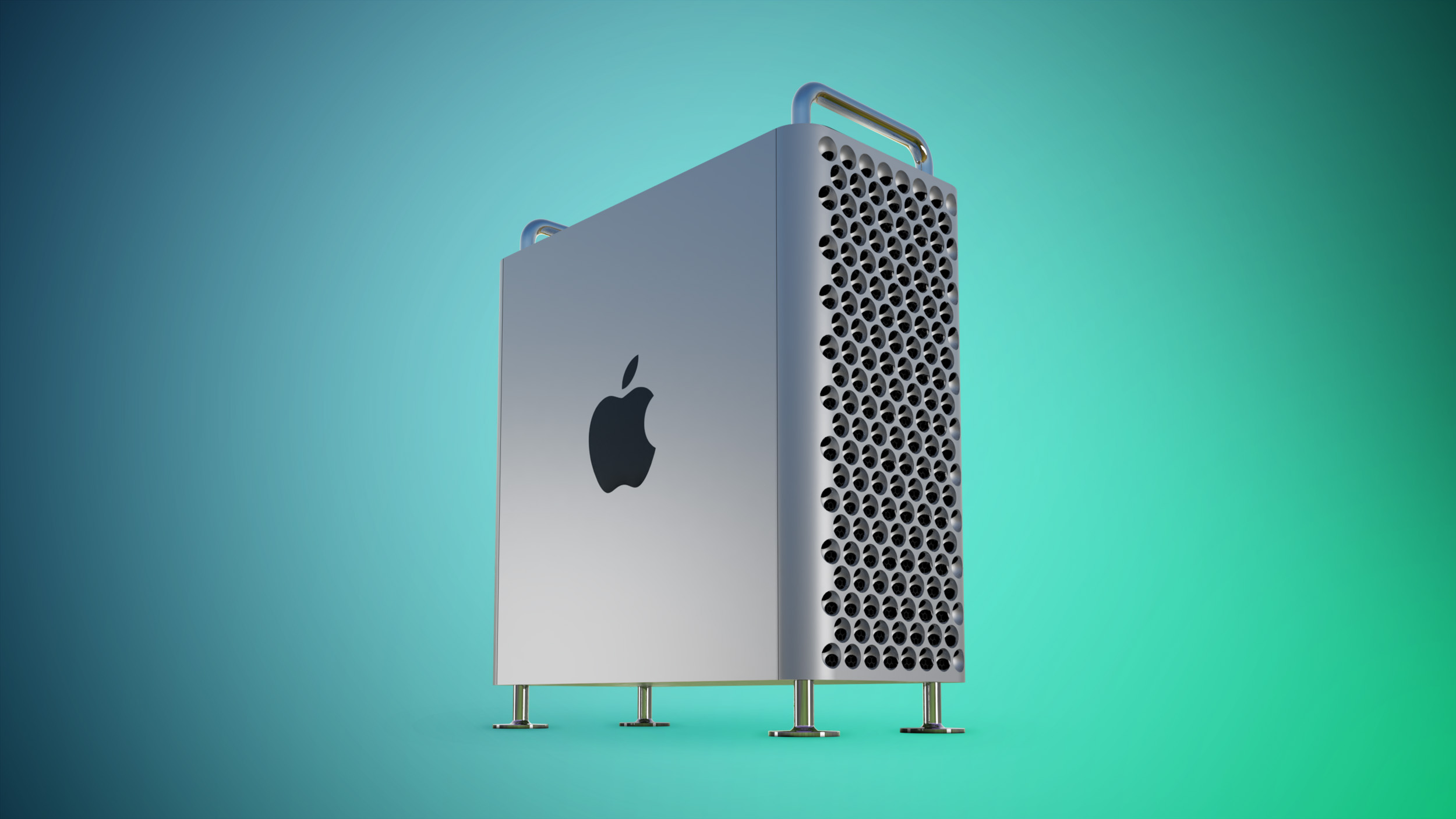
Mac-Pro-Feature-Teal.jpg

The Mac Pro was last updated in 2023, which was when Apple added an M2 Ultra Apple silicon chip, but the chassis has not been refreshed since 2019. Apple redesigned the Mac Pro to be more modular in 2019 after failing with its "innovative" trashcan Mac Pro, but the machine has never been mainstream due to its $6,999 starting price.

Apple has largely replaced the Mac Pro with the Mac Studio, a device that is smaller and uses newer Apple silicon chips. The Mac Studio is now Apple's high-end desktop machine designed for professional use.

The current Mac Studio features an M3 Ultra chip, though it is expected to get an M5 Ultra refresh later this year. Apple's desktop lineup also includes the Mac mini and the iMac.

The Mac Pro's downfall started in 2013 when Apple introduced a radical cylindrical design that turned out to be a major mistake. The Mac Pro's components were mounted around a central thermal dissipation core and cooled with a single fan that pulled air from under the case, through the core, and out of the top of the machine. It was quiet, but not efficient.

When Apple announced the 2013 Mac Pro, Phil Schiller infamously said "Can't innovate anymore, my ass," in response to critics who complained about the Mac Pro's lack of updates and Apple's failure to create products for pro users.

Unfortunately, the 2013 Mac Pro's design did not include PCIe expansion slots for graphics cards and other hardware, with expansion handled through Thunderbolt 2 ports. The design also did not account for future updates in GPU technology, leaving Apple unable to add larger graphics cards and other components to the device.

Apple ended up apologizing to its pro user base and said the 2013 design was thermally constrained in a way that made upgrades impossible. It took Apple until 2019 to unveil the current Mac Pro, which adopted a more standard tower form factor with eight PCIe slots.

After the 2019 launch, the Mac Pro got an Apple silicon chip in 2023, and that's it. There have been three Mac Pro updates in the last 13 years, so it's not surprising to see the Mac Pro retired. The Mac Studio offers almost all of the same capabilities as the Mac Pro, with the exception of PCIe expansion slots.

Article Link: Apple Confirms Mac Pro Is Dead, No Future Models Planned

I'm thinking it may be an April Fool's joke?
 
Register on MacRumors! This sidebar will go away, and you'll see fewer ads.