

Become a MacRumors Supporter for $50/year with no ads, ability to filter front page stories, and private forums.

MacRumors

macrumors bot
Original poster


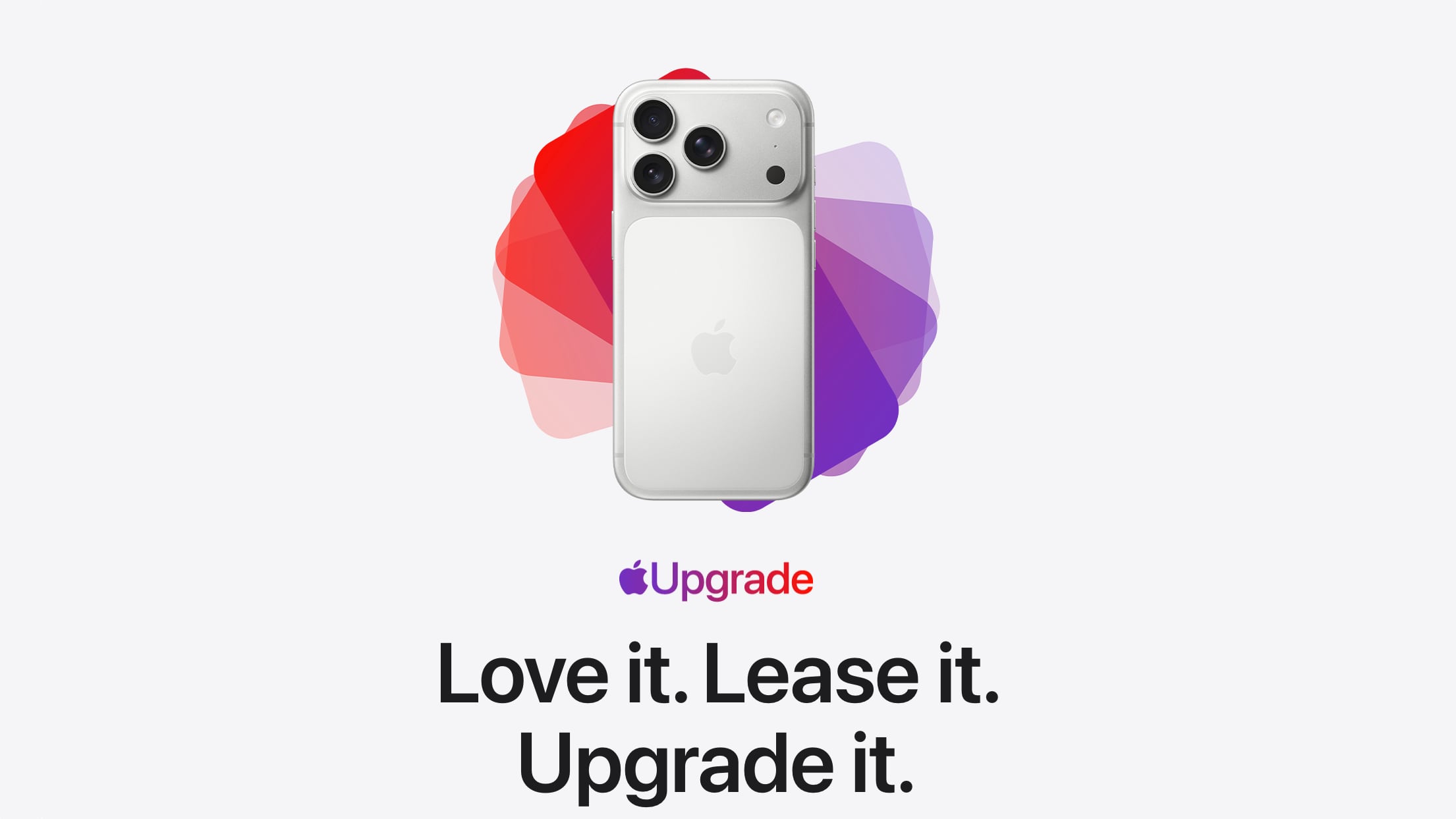
Apple considered a so-called "white-glove" element for its Apple Upgrade leasing program that would have delivered each new replacement device already loaded with the customer's data, but the idea never made it out of planning, according to Bloomberg's Mark Gurman.
apple-upgrade-program-1.jpg

Apple Upgrade launched in the U.S. on July 28, replacing the iPhone Upgrade Program and iPhone Payments. The plan lets customers lease an iPhone, iPad, Mac, or Apple Watch rather than buy one outright or pay in installments. iPhone and Apple Watch leases run 12 or 24 months, while Mac and iPad terms are 24 or 36 months. At the end of a term, customers return the device, pay off the balance and keep it, or trade up to a new lease.

In his latest Power On newsletter, Gurman reports that when the concept was first discussed years ago, Apple also weighed the idea of having each year's device arrive at the customer's door ready to use, restored from their iCloud backup before it shipped. The version of Apple Upgrade that was actually launched last month includes nothing of the sort.

Setting up a new iPhone can be a notoriously drawn-out process, and the feature would have removed that step from launch day entirely. Gurman believes however that the privacy optics may have put Apple off the idea.

Gurman says the technical side was never the obstacle. Rather, Apple may have decided the idea of receiving a new iPhone with personal account data pre-installed on it could be unnerving for some customers, provoking questions about how the data was transferred and whether anyone could have accessed it.

Article Link: Apple Dropped Plan to Ship Leased iPhones Already Set Up for Users
 
  • Haha
Reactions: Z-4195
The era of owning nothing is beginning. They also trying hard to normalize shoe box housing (shipping containers turned into "houses" and similar"). Paving the way for all to become worker drones for billionaires owning nothing, keeping their mouth shut.
 
The era of owning nothing is beginning. They also trying hard to normalize shoe box housing (shipping containers turned into "houses" and similar"). Paving the way for all to become worker drones for billionaires owning nothing, keeping their mouth shut.
Those housing shipping containers are bigger than most studio apartments in NYC, I will take it if you give me 3 minimum and stack them nicely.
 
The era of owning nothing is beginning. They also trying hard to normalize shoe box housing (shipping containers turned into "houses" and similar"). Paving the way for all to become worker drones for billionaires owning nothing, keeping their mouth shut.
We are talking about phones when people make hyperbole arguments about the dumbest things, people don't take it serious. If you keep your phone for a long time you can still buy it. How many people upgrade yearly or every other year? For those poeple this maybe a good option for them.
 
Gurman says the technical side was never the obstacle. Rather, Apple may have decided the idea of receiving a new iPhone with personal account data pre-installed on it could be unnerving for some customers, provoking questions about how the data was transferred and whether anyone could have accessed it.
And this is just going to stay here like this?

There are two possibilities:
Either our dice-roller and beloved fortune-teller has once again made something up out of thin air, and it’s the same nonsense we get every few months.

Or Gurman actually knows something that hardly anyone else does: namely, that Apple allows its employees, right down to the lowest support level, to copy and set up versions of user data on other devices.
Not all of which are fully encrypted.

So these lower support levels could also read the data directly.
And with the low salaries Apple pays and the “hire-and-fire” mentality in the U.S.…. I mean, North Korean and Chinese spies are supposedly in every tech company by now.
I’m just saying.

 
I mean it is really easy now.
I guess.

But when I act as tech support for my mother & see iOS through her eyes, I realise how baffling tech still is for anyone other than people who work in tech & tech enthusiasts.

‘Why has everything suddenly gone transparent?

‘Why did it update my iPhone and change it without asking me?’

‘Why have they changed how (features x, y z) work?’

‘Why is feature x in a different place now?’

Etc etc.
 
I’ve setup numerous Macs, iPhones and iPads. If your passwords are in order it’s usually pretty easy. In the past you often had to use your password(s) to activate your email(s) on your new device, but for awhile now you don’t have to do even that if you’re doing a device-to-device transfer with Migration Assistant.

A forgotten Apple Account password isn’t too much of a pain to change. But a forgotten Microsoft or Google password can be a migraine inducing exercise, like drilling your own teeth, to change.

I make a point of telling people that after the data transfer their new device’s desktop/homescreen will look very much like their old one thus making the transition easier and familiar.
 
I thought only we have access to our iCloud data 🧐
In theory, Apple could preinstall the encrypted data despite not having access to the unencrypted content; only when you unlock the device at initial setup would anyone have access to it.

But I'm no expert on cybersecurity and could see how people would be concerned about the integrity of their data.
 
  • Like
Reactions: Stratus Fear
I suspect the chances of botching a data transfer or transferring the wrong data, beyond just privacy concerns, made this unworkable. Imagine getting phone without all your data, or someone else's data and number.

Even if 99.9% of the transfer went through properly, if Apple sold, say a 100 million iPhones, that's still 100,000 botched transfers. Even at 99.99%, that's 10,000, which would be a PR nightmare, even if Apple could fix it.

There'd have to be a way to not use this service if it were real as well, since you may be buy-in one and intending to keep your existing phone as is, so just because Apple has your Apple ID doesn't mean it's a new phone intended otherwise be restored form a backup. If that process glitches and does backup, now you have to undo it before you sett up, and if it auto starts setup, well...

A really bad idea that was rightfully shelved, IMHO.
 
  • Like
Reactions: surferfb
As convenient as it sounds there’s a hint of an icky feeling with the idea that my data is being transferred by someone else
 
Gurman says the technical side was never the obstacle.

Technically this should be impossible because of iCloud's end-to-end encryption. At least if you have Advanced Data Protection enabled, not even Apple can access your iCloud data without your password or recovery key. (Although the UK wants them to add a back door to defeat this). And some items like keychains and passwords are always end-to-end encrypted even without ADP.

But I suppose they would have implemented it by having customers submit their iCloud password as part of the ordering process.
 
But I suppose they would have implemented it by having customers submit their iCloud password as part of the ordering process.
Why? They can just copy the encrypted data onto the phone. It can stay encrypted until the user enters the password to generate the decryption key.

new iPhone with personal account data pre-installed on it could be unnerving for some customers, provoking questions about how the data was transferred and whether anyone could have accessed it.
It really is just a perception problem.

I think that could be easily solved: Just show a 10 second decryption animation after the user enters the password (even though, technically, it would work in an instant). And also make it opt-in on the old phone a few days before.
 
  • Like
Reactions: Stratus Fear
Why? They can just copy the encrypted data onto the phone. It can stay encrypted until the user enters the password to generate the decryption key.

That would be possible. But it would likely just be a huge block of encrypted data that still needs to be processed on the phone to be usable. So the phone would still need to go though some form of setup process, and wouldn't necessarily save much time compared to just downloading the data from iCloud.
 
Apple could obviously easily devise and demonstrate a transfer that would prevent snooping employees. Data privacy in their hands is not a problem.
They won’t be able to ease the risk from theft after it leaves apples hands. A porch pirate would have a device with potentially very valuable information, your data, and one you never even touched.
 
  • Like
Reactions: jlc1978
Another problem would be the time period between Apple copying the data and shipping to your home would leave the device out of sync, so it would need some measure of additional sync anyway. Unless they left a phone turned on and syncing during transit I guess.
 
  • Like
Reactions: chickenpiccata
Register on MacRumors! This sidebar will go away, and you'll see fewer ads.