

Become a MacRumors Supporter for $50/year with no ads, ability to filter front page stories, and private forums.

MacRumors

macrumors bot
Original poster


Apple plans to adopt OLED panels capable of displaying a much wider range of colors, according to a new report from research firm TrendForce.
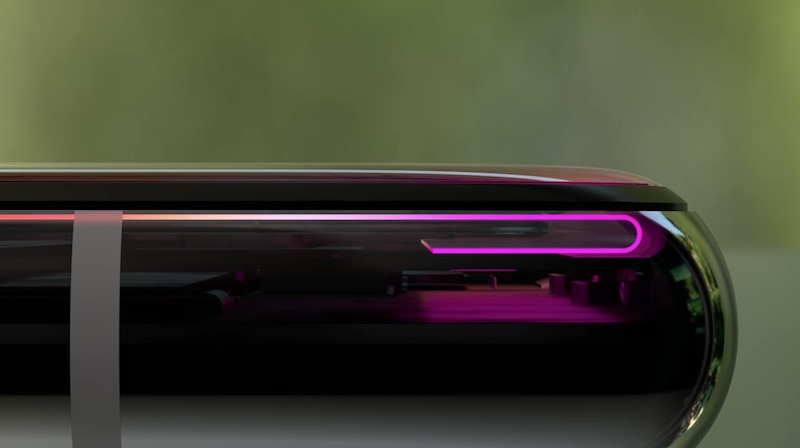
iphone-x-flexible-oled-display.jpg

The new panels would cover 95% of the BT.2020 color standard, which describes a far broader spectrum of colors than the DCI-P3 standard Apple's screens currently target. In practice, that means deeper, more accurate reds, greens, and blues. Reaching those richer colors demands more precise control over the light a display emits, along with better energy efficiency, so TrendForce expects the next round of OLED competition to hinge less on familiar specs like brightness and thinness and more on balancing color, power consumption, and overall performance.

Apple first brought OLED to the iPad Pro in 2024, and the technology is expected to come to the MacBook Pro between 2026 and early 2027. To reach the wider color range, panel makers are changing the chemistry of the layer inside each pixel that actually produces light, moving from a simpler recipe toward more sophisticated designs that pass energy between materials more efficiently.

TrendForce points to several of these new approaches. One makes a pixel emit a purer, more precise color, which is what lets a screen reach the tougher BT.2020 targets. Another adds a "helper" material so the pixel turns energy into light more efficiently. A third mixes in extra materials to keep a panel bright for longer without wearing out.

The shift is also a chance for display makers to rely less on technologies they have to license from others. All of this is said to be changing the relationship between the companies that manufacture displays and the companies that supply the materials inside them, with the winners increasingly being whoever can offer the best mix of cost, ease of manufacturing, and freedom from patent licensing.

Apple plans to adopt the more advanced OLED panels gradually across future MacBook Pro, iPad Pro, and iMac models, according to the report.

Article Link: Apple Plans Wider Color Gamut for Future MacBook Pro, iMac, and iPad Pro
 
  • Wow
Reactions: Z-4195
I read too fast and thought they’d offer these devices in more colors. But this is good news, how much extra do we get to pay for the privilege? Another 25%?
 
  • Like
Reactions: triumvirate
You'd think they would also release a new Studio Display with that kind of color accuracy around the same time. I wonder how expensive THAT would be too...
 
  • Like
  • Sad
Reactions: jayb3 and CDPlayer
I thought some of the only OLEDs on the market that get close to 95% coverage of BT.2020 are Samsung’s QD-OLEDs. Curious to see if this is a precursor to moving over to those displays, or if other industry makers can really somehow match their performance by improving standard WOLED.
 
  • Like
Reactions: hieranonymous
Current OLED panels already display over 1 BILLION colors. I wonder how many people can tell the difference or even care? Sounds like another reason to increase the price by using a more expensive panel technology.

I'm sure it won't be long before someone chimes in about their "need" for more color gamut range.

I agree with your take and it honestly just cracks me up.
We are so far beyond what basically everyone needs to do essentially everything.

Tech is in such a depressing place to me.
The ideas have all run out (seemingly) and it's now just trying to turn everything to "11" and/or turn the screws on consumer costs, as opposed to solving actual issues.
 
Last edited:


Apple plans to adopt OLED panels capable of displaying a much wider range of colors, according to a new report from research firm TrendForce.

iphone-x-flexible-oled-display.jpg

The new panels would cover 95% of the BT.2020 color standard, which describes a far broader spectrum of colors than the DCI-P3 standard Apple's screens currently target. In practice, that means deeper, more accurate reds, greens, and blues. Reaching those richer colors demands more precise control over the light a display emits, along with better energy efficiency, so TrendForce expects the next round of OLED competition to hinge less on familiar specs like brightness and thinness and more on balancing color, power consumption, and overall performance.

Apple first brought OLED to the iPad Pro in 2024, and the technology is expected to come to the MacBook Pro between 2026 and early 2027. To reach the wider color range, panel makers are changing the chemistry of the layer inside each pixel that actually produces light, moving from a simpler recipe toward more sophisticated designs that pass energy between materials more efficiently.

TrendForce points to several of these new approaches. One makes a pixel emit a purer, more precise color, which is what lets a screen reach the tougher BT.2020 targets. Another adds a "helper" material so the pixel turns energy into light more efficiently. A third mixes in extra materials to keep a panel bright for longer without wearing out.

The shift is also a chance for display makers to rely less on technologies they have to license from others. All of this is said to be changing the relationship between the companies that manufacture displays and the companies that supply the materials inside them, with the winners increasingly being whoever can offer the best mix of cost, ease of manufacturing, and freedom from patent licensing.

Apple plans to adopt the more advanced OLED panels gradually across future MacBook Pro, iPad Pro, and iMac models, according to the report.

Article Link: Apple Plans Wider Color Gamut for Future MacBook Pro, iMac, and iPad Pro
All I really need on iPad Pro is proper clamshell mode (or the ability to turn iPad screen off and use it with Studio Display) and for my Touch ID keyboard to work with the iPad Pro as well.

Apple-Here’s more colors.

Extra- Come to think of it, iPhone sorta has clamshell mode in a way , with iPhone mirroring , the display is off when in use with Mac…. Wild.
 
  • Like
Reactions: turbineseaplane
“At Apple, we’re committed to making the best displays ever and now with our Super Micro OLED Tandem Quantum Retina Displays, our products have surpassed physics with colors the human eye cannot see! Blues are bluer, reds are redder, greens are greener and our quantum systems have broken dimensions with a whole new visual spectrum of colors never seen before!* Surf the web, watch award winning Apple TV content, and create generative AI images with the most powerful and vibrant displays ever!

We know you’re gonna see it!

*requires corneal and occipital lobe quantum implants with Apple Vision Ultima”
 
I'm sure it won't be long before someone chimes in about their "need" for more color gamut range.

I agree with your take and it honestly just cracks me up.
We are so far beyond what basically everyone needs to do essentially everything.

Tech is in such a depressing place to me.
The ideas have all run out (seemingly) and it's now just trying to turn everything to "11" and/or turn the screws on consumer costs, as opposed to solving actual issues.
Thanks. I specifically wasn't ruling out that some people could use it in their very specific case, my point was that Apple will make it standard for everyone, and increase the price of ALL MacBooks.

Of course, it would be preferred that Apple give the customer a choice of panels so that those that need 12-bit panels can pay for it, but the rest of us don't.
 
  • Love
Reactions: turbineseaplane
Thanks. I specifically wasn't ruling out that some people could use it in their very specific case, my point was that Apple will make it standard for everyone, and increase the price of ALL MacBooks.

Of course, it would be preferred that Apple give the customer a choice of panels so that those that need 12-bit panels can pay for it, but the rest of us don't.

I've wanted this for so long now.

Give us BTO screen options please!!
 
  • Like
Reactions: DEMinSoCAL
The initial target market for this is going to be the “We do pro-level video editing for a living” crowd that currently purchase reference monitors for use in shooting, vfx, compositing and colour grading that alone, cost more than Macs.

Those people will actually be able to see this as a saving in both equipment expenditure and weight.
 
Current OLED panels already display over 1 BILLION colors. I wonder how many people can tell the difference or even care? Sounds like another reason to increase the price by using a more expensive panel technology.
pretty much most folks will be able to see the difference - humans can see between 32 and 64 BILLION colors, so 1B is just 1/32 of what we can typically see. sRGB is a tiny color space.

Fun Fact : Rec. 2020 covers 75% of all colors humans can see, P3 covers 53%. P3 has a slightly smaller area outside of R2020, but is otherwise well enclosed by it.

Rec. 2020 extends much further into the cyan, deep green, and dark blue boundaries of human vision.

All that said, we are still delivering video to Rec 709 for compatibility with old displays while many displays are in the P3 range 🙁
 
Register on MacRumors! This sidebar will go away, and you'll see fewer ads.