Become a MacRumors Supporter for $50/year with no ads, ability to filter front page stories, and private forums.
Apple never took that market segment seriously.

I believe they did, otherwise they would not have invested the time and money to develop the 2019 Mac Pro (as well as the 2017 iMac Pro). But Intel/AMD/Windows/Linux have so many more vendors who can offer more cost-competitive options at the lower end (where the Mac Pro played) as well as scale performance far higher than Apple could hope to match. So knowing they were out of the game, regardless, they walked away from it and focused on the consumer/prosumer market where they hold the advantage in both efficiency and performance.
 
must be for their own servers since Mac Pro doesn't exist anymore?
I was wondering this as well. We joke at how expensive these would be. One company comes to mind that could easily bankroll them. hahah As they aim to do more AI on their own servers, sounds like they have a ripe need internally. That would in turn let them better manage economies of scale and potentially drive down prices for others if they chose to sell them publicly.
 
must be for their own servers since Mac Pro doesn't exist anymore?

The servers Apple was building for Private Cloud Compute were four M2 Ultra Mac Studio motherboards in a custom rack-mounted chassis (so they were effectively four-node clusters).

However, Apple is moving away from "running their own iron" and will be using Google and NVIDIA going forward to power Private Cloud Compute.
 
The servers Apple was building for Private Cloud Compute were four M2 Ultra Mac Studio motherboards in a custom rack-mounted chassis (so they were effectively four-node clusters).
Was there evidence of that?

The Apple AI servers we saw being built looked more like a chassis with 32 M* Pro or Max motherboards to me?
1784481852324.png
 
Last edited:
It only proves their limitations after all especially since they cant even make workstation grade chips while they are using Mx Ultra chips for their own AI server which is far from enough. Eventually, they will need a powerful chip for both Mac Pro and servers.
 
Apple decided not to release the chips due to concerns over higher production costs and limited demand for the Mac Pro, according to Gurman.
They might revisit the concept later down the road because from what is known, there is some demand for more powerful chip than Ultra lineup and Mac Studio’s chassis can definitely handle it, and more importantly, AI.

It’s too expensive to make right now but it’s possible once costs manages to go down they will revisit the concept later
 
  • Like
Reactions: orbital~debris
Be interesting to see how well Nvidia's DGX stations do. They retail for around £100K. If Apple manages to catchup to Blackwell performance with quantised models (fp8 etc), then these extreme chips could see a return. Huawei have made some great progress stacking silicon ("Logic Folding")- there is still scope to increase transistor "density".

But as other commentators have pointed out, these are only interesting if they can offer extremely high memory bandwidth.
 
The servers Apple was building for Private Cloud Compute were four M2 Ultra Mac Studio motherboards in a custom rack-mounted chassis (so they were effectively four-node clusters).

However, Apple is moving away from "running their own iron" and will be using Google and NVIDIA going forward to power Private Cloud Compute.
I don't think that's the case. They're leasing the available capacity from other companies (just like every other AI firms) but there is no evidence they're not going to return to their own server-specific silicon when it is ready.

There have been new rumors in the past few months that they're working on fully-custom server chip designs that can scale better than reusing consumer M designs. (look up Baltra, source here)

Their M Ultra chips were already not scaling effectively, experiencing a rapid performance decrease with increased chip density. This is why they remained with M2 Ultras and omitted the same Fusion connector on the M3/M4.
 
Imagine being one of the engineers spending probably years working on those chips and/or the computer itself.

Tim: sorry guys we’re shutting it all down.Don’t fret you still have a job - we’re moving you to Apple Polishing Cloth 2.0!
You won't believe it: this is a normal occurrence in the development department of any large company. They work on new products while the management department decides what goes into production and what doesn't.
 
They probably figured a chiplet direction was the way to go.

The problem with an Extreme chip, somewhat similar to Ultra, is the user has limited choice over how many CPU and GPU cores they can order for their requirements. So, a music producer who wants the most CPU cores must pay for unnecessary graphics cores, etc.

Chiplet would offer a great level of customisation and the costs could be scaled to the user’s budget and needs.
 
....allowed extra RAM be upgraded by the user beyond the unified memory. You pay for the fixed unified memory on the CPU board, then you can add more that's slower that gets used when the unified memory fills up.....

Has anyone here ever seen a computer with tiered performance RAM? I doubt it. I did work as a software engineer maintaining the operating system on such a computer back in the late 1970s.


Take my word for it, this would require some fundamental changes in the OS kernel. This kind of work takes years, not months, and I assume they would still want to keep these changes merged with the normal kernel for unified RAM. The software work would add some cost but a major schedule delay.


Using simply to backfill faster RAM would drag down the performance of the computer. You really would need to let the kernel store different data in the slower RAM.


Think of a transportation company that owned airplanes. But they have so much demand that they are turning away customers. So they buy a fleet of buses and semi-trucks. This could work ONLY if they carefully managed what went on the plane and what went on the road. Simply saying “ If the plane is full, you ride the bus" is not going to give the best result. Management now is much more complex. Clothing going to the rack on a department store should be bumped off the plane so that a passenger has a faster set. And you now have 1,000 corner cases to consider, and your job is 1,000 times more complex than back when all you had was a fleet of planes.


One example: With your backfillable RAM, it could store data the CPU needs, but it could not be used as VRAM to back a GPU. Only the soldered-down LPDDR5 is fast enough for that. Same with neural network chips. But the OS could always copy blocks of data between the soldered-down and socketed RAMs. Now routing between buses, trucks, and planes seems simple. They would never get this working in only a year as it is a huge overhaul.


But really when people say they want “user-expendable RAM," that really means they really only want cheaper RAM. Those days are over. Today, expensive as Apple's RAM is, they are only charging market prices with as I see it almost no markup for LPDDR5 RAM. The stuff is expensive no matter how you buy it.
 
Has anyone here ever seen a computer with tiered performance RAM? I doubt it. I did work as a software engineer maintaining the operating system on such a computer back in the late 1970s.

Perhaps this is overly flippant, but isn't VM swap on silicon chip flash storage just tiered memory?

Optane tried to do play a bit in this space too, when used as swap.

I think the primary issue with this is: it only really helps when the performance/price/capacity gap is large, and really that isn't the case. LPDDR5 is basically the same stuff that's in RAM sticks, with tighter spec constraints on the package.
 
  • Like
Reactions: HVDynamo


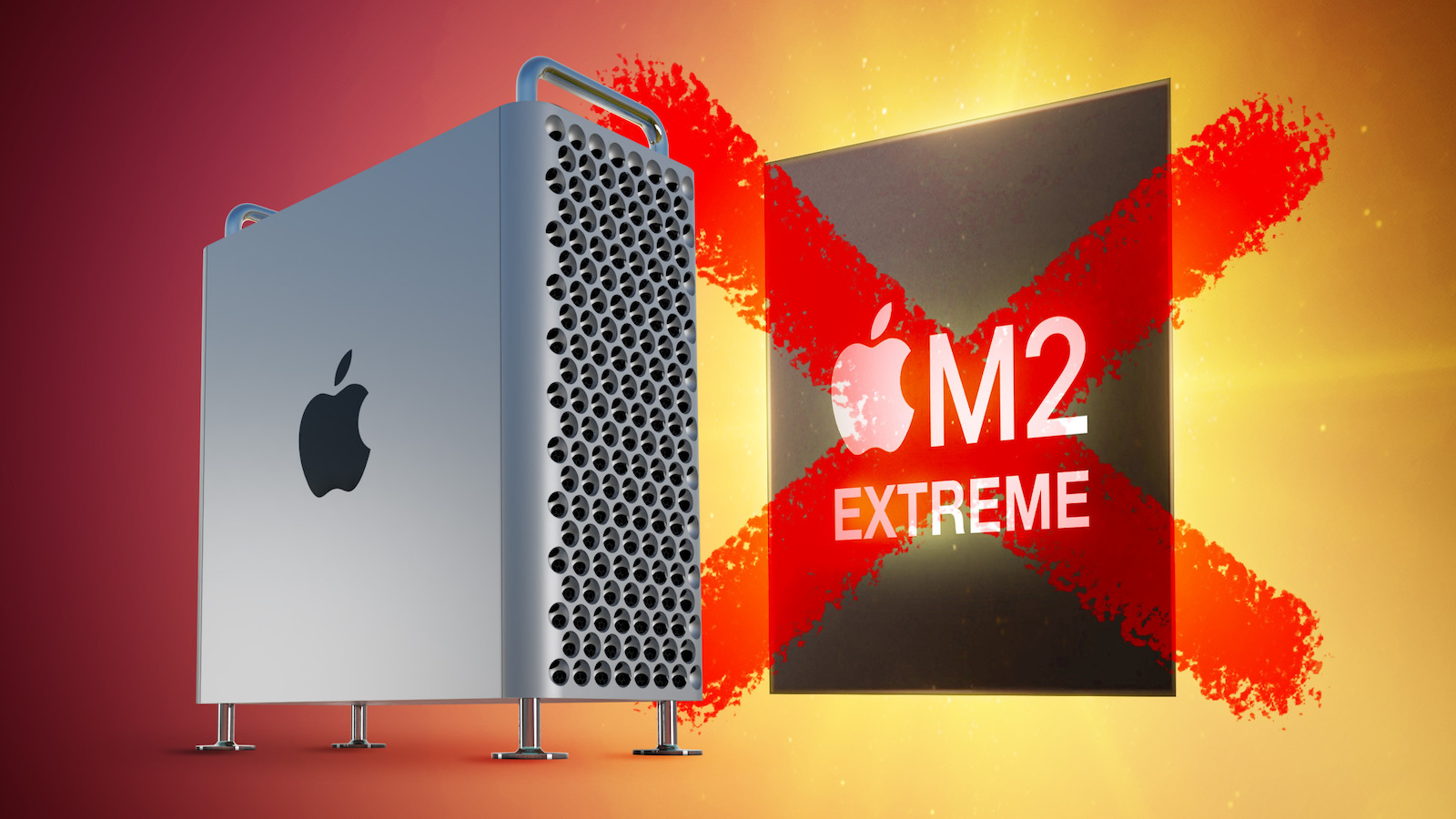
Apple once developed "M2 Extreme" and "M3 Extreme" chips for the Mac Pro, but it decided not to release them, according to Bloomberg's Mark Gurman. He first reported on this topic in 2022, and he touched on it again in his Power On newsletter today.

mac-pro-m2-extreme-canceled.jpg

"Extreme" chips would have had twice as many CPU and GPU cores as Apple's "Ultra" chips.

"The idea was to offer twice as many graphics and main processing cores as that chip," he said. "In the past, I've called this proposed processor the 'Extreme' chip, which to me is the most sensible Apple marketing name for something above Ultra."

Apple decided not to release the chips due to concerns over higher production costs and limited demand for the Mac Pro, according to Gurman.

Not only did Apple ultimately scrap the "Extreme" chips, but it discontinued the Mac Pro entirely this year following a 20-year run.

Article Link: Apple Reportedly Worked on Two 'Extreme' Chips
Well Mark might have been calling the rumored chip "Extreme", but everyone else was calling it that before he ever said a thing about it. I think there were even rumored patents of a 4-way ultra-fusion strip as well as a stacked design. Nowadays, an 'Extreme' chip would have hot rodded specs like 1.5TB of RAM, 1.5 TB/s bandwidth and 120GPU cores with as many integrated ANUs all for around $10-12k. That way, they could compete with the 6000RTX with similar speed but a larger RAM footprint and more overall usability.
 
  • Like
Reactions: peter2
Has anyone here ever seen a computer with tiered performance RAM? I doubt it.
i5-4570-R

"The Intel Iris Pro 5200 is an integrated graphics processor that does not have its own dedicated video RAM (VRAM). Instead, it uses system memory (DDR3L RAM) as shared video memory, but features a built-in 128 MB of eDRAM (Level 4 cache) that bridges the GPU and CPU to deliver high-speed memory access"

That was a chiplet in the CPU. Then the regular RAM was out in sockets as usual. It's the same concept as was being discussed, On chip RAM used first, then outboard RAM. A unified memory system with tiered performance.

As for "Think of a transportation company that owned airplanes. But they have so much demand that they are turning away customers. So they buy a fleet of buses and semi-trucks. This could work ONLY if they carefully managed what went on the plane and what went on the road."

Like UPS and Fedex do every day? Or for that matter the Fusion Drives Apple was rather fond of a decade ago. It's a solved problem. Doing RAM that way will increase power consumption though so for the laptop market there is a good reason not to do it. On a desktop power usage matters a lot less.

The graphics of that i5 mentioned above outperformed the HD 630 graphics in an i7-8700 by a considerable margin. That's another example of how Intel lost its way in the late 2010s.
 
  • Like
Reactions: dmi and HVDynamo
When ever discussions about Apples naming occurs, like, "Nano, Ultra, and now Extreme, Im reminded of that famous SNL skit where Fred Armisen played Steve Jobs, and seemingly released new iPods within seconds of each other, including the iPod Micro, Pequeno, and ultimately the Invisio, which of course was invisible. Fun times!
 
  • Like
Reactions: orbital~debris
So maybe on the one hand they did this move when they didn't see AI coming. On the other hand, maybe they still know they'll be able to hit the performance they want with what they're already doing. I think it would be silly to think they're naive.
 
  • Like
Reactions: orbital~debris
Register on MacRumors! This sidebar will go away, and you'll see fewer ads.