Paradigm shift
Not gonna happen. People need tactile feed back in order to type correctly and efficiently. It's a nice idea, but somethings just can't happen in certain ways. If Apple did make the MAC BOOK PRO without a real keyboard I would have to buy a Dell and suck it up with Vista.
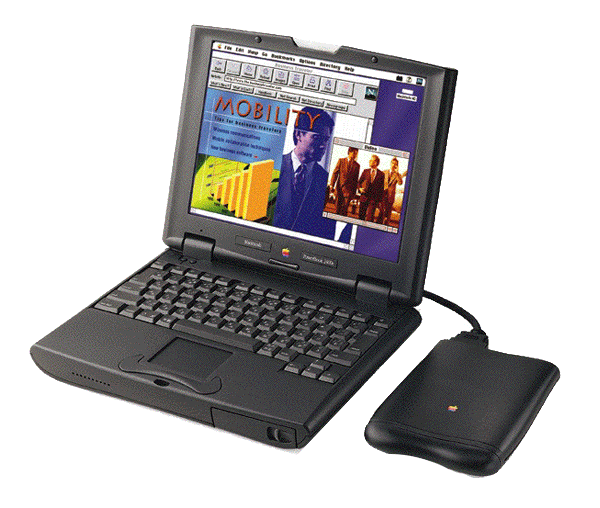
It is past time for a paradigm shift on computer keyboard input. The idea that you "have" to have tactile feedback in terms of key depress in order to type correctly is outdated thinking. The current keyboard designs for the Mac and Laptop lines are completely "flat" with a key depress of only a couple of mm (millimeters) compared to original manual typewriters (about 1/2 an inch or more) or the original IBM selectric style type writers (about 1/4 inch but watch out for twitchy fingers) of about 30 years of so ago-back when typing class was a requirement in junior high school. The Original Apple ][ and IBM PC keyboards were carry overs from the Selectric style typewriter/teletype keyboards. These keyboards even tried to mimic the sound (another form of sensorial feedback) of those keyboards.
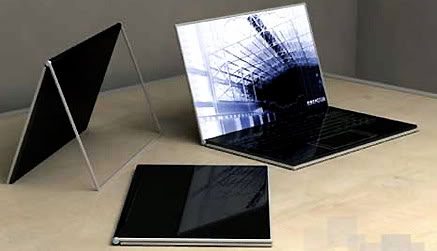
Now imagine a new keyboard that requires no depression of a physical key. You would still have tactile feed back in your fingers as you push down on the pad with each keyboard stroke of your finger tips (the pad pushing up in reaction to your fingers pushing down.) Now picture what happens as your fingers approach the screen. At a certain distance, the computer senses your fingers and a a keyboard fades in to view. The home row keys of this virtual keyboard are automatically positioned under each finger, regardless of the size or spread of the users fingers. In fact, if the user so desires, you would be able to change the distance between the keys simply by spreading or squeezing your fingers together making a smaller or larger keyboard depending on need. Now imagine that you're from Europe or Japan or Switzerland, etc. With a simple menu selection you can change your virtual keyboard to any country in the world with the touch of a pop-up menu selection (great for someone doing translations, etc.) Or, pick a DVORAK keyboard, or customize the keyboard to suit your particular ergonomic needs. Say I tilt my wrists at a particular angle and the keyboard automatically adjusts to that angle! (great for someone with arthritis or possible bone disease). Maybe I even want to invent my own keyboard that best suits my needs. Now I can just move my virtual keys to any position on the screen, assign a group to either the left or right hand or set it up for 2 finger typing or one handed typing (maybe I've lost an arm in an accident?). You could save each custom layout and call them up with a flick of a finger. A virtual keyboard gives me infinite possibilities that you don't have with a conventional keyboard.
As you type, the symbols appear above the keyboard, the computer still gives both audible and visual cues if you need them (and they can be customized to the users desires). If you move your hands and fingers away from the keyboard, the virtual keyboard slowly vanishes to maximize your desktop. If a single finger approaches the screen, different touch screen commands are assumed by the OS (touch, flick, tap, double-tap, etc.)
And that's just for typing. Now I call up garage band. Do exactly the same for different musical keyboards. What about other control surfaces? Calculators, keypads, audio/video control boards, electronic testing software, etc.?
Additionally, such an interface eliminates another piece of physical hardware (probably two if you include the mouse as well). Perhaps increasing reliability. Then think about the environmental and manufacturing savings. If you don't have a broken keyboard or mouse to replace that's one less thing to go to a landfill.
I, for one, would love such an interface. Once it becomes ubiquitous, those children that grow up using it will consider the physical keyboard "quaint" to quote Scotty from
Star Trek, the Voyage Home.