

Become a MacRumors Supporter for $50/year with no ads, ability to filter front page stories, and private forums.

MacRumors

macrumors bot
Original poster


Apple today announced Apple Business, a new all-in-one platform that unifies device management, productivity tools, and customer outreach features.
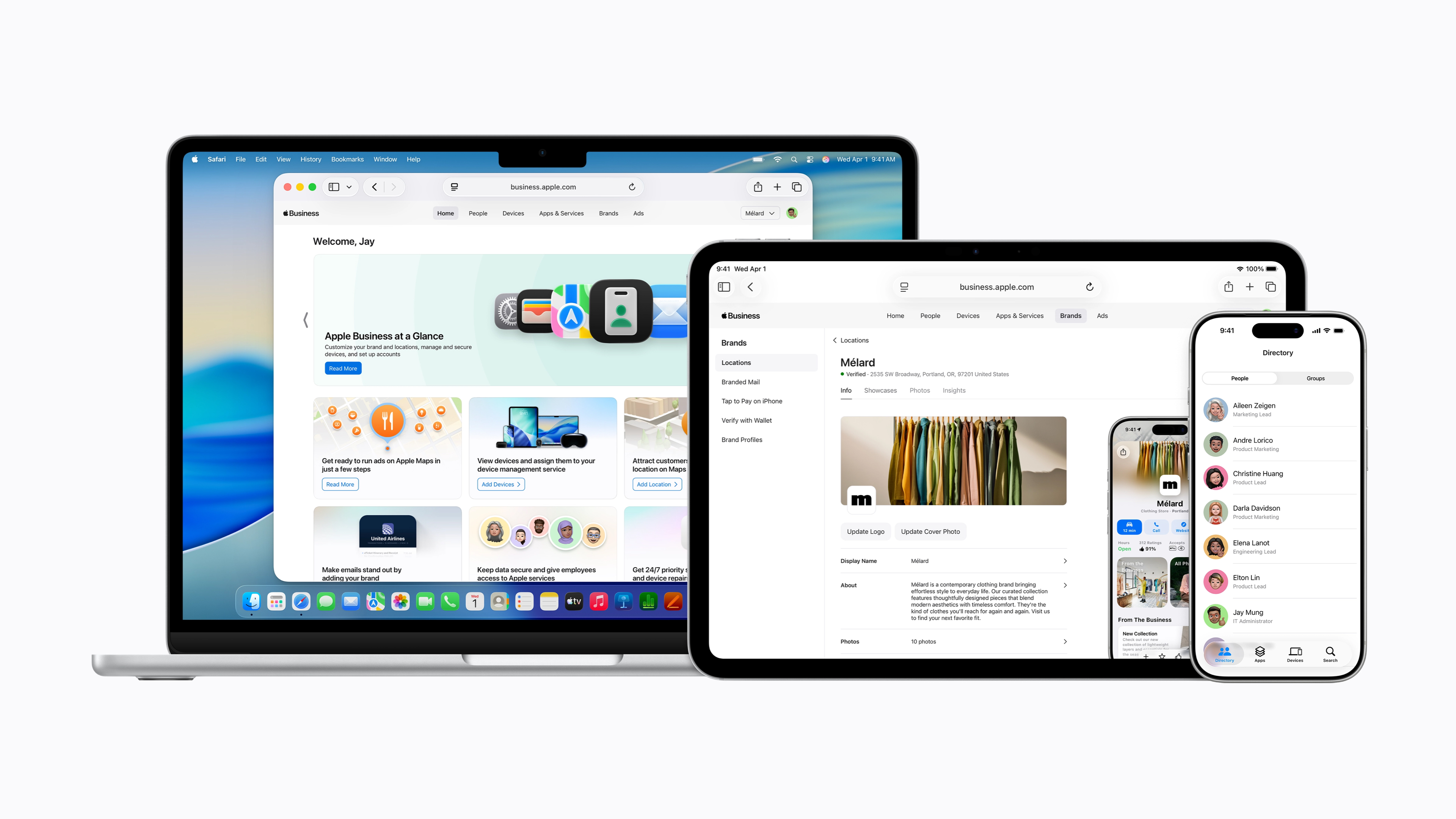
Apple-Business-hero.jpg

The service is designed to be a consolidated replacement for several of Apple's existing business-focused offerings, including Apple Business Essentials, Apple Business Manager, and Apple Business Connect. It provides organizations with a single interface to manage devices, employees, communications, and customer engagement across Apple's ecosystem.

Apple Business incorporates built-in mobile device management (MDM), which allows companies to configure device settings, security policies, apps, and user groups from one place. Apple Business app will allow employees to install work-related apps, access colleague contact information, and request support.

New "Blueprints" enable administrators to preconfigure devices with specific settings and apps, facilitating zero-touch deployment so that employees can begin using devices immediately after unboxing. Zero-touch deployment is available when devices are purchased through Apple or authorized resellers.

The platform introduces Managed Apple Accounts with what Apple describes as "cryptographic separation" between personal and work data, allowing employees to use the same device for both purposes without commingling information. Account provisioning can be automated through integrations with identity providers such as Google Workspace and Microsoft Entra ID.

Additional features include the ability to create user groups, assign roles, distribute apps through the App Store, and access an Admin API for large-scale deployments, covering device, user, audit, and MDM service data.

Apple Business also adds integrated email, calendar, and directory services tied to custom domains. Businesses can either bring an existing domain or purchase one through the platform. These tools include features such as calendar delegation and a company directory with personalized contact cards.

In addition to internal management tools, Apple Business introduces new tools for customer engagement. The platform will allow businesses to manage how their brand and locations appear across Apple services, consolidating features previously available in Apple Business Connect.

These include brand profiles with logos and details, customizable place cards in Apple Maps with photos, hours, and actions such as ordering or reservations, and analytics showing how users discover and interact with locations. Branded communications will extend to the Mail app and iCloud Mail, as well as order tracking in Wallet, and that businesses using Tap to Pay on iPhone can display their branding during transactions.

Apple also announced a new advertising feature tied to Apple Maps, scheduled to launch in the United States and Canada later this summer. Businesses will be able to create ads that appear at the top of search results in Maps, as well as within a new Suggested Places experience.

Apple Business will be available starting April 14 in more than 200 countries and regions as a free service for new and existing users of its prior business platforms, with certain features limited to specific regions. Optional paid services for additional iCloud storage and AppleCare+ will remain available within the platform.

Apple Business Essentials, Apple Business Manager, and Apple Business Connect will be discontinued once Apple Business launches, with existing data such as claimed locations and account information automatically migrated to the new system. Business Essentials customers will no longer be charged monthly fees for device management after the transition.

Article Link: Apple Unveils 'Apple Business' All-in-One Platform
 
there is one simple formula in good design, the more your company B2B the worser design

If you get money from bussiness there is no reason for steakeholders to try something new in consumer market
 
Explain how it is "not even remotely like it". I said -ish implying it wasn't identical but it certainly does have some similar components. Are you saying it has ZERO things in common with google workspace?

Keep in mind, I subscribed to Google Workspace and have firsthand experience with it.

Yes. Apple “business” offers no cloud iWork suite of tools and is just for device management and business brand settings for maps and iMessage.
 
Last edited:
I'm looking at changing MDM vendors. I wonder how this compares to Mosyle and Jamf. My guess is it's not as full featured.
May be similar to JAMF Now than the full suite (Pro). I'm on the edu side of things, hopefully something is coming.
 
Explain how it is "not even remotely like it". I said -ish implying it wasn't identical but it certainly does have some similar components. Are you saying it has ZERO things in common with google workspace?

Keep in mind, I subscribed to Google Workspace and have firsthand experience with it.

To the extent that it's an MDM-like suite of tools, then sure, it's like all manner of other examples. Singling out GSuite is an odd example, however. GSuite's tools are mostly about enforcing organizational, corporate, legal, and/or data storage requirements for data held within Google's cloud plus some basic MDM features for specific hardware. It's mostly hardware agnostic.

Apple's tools have few compliance levers, and are more about managing and deploying Apple hardware in a corporate or organizational setting. It's hardware specific.
 
I'm curious—where does MDM software reside on the computer? Or is it even considered software (as opposed to, say, firmware)?

It's not like a normal application, because if you completely erase and reinstall, MDM remains (as it needs to, to prevent theft).

So I assume companies that produce MDM's need to work specifically with Apple so they can install it somewhere not accessible even to users with administrative permissions.
 
They need to come out with a consumer version of this. As the family IT manager of my households devices, update day can take an hour going to each device.

Having a dashboard where I can tell my wife’s phone to update overnight without having to go into her phone would be nice.

I think I did the math and we have like 32 Apple devices that receive updates. Apple needs to address this. Include it as part of iCloud+ and allow anyone on your iCloud family to be managed.
 
Still no findmy/activation lock support for managed devices and accounts? And no way to force updates?

Honestly, it’s sometimes better to just make a personal apple account (devices@yourcompany.com) and manage all your devices thru that lol
 
I'm curious—where does MDM software reside on the computer? Or is it even considered software (as opposed to, say, firmware)?

It's not like a normal application, because if you completely erase and reinstall, MDM remains (as it needs to, to prevent theft).

So I assume companies that produce MDM's need to work specifically with Apple so they can install it somewhere not accessible even to users with administrative permissions.

It's part of the operating system. The OS provides programming interfaces and functions for any MDM to use. They're documented so Apple don't have to work with everyone.

The OS then enforces it and uses hardware like Secure Enclave to make sure you can't escape by just deleting software and reinstalling.

Other operation systems might be a less bit rigid and leave more control to the MDM-provider.
 
Well well well

Took them long enough

This was the Apple gap in market

Apple were well known for using Jamf internally

Anyone know if this is based on a Jamf style architecture?

I would say, they need it to be free and have excellent integration with Microsoft 365/intune for it to be a success in business.

Platform sso showed promise but I haven’t looked at it since 2024.
 
Register on MacRumors! This sidebar will go away, and you'll see fewer ads.