Become a MacRumors Supporter for $50/year with no ads, ability to filter front page stories, and private forums.
Bumping this thread because I'm currently dealing with the same thing. I have a launch 13 Pro. The battery health stayed 98% for the first year. Dropped to 92% the second year. Dropped to 82% by the third year. It's been stuck at 80% for probably half a year now. I have optimized charging disabled. I've tried to completely drain it and fast charge it to 100% several times. I just want it to get to 79% so I can get my free battery replacement, and I can't help but think that they're programming it to not accurately show the real health so they don't have to give out as many "free" battery replacements.

When my phone has a full charge it still performs wonderfully, and if I could just get the new battery then I feel like the phone will be good for at least another year or two before it really starts to show its age. I would also just buy the new battery but it would suck to do that when I'm only 1% away from a "free" replacement.

What are the odds of me just walking into an Apple store and getting the "free" replacement since it's so close?
 
Last edited:
  • Like
Reactions: PhillyGuy72
Bumping this thread because I'm currently dealing with the same thing. I have a launch 13 Pro. The battery health stayed above 98% for the first year. Dropped to 92% the second year. Dropped to 82% by the third year. It's been stuck at 80% for probably half a year now. I have optimized charging disabled. I've tried to completely drain it and fast charge it to 100% several times. I just want it to get to 79% so I can get my free battery replacement, and I can't help but think that they're programming it to not accurately show the real health so they don't have to give out as many "free" battery replacements.

When my phone has a full charge it still performs wonderfully, and if I could just get the new battery then I feel like the phone will be good for at least another year or two before it really starts to show its age. I would also just buy the new battery but it would suck to do that when I'm only 1% away from a "free" replacement.

What are the odds of me just walking into an Apple store and getting the "free" replacement since it's so close?
Why would you think it's free? You have to pay for the battery replacement. And at 80% and 4 years old, they'd probably replace it even though it's not under 80% yet.
 
  • Like
Reactions: MarkX
No. Typically iOS devices drop relatively quickly to 90% (with significant usage throughout the day) and 90% to 80% is slower. It’s normal.

Honestly, I’d just use it and ignore that number, especially when considering that it works fine for you.

You are correct in saying that iPhones drop relatively quickly to 90% but 16e users like myself that would take far longer ( my 16e went to 99% today after using the phone for over 9 months)
My daughter’s 14 finally hit 79%. We’ll be making an appointment to have her battery replaced very soon.

I know this is old news but if this was a 14 Pro being 79% the battery will expand and swell much quicker than other iPhones ( have seen this many times throughout the internet and I have also witnessed this happen to a friends 14 Pro when the battery was at 78%)

No battery has been quite defective than the 14 Pros version

Why would you think it's free? You have to pay for the battery replacement. And at 80% and 4 years old, they'd probably replace it even though it's not under 80% yet.

AppleCare+
 
  • Like
Reactions: reinem85 and EugW
^ Yes. It's "free" if you have AppleCare+. I put "free" in quotation marks because you are paying for AppleCare+ although obviously battery replacements are not the only function.
 
Bumping this thread because I'm currently dealing with the same thing. I have a launch 13 Pro. The battery health stayed 98% for the first year. Dropped to 92% the second year. Dropped to 82% by the third year. It's been stuck at 80% for probably half a year now.

I was the official poster in this thread and back in November 2024 my 14 Pro Max dropped to 85%. It's now been on 84% the past six months. I charge my phone nightly. Even though I'm on AppleCare, I'm sceptical how it seems to be able to maintain such a healthy battery (and not drop below 80%).
 
  • Like
Reactions: no0nefamous
If you’ve paid into an AppleCare+ plan for 2-3 years without any other claims, you’ve already paid more money in monthly instalments than walking into a store to have the battery replaced without AppleCare.

And if it isn’t below 80% then they may refuse it anyway.
 
If you’ve paid into an AppleCare+ plan for 2-3 years without any other claims, you’ve already paid more money in monthly instalments than walking into a store to have the battery replaced without AppleCare.

And if it isn’t below 80% then they may refuse it anyway.

Yes I get that but AppleCare+ is primarily phone insurance, and if I were to lose the phone, what I have paid into it is still cheaper than paying for a new device. The fact that they also replace batteries "for free" is a bonus.
 
  • Like
Reactions: Steven SANH
If you’ve paid into an AppleCare+ plan for 2-3 years without any other claims, you’ve already paid more money in monthly instalments than walking into a store to have the battery replaced without AppleCare.

And if it isn’t below 80% then they may refuse it anyway.
Yes I get that but AppleCare+ is primarily phone insurance, and if I were to lose the phone, what I have paid into it is still cheaper than paying for a new device. The fact that they also replace batteries "for free" is a bonus.
Exactly, the no-additional-cost battery replacement is a bonus. However, it hasn’t been a notable value proposition for probably more than a decade. I guess if you’re the modern “heavy user” (or whatever they prefer to call themselves), your device’s may accumulate charge cycles quickly enough for it to matter. As a reminder, Apple guarantees* the battery capacity (a.k.a. “Health”) to be within 80% up to 500 charge cycles, 1000 cycles for iPhone 15 and newer. But for most instances, the original battery will be viable for the preferable/comfortable life of the device.

You even say:
When my phone has a full charge it still performs wonderfully, and if I could just get the new battery then I feel like the phone will be good for at least another year or two before it really starts to show its age.
So, presumably, if the battery lasts (i.e., the reported state of health drops below 80% within the next six months or a year), you’ll still be good (i.e., the device will likely still “perform wonderfully”) and could also utilize, take advantage of the no-cost replacement then. In other words, if it happens, great; if it doesn’t, you don’t appear to be really missing out, at least on much.
 
My original post in this thread said it has stayed on 85% for 6 months. It's been another 3 months now and it's still on 85%.
Maybe I have an exceptional battery! :)
But seriously, I do get great battery life daily out of my 14PM.
It's now been 1 year and 3 months from 85% to 84%. I charge my phone nightly. Can anyone explain how it is stuck on 84%.
 
It's now been 1 year and 3 months from 85% to 84%. I charge my phone nightly. Can anyone explain how it is stuck on 84%.
Review post #8.

From another one of the dozens of battery discussions:
And also, battery health depends on a quintillion factors.

The first one is good-old dumb luck. Some people are just luckier than others. But I also think that most people underestimate longevity. My 9.7-inch iPad Pro was at 164 cycles and 91% health after one year. Atrocious, right? Nine years after purchase, 800 cycles and 85%.

Even if it dropped below 80%, give it time and it will not collapse.
The point is that so too many people get obsessed with the initial drop, which is typically only recognizable by the raw measured capacity. Before stats like “battery health” became a regular feature, battery degradation was a finite topic.

Furthermore, as also implied by the above, even when a battery is in the 70-something-percent of original capacity, it normally does plenty well.
 
With my 14 Pro, I was keeping track of battery health via the raw numbers in the analytics file, it dropped below 80% before my Apple Care expired, battery settings figure was still around 83 iirc. Opened a chat with Apple to see if they would go by the former value, which was a no.

Soon after Apple Care expired and an iOS update, number dropped below 80.

Next iPhone I get, I'll avoid Apple Care. Also with the return to aluminium, I'll prob stick a thin carbon case (as a non case user, I've managed to put 3 small dents in this Pixel within 1 month, where my 2.5 year old 14 Pro was perfectly good thanks to the SS frame).
 
I wonder if there's any way to gather wider data on this. I know it's anecdotal but its hard to not feel like Apple could be manipulating the battery health percentages to avoid giving out AppleCare battery replacements. It's just so peculiar how long my phone's battery health has been stuck at exactly 80%.
 
Last edited:
I wonder if there's any way to gather wider data on this.
I’m still logging and testing battery performance. It’ll still be a small sample set, but worthwhile, methinks.

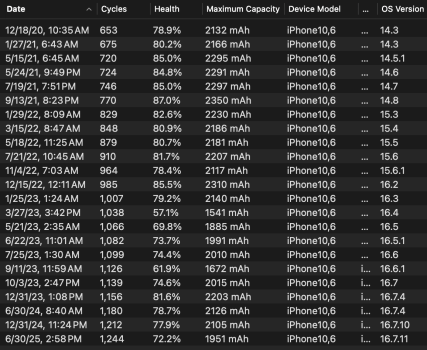
Anyway, to give you another set a data:
iPhone-X_coconutBattery_nearly-8-years-later.png
I can’t recall every percentage iOS reported, though I do remember it was at ~1,000 cycles when iOS finally reported less than 80% health. As a reminder, that’s double the cycles Apple estimates. By the way, as of today, that iPhone X still reports 72% capacity, which has been the case for at least a few months.

I know it's anecdotal but its hard to not feel like Apple could be manipulating the battery health percentages to avoid giving out AppleCare battery replacements.
Possible but, realistically, nah. Apple would just drop that as a perk or change the requirements. In fact, they did as of iPhone 15. And, actually, the change is a counter argument to the baseless cynicism, as the expectation/estimate (i.e., coverage) doubled.
Batteries of iPhone 14 models and earlier are designed to retain 80% of their original capacity at 500 complete charge cycles under ideal conditions. Batteries of iPhone 15 models are designed to retain 80% of their original capacity at 1000 complete charge cycles under ideal conditions. Actual battery performance depends on a number of variables, including how iPhone is used and charged regularly.
 
Register on MacRumors! This sidebar will go away, and you'll see fewer ads.