Become a MacRumors Supporter for $50/year with no ads, ability to filter front page stories, and private forums.
An adequately documented fee for notarization and security checks is probably justified. Some courts in the US seem to agree with this. A fixed fee per submission would probably be fair.
But "notarization and security checks" aren't the only things of value that Apple provides to developers. Developers also benefit from the work that Apple puts into developing iOS and developer tools.

Here is what the judge in the Epic case said:
"First, and most significant, as discussed in the findings of facts, IAP is the method by which Apple collects its licensing fee from developers for the use of Apple’s intellectual property. Even in the absence of IAP, Apple could still charge a commission on developers. It would simply be more difficult for Apple to collect that commission."

Anything above that would be rent-seeking in my opinion.
It's not so much an opinion as an incorrect use of the term.
 
No. If an app uses Apple’s APIs, SDKs, OS features, security infrastructure, signing/notarization, and gets access to iOS users and device capabilities, Apple charging something is ordinary value capture.
In order to determine the true value of that something, it is normal practice to compare to other similar products and services. In this case, what is charged for APIs, SDKs, OS features, security infrastructure and signing/notarization provided for MacOS, Windows, and Android applications.

The answer, of course, is exactly what the providers of those other OS's charge for the same thing: nothing.
 
Licensing any kind of IP is, by definition, rent seeking.
Are you a charity or a publicly traded company? Apple isn't a charity. They are a publicly traded company so they have to recoup their investments in the things they create. And are fully allowed to profit from those for which they create (IP).
 
  • Like
Reactions: I7guy
In order to determine the true value of that something, it is normal practice to compare to other similar products and services. In this case, what is charged for APIs, SDKs, OS features, security infrastructure and signing/notarization provided for MacOS, Windows, and Android applications.

The answer, of course, is exactly what the providers of those other OS's charge for the same thing: nothing.
Does Google not charge 30% as well?
Value is what someone is willing to pay for X thing. Apple set a price. The purchaser decides if it is worth the price being charged for X. If they don't value it that high. They don't buy it.
 
Every news article involving someone with the last name “Sweeney” is a guaranteed headache these days
And someone with the first name was a pain in the neck, too. But at least we got a great Monty Python sketch out of it.
I just realized, while looking up Sweeney Todd videos on Youtube, that Johnny Depp kinda got to play Edward Scissorhands twice. Not sure if that's good or bad.
 
Demanding a "Technology Fee" for transactions that don't happen through the App Store is rent-seeking (or monopoly rent) then?
They are still using Apple's IP in order to provide the application on the phone. They have just provided a hard number for what Apple can charge for each part of it. So the lowest is 5%. Using a 3rd party store, and payment system. And up from there. They are still creating a 3rd party store via Apple's IP.
 
  • Like
Reactions: I7guy
Does Google not charge 30% as well?
Value is what someone is willing to pay for X thing. Apple set a price. The purchaser decides if it is worth the price being charged for X. If they don't value it that high. They don't buy it.
Yes, and Google should either also be subject to the same restriction as Apple and should also allow developers to bypass the Google app store or use an alternative store without providing any payment to Google.

The "...what someone is willing to pay" argument is only valid when talking about customers who have a choice and producers operating in a meaningfully competitive marketplace. As long as consumers are captive, the free market doesn't work and free market arguments are without merit.
 
I still find is so mind boggling that people,
1: Don’t think Apple has a right to collect a fee for their IP
2: Still keep saying Apple charges a 30% ‘tax’ (it’s a commission fee), when it has already been proven multiple times that the majority of developers pay 15% or less.
3: have no understanding of how a commission system works. Amazon, Walmart, Google, Microsoft, Sony, even Epic all have fees they charge others for putting product into their store fronts, and those fees are collected at time of sale. It doesn’t matter if it’s a digital or physical store, they have to make money one way or another to keep the lights on.
 
Exactly. I figured they would go after them next.
They will, just trying to get as many legal precedents as they can. Anyone who thinks that Epic would NOT love to have Fortnite available to all those Steam users without having to pay Valve a penny haven’t been paying attention.
 
The fee is to compensate Apple for the value they provide developers through their investment in the core technologies of iOS. Seems pretty straightforward to me.
And it’s SUPER simple. Take me, I think Apple’s commission structure is unfair and they should not be treating their developers that way! As a result, I have made the decision to NOT be a developer for Apple products. By making that decision, Apple gets zero percent of my earnings. I’ve cracked the nut.

Turns out, there’s a few jobs out there that aren’t Apple Developer. Who knew?!
 
I still find is so mind boggling that people,
2: Still keep saying Apple charges a 30% ‘tax’ (it’s a commission fee), when it has already been proven multiple times that the majority of developers pay 15% or less.
Not just “majority” VAST majority… actually more accurate to say “virtually all” developers pay a 15% commission because out of all iOS developers (~34 million), the number that clear $1million a year is under 300… a number that “majority” sorely misrepresents. :)
 
From the linked article:

How is Apple's 5% phantasy fee (aka Core Technology Fee) adding value?
I really honestly don't understand this.

I made comment years ago here. Apple runs a store. Online. They charge people to sell in it. A flat fee as a dev and then a % of sales.

Re-cap: App store 👈

Traditionally in retail Department Store a 3rd party brand/commercial operation, say another clothes brand, would have a concession stand/stall/space on the fashion department floor, this is a step up from having the store stock your product and re-sell for you on your behalf, either way they might pay a fee or % of sales to the Department Store for that own-space which is all about their product/brand. The department store might have various ranges of it's own brand products in the various departments, inter mixed with 3rd party offerings competing in similar space.

That's all the APP store is. Apples online software store. Which they retain exclusive rights to control. The analog is well established in markets over centuries.

Take Car dealerships. Oh it's just not fair Toyota can't sell in BMW dealerships, is something I have never heard.

If you do not like the arrangement as a consumer, then you buy another phone and you get your apps elsewhere, which is available, because that is the market and the market place is very well catered for in this massive industry - APPLE is not the market. The whole argument on a facile level treats Apple as if it has an unfair advantage, like a monopoly, because it is the only phone maker and is therefore "the market". Yet it is not. It has no monopoly. It only has control within in its product range and services.

Dev / sellers can sell on at least two massive market places, across a huge range of devices, into the world market. It's a huge market. There is a lot of competition in he space globally. Other brands and have come and gone that at one point were the big players, at one pot it seemed no one could out do Nokia, and there were a lot of brands.

What is really happening is the commies can't invent things that anybody wants and so when things mature they come along and either or both, steal and try break which is really power play.

While "the market" is not perfect, people in the US sure do get the best prices on Apple products!

No one in the US pays carbon taxes.

Do people in the US want to pay carbon taxes?

 
This Epic-Apple lawfare is becoming tiring. I don't care too much who's right and who's wrong – just hope this gets settled worlwide and we can move on.
 
I don’t think people outside of the gaming space truly appreciate how insufferable Tim Sweeney is

The man constantly whines about everything, I implore you to look up his complains about Steam
 
Not just “majority” VAST majority… actually more accurate to say “virtually all” developers pay a 15% commission because out of all iOS developers (~34 million), the number that clear $1million a year is under 300… a number that “majority” sorely misrepresents. :)
Only 300 developers over 1 million seems very low. Can you provide a citation for this claim?
 
Only 300 developers over 1 million seems very low. Can you provide a citation for this claim?
I was surprised it was that low too. Did some googling, and while it’s more than 300, it’s appears it’s not much more - less than 600.

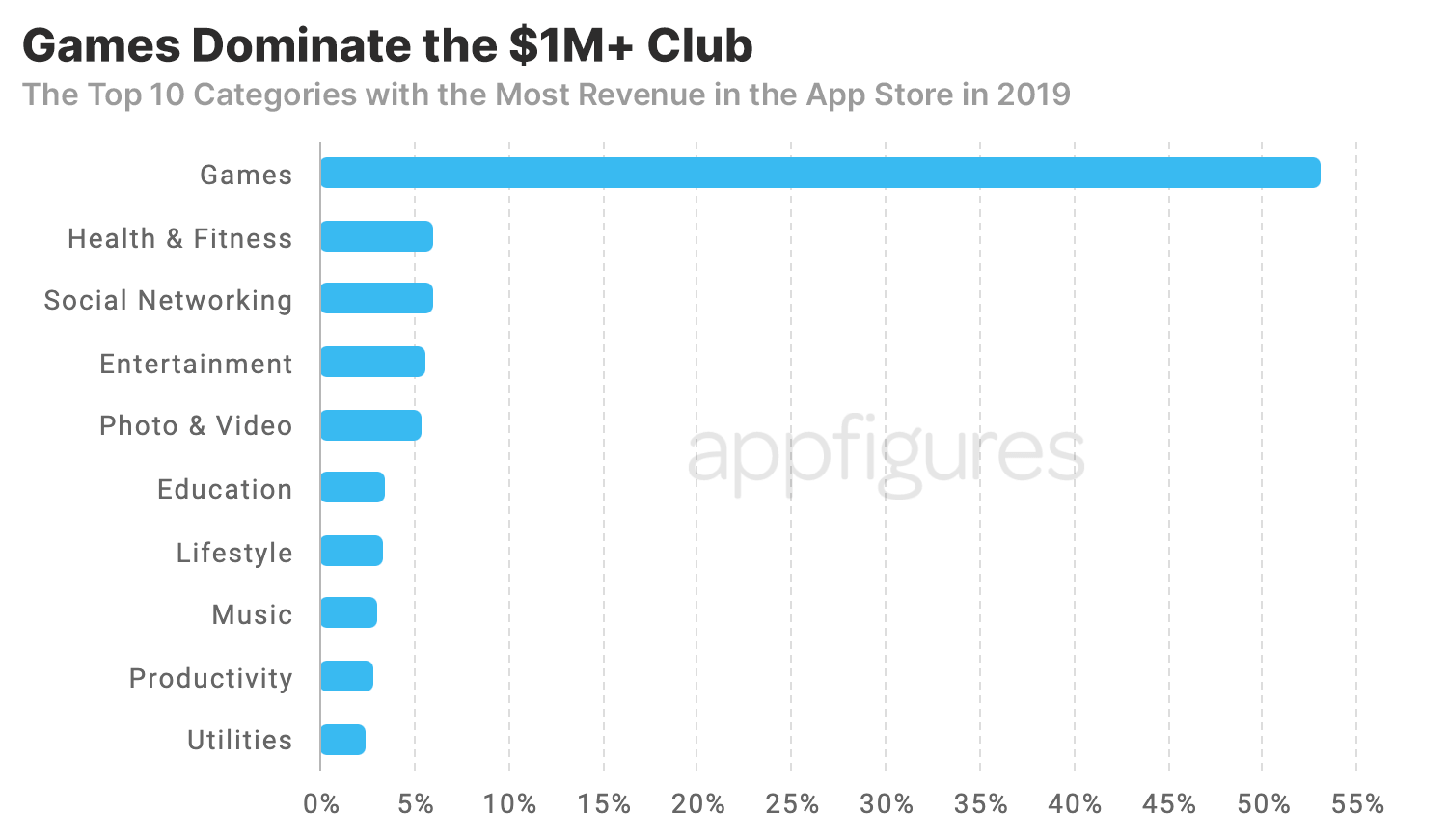
Edit: Just noticing the chart says “first $1m” even though the article implies it’s all developers making more than $1m (“Over 900 app publishers are expected to earn more than $1 million in net revenue from digital app storefronts in 2021.”)

Trying to find the actual report to see if that’s all developers making more than $1m or developers making more than $1m for the first time.

1766231127865.jpeg


Last edited:
  • Like
Reactions: MilaM
More estimating here. When the Small Business Program was announced, AppFigures said less than 2% earned more than $1m, and there were ~125,000 developers monetizing apps. That math works out to 2,500 developers.

To understand the impact, we first have to look at how many developers can make money on the App Store. Using Explorer, we can see that of the 2 million apps available in the App Store right now, 376K are either a paid download, have in-app purchases, or monetize with subscriptions. Those apps belong to 124.5K developers. Of those developers, only a little under 2% earned more than $1,000,000 in 2019.


Understand this data is a few years old, but 2,500 tracks better with my expectations than 300 or 600.
 
  • Like
Reactions: I7guy
This Epic-Apple lawfare is becoming tiring. I don't care too much who's right and who's wrong – just hope this gets settled worlwide and we can move on.
I don't see this getting resolved until all legal avenues have been exhausted for the both of them.

First off, Tim Sweeney has nothing to lose (since Fortnite isn't on the App Store anyways), while Apple has everything to lose (whatever the legal outcome, it looks increasingly clear that the App Store may not be allowed to stay around in its current incarnation).

Second, it's not that both parties are acting irrationally. Rather, each of them is fighting for very different things. Apple desires control over everything else (even profits). It's what made them so successful in the first place. An Apple that retains control over its ecosystem is an Apple that always wins.

Tim Sweeney wants to blow up the current App Store model. Not only because he wants to be able to offer his own App Store on iOS devices, but because he wants to have the last laugh. And he makes enough money from Fortnite to carry on this battle indefinitely.

I don't see these two shaking hands and making up anytime soon. The way third party app stores is implemented in Japan is also not looking great for Epic, since it requires the inclusion of controls for child safety (and we know that freemium games like Fortnite are anything but safe for children). If Apple is able to replicate this model around the world for countries that demand it (and convince governments that it's in their best interests to allow them to continue having notarisation rights over apps distributed in third party stores), it could still be a solid middle finger to Tim Sweeney. Here's the support for third party app stores, but you won't be able to profit off young kids the way you previously did.

I can live with that. Apple doesn't need to win. Epic just needs to lose. 😈
 
Your weekly reminder that Sony, Nintendo, and Microsoft all charge 30% for their game stores on their consoles. Never heard him complain much about that.
Of course, he behaves like a narcissistic toddler, angry and offended. But even in this, he is just a minor follower.
 
Yes, and Google should either also be subject to the same restriction as Apple and should also allow developers to bypass the Google app store or use an alternative store without providing any payment to Google.
Well that's to answer your statement that to value something, you need to compare it to something similar. Which in this case is AppStore vs PlayStore. They both have similar products sold within each for their respective platforms.
Does not Samsung have a store too? Not to mention, on Android you already have 3rd party stores. If you're a customer, and you require or just want a 3rd party App store. You can pick an Android. That is your choice.
And since they can charge as much as the market will bear. There is generally nothing wrong with this configuration. Other than people "feeling" that amount is highway robbery. While providing no reasonable amount that would be fair to the IP of Apple. At least the Japanese provided actual numbers that Apple is allowed to charge for their IP. For that I give them lots of credit.

What generally isn't anyones choice is to have "their" feature supported by the manufacture. Just because you want to have it. That manufacture generally isn't required to do so. For instance. No one is forcing Hyundai to make a car to compete with a Bugatti. And if you wanted to trick out your Hyundai to perform like a Bugatti. You can sure try. But, Hyundai isn't going to support you. Nor should they have to. There are those that want Apple to make a foldable device. And while that maybe cool. Apple is under no obligation to do so. "Just" because someone(s) want it. They might make one if they believe people would buy it. But, even then. It's not for anyone to force them to do so.
The "...what someone is willing to pay" argument is only valid when talking about customers who have a choice and producers operating in a meaningfully competitive marketplace.
They do, and they are. Again, 3rd party stores exist on Android. Android is a competitor to Apple's AppStore. They compete on phone devices, and tablets. Apple came up with the 70/30 split. Why not ask Google to do a 80/20 or 90/10 to better compete? Why not ask EPIC to not charge at all for any app on the store no matter what they do?

Do you have any idea what cloud costs are? Network bandwidth, Storage, CPU processing, memory. Across multiple regions, and or globally. Backup and Fail-over solutions to ensure nothing is lost. Security, Patching and Monitoring. It's far far far from free.
As long as consumers are captive, the free market doesn't work and free market arguments are without merit.
To some extent a consumer will always be captive. You can't buy something that doesn't exist. Nor can you force someone else to make it exist just because.
 
When Netflix stopped letting users subscribe from within the app, their monthly prices didn't come down either to compensate for the cut that they no longer had to pay Apple. Netflix simply kept the difference.
Netflix is A GREAT example that most companies won’t be passing any savings whatsoever to the consumer out of goodwill… they will charge whatever the costumer is willing to pay, and lower the price of items out of competitive reasons with other similar services (which they have lately become “specialized” enough, at least the main ones).

So Netflix started in 2011 at $7.99, for their main ad-free plan… today, 14 years later, after all the tech and power, efficiency and costs reductions advances, store fees reductions (introduction of 15% fees after the first year), all of that, gives us today a standard ad-free plan at $17.99 a month. There’s still an ad driven plan for $7.99 a month, granted, but that’s not an equivalent from the 2011 offer.
 
  • Like
Reactions: I7guy
Netflix is A GREAT example that most companies won’t be passing any savings whatsoever to the consumer out of goodwill… they will charge whatever the costumer is willing to pay, and lower the price of items out of competitive reasons with other similar services (which they have lately become “specialized” enough, at least the main ones).

So Netflix started in 2011 at $7.99, for their main ad-free plan… today, 14 years later, after all the tech and power, efficiency and costs reductions advances, store fees reductions (introduction of 15% fees after the first year), all of that, gives us today a standard ad-free plan at $17.99 a month. There’s still an ad driven plan for $7.99 a month, granted, but that’s not an equivalent from the 2011 offer.
$17.99 a month for as many movies as you want, many of them 4K. For that price you can't even buy a single 4K Blu-ray movie. Granted, Netflix 4K isn't quite as good as BD 4K, but for most people the choice is a no-brainer.
 
$17.99 a month for as many movies as you want, many of them 4K. For that price you can't even buy a single 4K Blu-ray movie. Granted, Netflix 4K isn't quite as good as BD 4K, but for most people the choice is a no-brainer.
The point is Netflix did not reduce the cost to consumers after they stopped paying Apple any commission at all. They’ve only continued to put it up. All that money just went straight into Netflix’s pocket, not yours.
 
If Apple shoves the couch into the toe, this analogy would make more sense.

Apple’s implementation of taking a cut from third party stores and from web downloads is really anticompetitive and rent-seeking.
Every platform takes a cut from the apps/games that run on them. Nintendo, Sony, Microsoft, Atari, Android. Most of them sell their device at a loss knowing they will make a return “rent” from the developers that want to have their software on that device. The better the device, the more incentive for the developer to come to that platform. Apple has made the best device for developers, why should they have to give up that “rent” now because “it is successful “. That doesn’t make sense. Imagine if the PS6 becomes so successful that epic sued Sony, and tried to force Sony to have an alternative store on the PlayStation, because its “anti-competitive“.
 
Register on MacRumors! This sidebar will go away, and you'll see fewer ads.