turbineseaplane
macrumors Penryn
Even IF it’s true, we’re talking milliseconds? Maybe 1 second faster? Not a selling point when internet on any device is fast enough as it is
Would we be saying this if it was Apple‘s browser that was faster?

Even IF it’s true, we’re talking milliseconds? Maybe 1 second faster? Not a selling point when internet on any device is fast enough as it is

LoadLine is an emerging benchmark test developed by the Chrome and Android teams that simulates the complete process of loading a website to determine how fast a webpage appears after a link is clicked. Android phones score up to 47 percent higher on the LoadLine test than non-Android competitors, according to Google.


I agree, safari is good enough for my needs but I do feel like it’s lost its way a bit.Probably true.
Safari on all platforms is usually behind.


Fastest web browsing is nice to have, however, confidentiality, privacy and security are most important in current cyber eras. Fortunately and thankfully, Apple product operating systems provide confidentiality, privacy and security protections that governments can trust. Apple products are the only one trusted product in the planet. In addition to that, Apple is the only technology company that has corporate retail stores all over major cities that serve their customers for any needs in convenience. Therefore, I only can trust Apple for technology needs.
Google today said that Android has set a new record for mobile web performance, making it the fastest mobile platform for web browsing.
The newest Android devices have set new records on web performance benchmarks like Speedometer and LoadLine, which Google attributes to "deep vertical integration across hardware, the Android OS, and the Chrome engine."
Speedometer simulates real-world user actions to measure interaction latency when using a web browser, and it's a metric that major browser engine developers use to determine responsiveness. According to Google, a high Speedometer score correlates to a "more fluid, snappy feeling when you tap, scroll, or type on a website."
In charts published by Google, three unnamed Android devices earned higher Speedometer 3.1 scores than an unnamed "competing mobile phone platform," which is likely iOS.
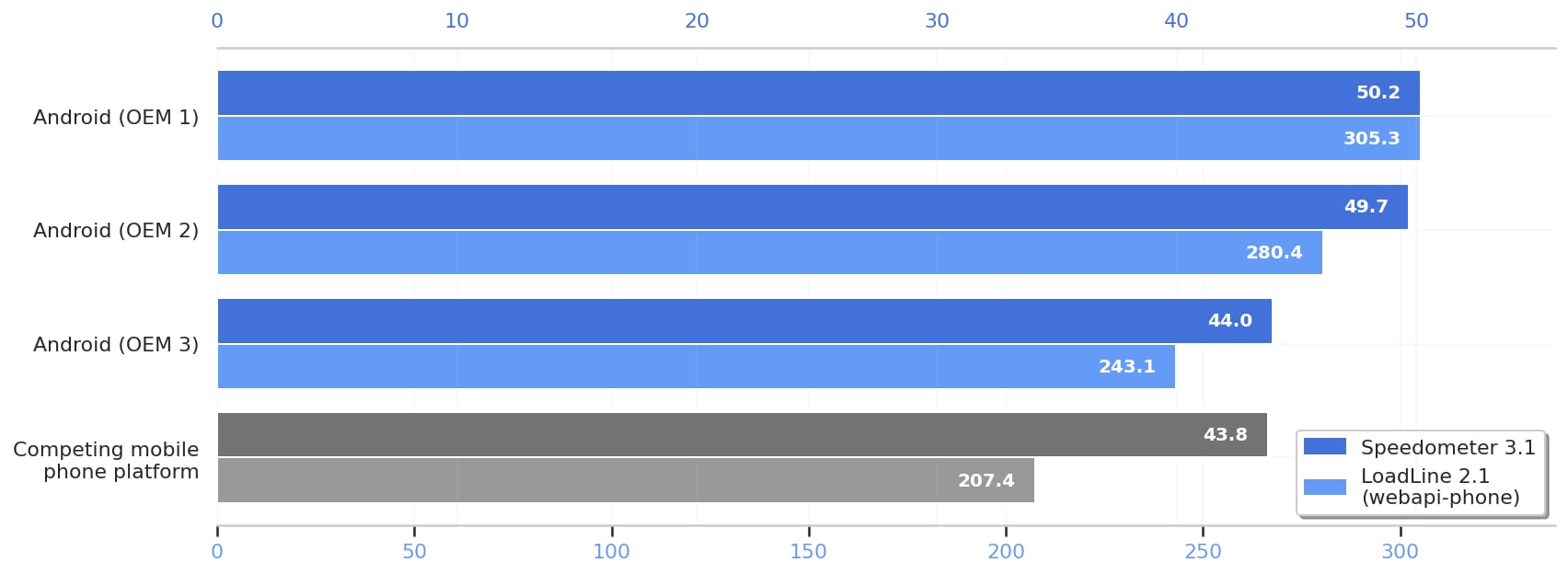
LoadLine is an emerging benchmark test developed by the Chrome and Android teams that simulates the complete process of loading a website to determine how fast a webpage appears after a link is clicked. Android phones score up to 47 percent higher on the LoadLine test than non-Android competitors, according to Google.
Google says that it collaborated with select SoC and OEM partners to optimize Chrome and kernel scheduler policies to get the faster web browsing speeds. With the improvements, some Android flagship phones have improved their Speedometer and LoadLine scores by 20 to 60 percent year-over-year. For users, the change translates to four to six percent faster page loads and six to nine percent faster high-percentile interactions.
Article Link: Google Claims Android Is Now Faster Than iPhone for Web Browsing
They’re so confident, they don’t even name the phone models, OS version, nor browser version.
Google today said that Android has set a new record for mobile web performance, making it the fastest mobile platform for web browsing.
The newest Android devices have set new records on web performance benchmarks like Speedometer and LoadLine, which Google attributes to "deep vertical integration across hardware, the Android OS, and the Chrome engine."
Speedometer simulates real-world user actions to measure interaction latency when using a web browser, and it's a metric that major browser engine developers use to determine responsiveness. According to Google, a high Speedometer score correlates to a "more fluid, snappy feeling when you tap, scroll, or type on a website."
In charts published by Google, three unnamed Android devices earned higher Speedometer 3.1 scores than an unnamed "competing mobile phone platform," which is likely iOS.
LoadLine is an emerging benchmark test developed by the Chrome and Android teams that simulates the complete process of loading a website to determine how fast a webpage appears after a link is clicked. Android phones score up to 47 percent higher on the LoadLine test than non-Android competitors, according to Google.
Google says that it collaborated with select SoC and OEM partners to optimize Chrome and kernel scheduler policies to get the faster web browsing speeds. With the improvements, some Android flagship phones have improved their Speedometer and LoadLine scores by 20 to 60 percent year-over-year. For users, the change translates to four to six percent faster page loads and six to nine percent faster high-percentile interactions.
Article Link: Google Claims Android Is Now Faster Than iPhone for Web Browsing

LoadLine is an emerging benchmark test developed by the Chrome and Android teams that simulates the complete process of loading a website to determine how fast a webpage appears after a link is clicked. Android phones score up to 47 percent higher on the LoadLine test than non-Android competitors, according to Google.
It's not a fair comparison because in iOS, Google Chrome is essentially just a "skin" over the WebKit web layout engine that is part of iOS. In Android, Chrome is running Google's own Blink web layout engine.
True. Every android user I see has to carry a charger with them. My 15PM is at 60% by bedtime.Now do battery life

TBF if web browsers on iOS weren't just rebadged crapari, sorry safari, then iOS would have quicker web browsing I'd imagine
True. Every android user I see has to carry a charger with them. My 15PM is at 60% by bedtime.
Agreed.
I do very little web browsing on my phone, but Safari kinda sucks. I end up using Firefox Focus most of the time.