
Got a tip for us?
Let us know
Become a MacRumors Supporter for $50/year with no ads, ability to filter front page stories, and private forums.
Google Claims Android Is Now Faster Than iPhone for Web Browsing
- Thread starter MacRumors
- Start date
- Sort by reaction score
You are using an out of date browser. It may not display this or other websites correctly.
You should upgrade or use an alternative browser.
You should upgrade or use an alternative browser.


Naraxus
macrumors 68030
Which has zero to do with the topic at hand. Nice try though.Keep in mind, Apple did a demo for Apple Intelligence that was completely fabricated

turbineseaplane
macrumors Penryn
Cool beans Google.
But at least on Safari my data isn't being sucked up faster than a Hoover vaccum.
I hate to break it to you about the Internet…
If you’re on it, your data is getting sucked up like a Hoover vacuum.

Would probably be a good idea for Apple to not insist of all browsers on iOS have to use the WebKit render engine?
The main positive feature on Android browsers is using native render engines like Blink and Gecko supporting standard web extensions - not only ad blockers! That is a feature I always envied Android users of...
The main positive feature on Android browsers is using native render engines like Blink and Gecko supporting standard web extensions - not only ad blockers! That is a feature I always envied Android users of...
Mark2series
macrumors newbie
And mobile Chrome is locked down so you can't add plugins or ad blockers, super cool. And it still scrolls like garbage on new Android devices compared to old iPhones on safari.
Unregistered 4U
macrumors G5
And, as a normal consumer and web user, the difference in performance is negligible at best and “still not worth switching platforms for” at worst. So, no need to go to any extra effort to display ads to the most valuable group of consumers in the world. 🙂And as a normal consumer and web user, all I want is a reliable and functional browser experience.
If Apple can’t get more people to care about their web browser, that’s their problem.
What is your M4 Mini configuration? I've got a base M4 Pro with 24GB and my numbers on Speedometer 3.1 were much lower (average of 5 runs in Safari/FF/Chrome got me 23.6/24.6/31.5).It's great to see any device platform make improvements in web browsing speeds.
I'm not sure where they are getting those numbers. I just did a Speedometer 3.1 test in Firefox on an M4 Mac Mini and got a 38.1 and Safari on the same computer was a 37.1 (confidence intervals overlapped between Firefox and Safari so it's unlikely the results were statistically different). I'm not sure if it matters, but that was using a wired 2 gbps internet connection. I do have ad blocking though.
Safari on my iPhone 16 Pro was only 26.7 with Speedometer 3.1.
Again, what are the test conditions and devices?
Unregistered 4U
macrumors G5
And, this quote…Slower than Chrome… at a benchmark made by the Chrome team.
lol.
is pulling a LOOOOT of weight. Nowhere does Google actually say they render faster than Safari on iOS. But, they’re very happy for everyone to assume that I’d bet. 🙂In charts published by Google, three unnamed Android devices earned higher Speedometer 3.1 scores than an unnamed "competing mobile phone platform," which is likely iOS.

TJFDenver
macrumors 6502
realmccoy69
macrumors member
Unregistered 4U
macrumors G5
Well, considering how that’s currently a thing in the EU and no browser company has released a browser without the WebKit render engine, it would have zero effect.Would probably be a good idea for Apple to not insist of all browsers on iOS have to use the WebKit render engine?
The main positive feature on Android browsers is using native render engines like Blink and Gecko supporting standard web extensions - not only ad blockers! That is a feature I always envied Android users of...

eveluvsrainbows
macrumors 6502a
Non-existent on my iPhone. Perhaps disable iCloud Private Relay if you have it enabled? I have it permanently disabled. iCloud Private Relay significantly impacts load times for some users.The 20 second pause in safari since iOS 26.3+ sure helps these stats
glorfindeal1
macrumors newbie
Well, just because it is only a thing in the EU, no browser manufacturer invest extra development for a browser only usable in the EU. Remember, a browser doesn't cost anything, so it doesn't bring in money. This was exactly Apples plan in malicious compliance to the rules!Well, considering how that’s currently a thing in the EU and no browser company has released a browser without the WebKit render engine, it would have zero effect.
neuropsychguy
macrumors 68040
Base M4 Mini (16 GB of RAM but with a 1 TB SSD I did the aftermarket upgrade). Firefox was pretty standard other than uBlock Origin installed. That was macOS 26.4.What is your M4 Mini configuration? I've got a base M4 Pro with 24GB and my numbers on Speedometer 3.1 were much lower (average of 5 runs in Safari/FF/Chrome got me 23.6/24.6/31.5).
I just tried on my work base model M4 Pro (24 GB RAM but running macOS 15.3.1) with the same Firefox setup (uBlock Origin) and got 40.77 average over 3 runs (two were 41.3 so I stopped there).
My Safari runs were 35.43 over 3 runs. That's a basic Safari install but with 1Blocker. I didn't try without the ad blocking off.
I only did 1 run at home so it looks like it's a complete wash between the two systems. If anything, Safari was "snappier" in macOS 26 than in 15.3.1 (which should be the case, because Apple's made some additional refinements to it). Although, my work computer is on a 1 gbps connection so I don't know if that made a difference.
I'm not sure why your numbers were lower. I still not sure what Google was running to get any of the results they did.

codewrangler
macrumors regular
Does not matter, really. Most experiences on a mobile device is through apps. not a browser. So...

ikramerica
macrumors 68020
May be true and meaningful, but reads like “chrome scores highest on test developed by chrome.”
Google today said that Android has set a new record for mobile web performance, making it the fastest mobile platform for web browsing.
The newest Android devices have set new records on web performance benchmarks like Speedometer and LoadLine, which Google attributes to "deep vertical integration across hardware, the Android OS, and the Chrome engine."
Speedometer simulates real-world user actions to measure interaction latency when using a web browser, and it's a metric that major browser engine developers use to determine responsiveness. According to Google, a high Speedometer score correlates to a "more fluid, snappy feeling when you tap, scroll, or type on a website."
In charts published by Google, three unnamed Android devices earned higher Speedometer 3.1 scores than an unnamed "competing mobile phone platform," which is likely iOS.
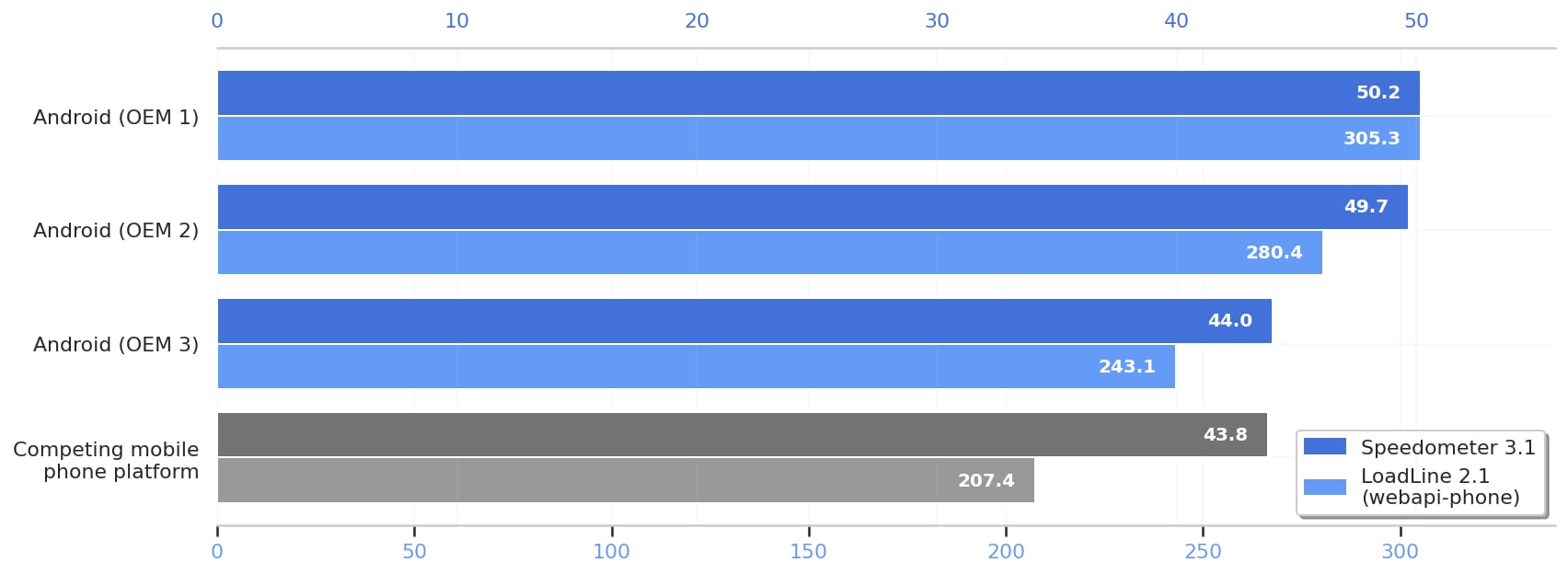
LoadLine is an emerging benchmark test developed by the Chrome and Android teams that simulates the complete process of loading a website to determine how fast a webpage appears after a link is clicked. Android phones score up to 47 percent higher on the LoadLine test than non-Android competitors, according to Google.
Google says that it collaborated with select SoC and OEM partners to optimize Chrome and kernel scheduler policies to get the faster web browsing speeds. With the improvements, some Android flagship phones have improved their Speedometer and LoadLine scores by 20 to 60 percent year-over-year. For users, the change translates to four to six percent faster page loads and six to nine percent faster high-percentile interactions.
Article Link: Google Claims Android Is Now Faster Than iPhone for Web Browsing

platinumaqua
macrumors 65816
Let's see, Safari supports ad blocking (content blockers) but Chrome (Android) doesn't. However, Android can run full fat Firefox that supports ad blocking extensions, so it's a wash to me
ikramerica
macrumors 68020
I care about FUNCTATION.Safari is the worst web browser. Only 7 of 10 websites works on Safari. I dont care about speed, I care about REABILITY !
now i see it
macrumors G4
Everyone knows that using an iPhone on the internet is a horrible experience for the most part. There are some exceptions of course- but it definitely sucks. Always has.

Ledsteplin
macrumors 68000

awesomecat
macrumors newbie

tbayrgs
macrumors 604
As someone who uses both Android and iOS, the mobile browsing experience on Android with Chrome is terrible. The UI is terrible, so much is only available under the hamburger menu, password autofill with 3rd party apps like 1Password is inconsistent at best and no content blocking extensions. Samsung’s browser is so much better, actually Android’s closest approximation to Safari. I’d use Firefox or Brave before Chrome.