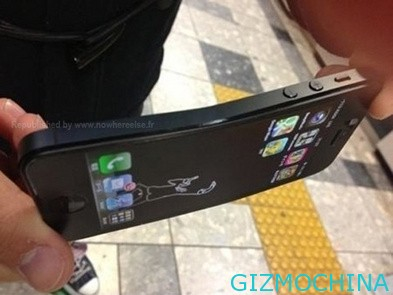
I've always thought plastic was able to absorb the impact greater while something stronger would transfer the impact directly to the screen but then again I'm not engineer.
In a case you want rubber to absorb the impact. Ideally, the rubber would be thick enough so that all the deformations caused by impact do not transfer to the actual phone, if that makes sense. Essentially, you want the rubber case to take all the impact, no the plastic on the phone.
A rubber case will bend inwards at the point of impact. That is how it absorbs the impact. And you want that as long as that bend stays in the case. But you never want the plastic to bend. See below.
I think you'll find if the thin aluminium of the iPhone 5 would bend considerably easier then that of the Galaxy S3. As ive already pointed out, aluminium is a "soft metal" - think of foil and cans.
You're joking, right? The plastic in that picture I showed you is so ridiculously thin and bends so easily. As for aluminum foil and soda cans, care to prove that the iPhone uses the same quality aluminum that is also at the same thickness? Or are you just going to say that with nothing to back it up?
Image
So a frame that doesn't deform or bend will keep the screen from breaking? And one that does will likely cause damage? The screen is bending in the picture!
You really can't read. Go back and read my last post. I never said it wouldn't bend. I only mentioned that it would require more pressure to get the aluminum in the iPhone 5 to bend as much as the plastic in a GS4. And thanks for showing this picture because it actually proves my point in a way.
The angle that this aluminum bends is far less than the GS4 plastic in the picture I linked to earlier. And which one do you think took more pressure to bend? Obviously the aluminum because the thin plastic on the GS4 is weak and easily flexible. So really, the plastic required less force and was able to bend at a higher angle, and the aluminum required more force and did not bend as much.
And here is where something that is easily flexible can harm a phone.

Imagine this phone is falling to the floor and lands on this top right corner. The two lines indicate how much the frame bends inward at the point of impact. So before going on, which line would put more stress on the glass? The one that bends inward more, or the one that bends inward less? I would love to hear your answer on this specific question when you undoubtedly respond with more half-thought arguments.
Now, as has been discussed, the plastic in the GS4 bends ridiculously easy. If you don't believe me, take the plastic back off a GS3 and just feel how weak and flexible it is. Multiple reports indicate they are using the same "quality" of plastic.
So judging from that, we can tell that plastic will require much less force in order to deform. And aluminum would require more force in order to deform at the same magnitude of something that is plastic.
So the black line indicates how much an aluminum frame would deform on impact, and the red line indicates how much a plastic frame would deform on impact with the same amount of force, and a phone of the same weight and size.
It is simple, which deformation, the one indicated by the black line or the one indicated by the red line, will cause more stress on the front glass?
A STIFF frame will PREVENT damage? Is this why its important to isolate glass AWAY from stiff frames in cars and buildings? There's always an absorbent material around them, rubbers, silicones, etc.
SHOCK is what shatters glass/screens. That's why we put softer cases on our phones! It's also why a phone screen is more likely to break in a designer metal case that's stiff and rigid. More shock the case absorbs the less it transfers.
Your new theory is like saying a car with a rigid frame and no crumple zones is safer then one with those things. When in reality all the shock/impact is transferred to place you don't want it too in stuff/rigid material.
See above.