

Become a MacRumors Supporter for $50/year with no ads, ability to filter front page stories, and private forums.

MacRumors

macrumors bot
Original poster


Apple grew iPhone shipments in China by 24.4 percent year over year in the second quarter of 2026, making it the fastest-growing smartphone brand in a market that shrank overall, according to preliminary figures released today by research firm IDC.

iPhone-17-Review-Thumb-3.jpg

Total shipments in China fell 4.3 percent to roughly 66 million units, amounting to a fifth consecutive quarter of decline. Apple and Huawei were the only major vendors to grow, with Huawei up 19.4 percent.

Apple's share of the Chinese market rose from 13.9 percent to 18.1 percent year over year, which was second only to Huawei's 22.6 percent. Meanwhile, Xiaomi suffered the steepest fall among the big brands, with shipments down 21.7 percent.

IDC attributes the market divergence largely to the way vendors reacted to rising memory and component costs amid the AI infrastructure buildout. Most Android vendors raised prices from late March, but Apple and Huawei held theirs steady, instead introducing targeted promotions.

On top of this, Huawei kept widening its lineup to cover more of the market, while Apple's early warnings of upcoming price increases in the second half of the year encouraged some buyers to purchase iPhone 17 series models sooner than they might have otherwise. "That gave hesitant buyers a reason to go ahead and purchase," said IDC analyst Arthur Guo.

The growth came despite a weak June market, as smartphone sales during China's "618" shopping festival fell nearly 15 percent compared to the same period in 2025.
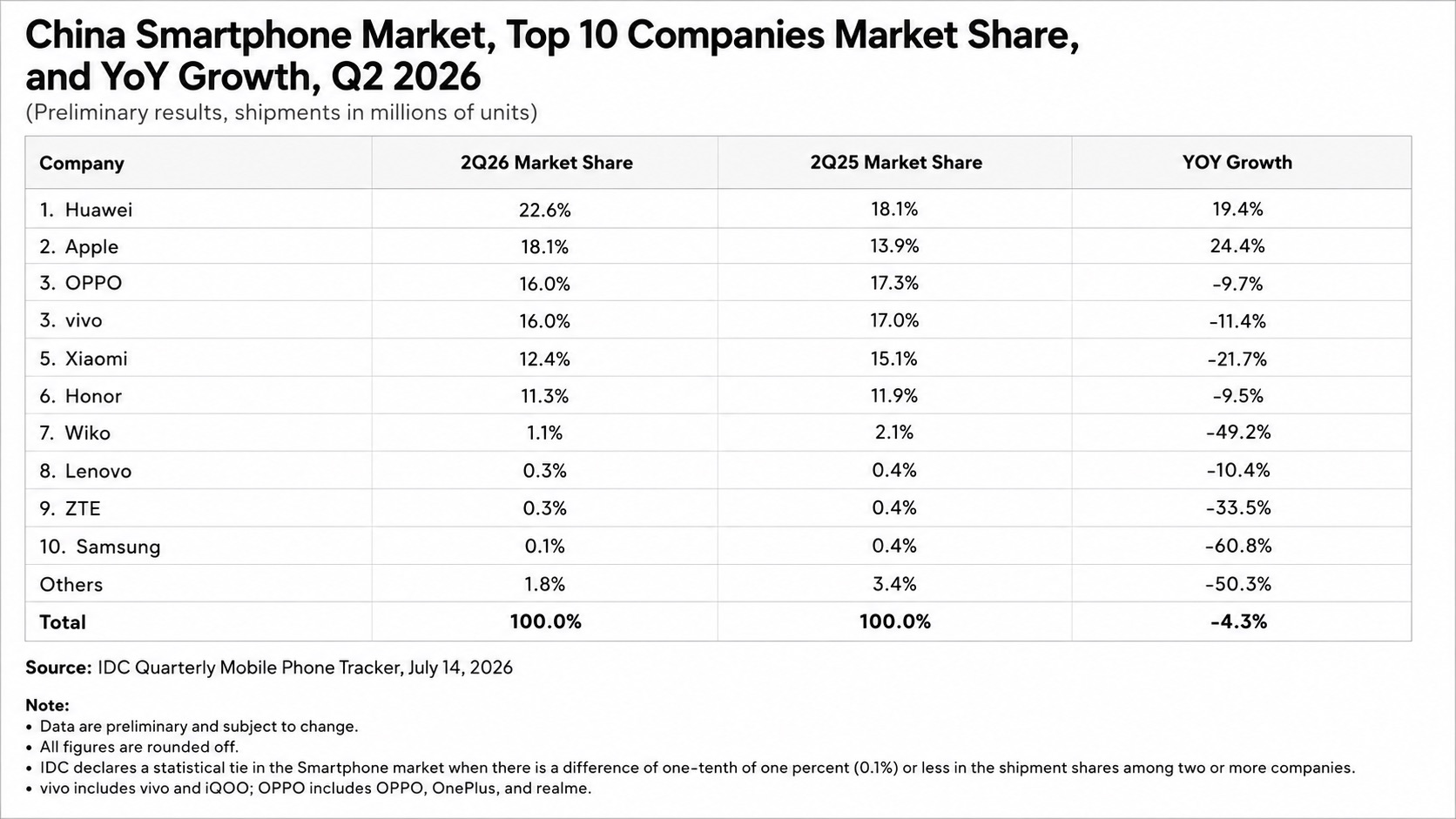
idc-china-smartphone-market-q2-2026.jpg

IDC says it expects conditions to deteriorate over the next couple of years. As vendors run down cheaper component inventory, the firm forecasts China's year-over-year decline could widen to around 20 percent in the second half of 2026, right around when Apple is expected to launch its new iPhone 18 Pro models and first foldable iPhone. Storage prices are unlikely to ease meaningfully before 2027, and a broader recovery is not expected until 2028 or 2029, reckons IDC.

On the bright side, the research firm believes customers are postponing upgrades rather than walking away from smartphones, so the delayed demand should return in time. On that basis, a recovery could arrive around 2028–2029 as a fresh replacement cycle comes due.

Article Link: iPhone 17 Pricing Helped Apple Buck China's Q2 Smartphone Decline
 
  • Haha
Reactions: Z-4195
Continuing to sell the 17 into next year at the same price is turning out to be a good move.

Ordinarily at this point in the cycle I’d tell people to wait, but it’s still a good deal.
 
I spent most of May in China this year. I was amazed at the relatively common sight of Chinese people with their iPhones. It seems (based purely on observations) that people in China hang onto their phones, at least their iPhones a lot longer than they do here, which might explain the overall decline in sales, but makes Apple's growth spurt in current sales marketshare even more compelling. I wonder what Apple's share of the overall Chinese user base is? I also wonder if Chinese people hang onto their HarmonyOS (Android-like) phones as long as their iPhones? Based on the overall lack of quality, I'd guess the answer is definitely no.
 
  • Like
Reactions: Le_Chiffre
Lower margins. Not something investors like to see. Probably worse than a temporary sales slump.
Lower margins that have been offset by price increase to Macs, iPads, Apple TV, HomePods, and Apple Vision.

I ask the question again, what would happen if Apple didn’t raise iPhone prices this year?
 
Lower margins that have been offset by price increase to Macs, iPads, Apple TV, HomePods, and Apple Vision.

I ask the question again, what would happen if Apple didn’t raise iPhone prices this year?
It's worth contemplating, as the answer is all but a forgone conclusion -- but it's a hypothetical that few are going to believe is possible, given Apple's history of maintaining impressively high margins, as compared to their competitors. Of course, as already pointed out, their real cash cow these days is services... so just as the stock analysts always like to say, "past performance is not indicative of future results," and all that.
 
It's worth contemplating, as the answer is all but a forgone conclusion -- but it's a hypothetical that few are going to believe is possible, given Apple's history of maintaining impressively high margins, as compared to their competitors. Of course, as already pointed out, their real cash cow these days is services... so just as the stock analysts always like to say, "past performance is not indicative of future results," and all that.

Past performance and decisions are not indicative of future results due to a whole host of variables.

Not many want to realize that most of the components and prices for the iPhone 18 series has already been locked in last year.

If Apple may increase prices this year and might not. If they do not, the competition will certainly decline in marketshare in comparison to Apple and the iPhone.

Some will go out of business in the next 12 months. Others will go out of business in the next 6 months. A few will go out of business in the next couple of weeks.

Lenevo, Motorola, one plus, zte, nothing, and Sony are all in danger of exiting the smartphone business, the only variable is when.
 
Lenevo, Motorola, one plus, zte, nothing, and Sony are all in danger of exiting the smartphone business, the only variable is when.
Chinese brands could be the big winner in the mid-term if they manage to get preferential contracts with domestic DRAM and NAND manufacturers. Apple customers tend to be more loyal, but some of them will switch to different brands if prices go up beyond a certain threshold. It's a tricky situation for Apple.

Elevated but stable prices were very good for Apple. A sudden change could be quite dangerous though, because consumers will have a reason to question their past preferences.
 
Chinese brands could be the big winner in the mid-term if they manage to get preferential contracts with domestic DRAM and NAND manufacturers and could use the price advantage to gain market share in Europe and the ROW. Apple customers tend to be more loyal but some of them might switch to different brands if prices go up significantly. It's a tricky situation for Apple.

Chinese brands are going to be hit the hardest. Many Chinese Android oems will stop making flagship phones altogether and are getting hit hard on the budget and midrange segments.

Xiaomi already cancelled their flagship phonee altogether, the 18 ultra.
IMG_4388.jpeg


Chinese Android oems might be the biggest losers in the next 12 months, not the biggest winners. 😂
 
Apple already raised prices on the Neo. You have to be born yesterday if you don't think price increases aren't upcoming on the iPhone 18. iPhone 18 Pro is going up $300.
Exactly, Apple raised prices on the Mac, iPads, Apple TV, HomePods, and Apple Vision. But not iPhones.

This isn’t difficult, what if Apple does not raise iPhone 18 prices this year?
 
Register on MacRumors! This sidebar will go away, and you'll see fewer ads.