Become a MacRumors Supporter for $50/year with no ads, ability to filter front page stories, and private forums.
What is the use case for needing hyper fast charging? Unless you’re traveling most people need to recharge phone once per day. At your computer/ipad? Plug it in for however long you have. If not using a car charger, carry your iPad/macbook/anker charger and you’re set.
 
  • Like
Reactions: platinumaqua
Silicon Carbon batteries don’t have the same long lifespan as lithium ion. They are going to the landfill a lot earlier
Potentially,

Though My One+ Watch 3 still lasts most of a work week without needing a charge, same as it did when I purchased it. I know it will likely degrade at some point, but so far it isn't losing capacity in any noticeable regard during my time with it.
 
Potentially,

Though My One+ Watch 3 still lasts most of a work week without needing a charge, same as it did when I purchased it. I know it will likely degrade at some point, but so far it isn't losing capacity in any noticeable regard during my time with it.
It’s not potentially, it’s confirmed by HTC on MKBHD interview. One reason Apple doesn’t want anything to do with it
 
It’s not potentially, it’s confirmed by HTC on MKBHD interview. One reason Apple doesn’t want anything to do with it
Respectfully to YouTube , no. That information is based on dated, and honestly legacy tech that made the way to some of the Chinese (and other) smartphones.

One+ doesn't employ the latest advancements in this tech and is using an older specification with the drawbacks MKBHD (great guy, but not a scientist) outlines.

Also remember One+ is not the flagship it used to be, the parent company is all but replacing / retiring the brand. That is a Big reason that Karl Pai (Now leader at Nothing) left the brand.


Source = Tycorun
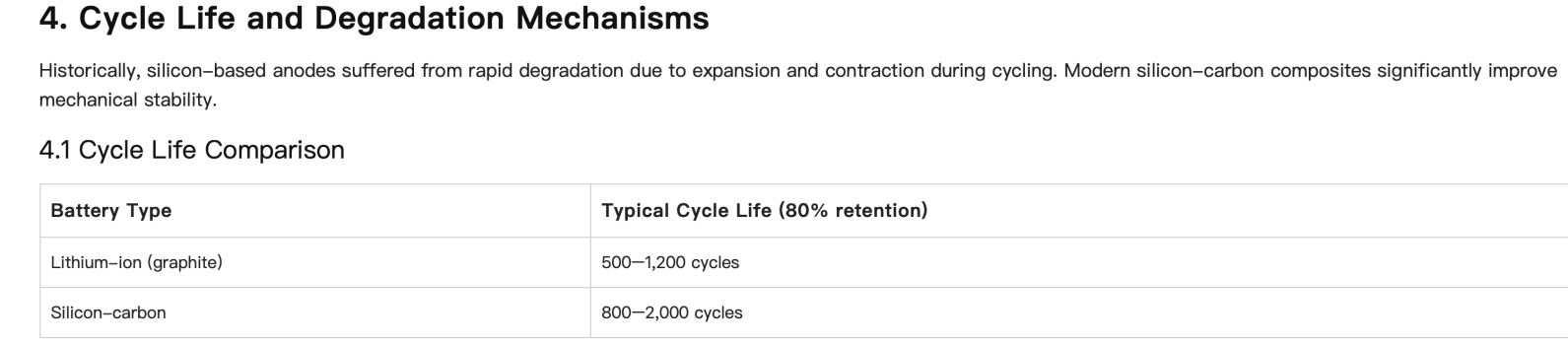
  • Silicon carbon batteries deliver longer cycle life and calendar lifespan, reaching 1,500–3,000+ cycles and 7–10 years due to improved lithium storage capacity and engineered structural stability.

source = A&S Power

Screenshot 2026-05-16 at 5.06.04 PM.png

There is also another added benefit to this tech.

Same source

Screenshot 2026-05-16 at 5.04.54 PM.png


Historically yes the technology was subject to degrading due to expansion, but the technology is advancing as well as the manufacturing process. If one can resist fast charging (which creates more heat that degrades the lithium component to both Lithium ion and Silicon-Carbon), it is showing enough potential that large manufacturers such as Toshiba, Eaton, Samsung and others are looking into it for next generation UPS batteries.

Additionally, all lithium batteries are subject to degradation based on the quantity of charge cycles they see. The higher density (available power storage) of Si/C means a battery sees a charger less, meaning less cycles, and less overall impact to the chemical storage.

As I have stated, I have not seen any degraded performance after having My One+ watch for a year, it also saw ¼ the charge cycles my AWU saw the year before I switched to it being my primary. My 1+ is still a 4day + per charge watch, and I actually use my devices functions.

This type of battery, and other solid state varients are going to end up in iPhones, and other devices in the Future. Glad apple didn't employ the 1st gen Si/C batteries just to say they did it, the early versions have too many disadvantages.


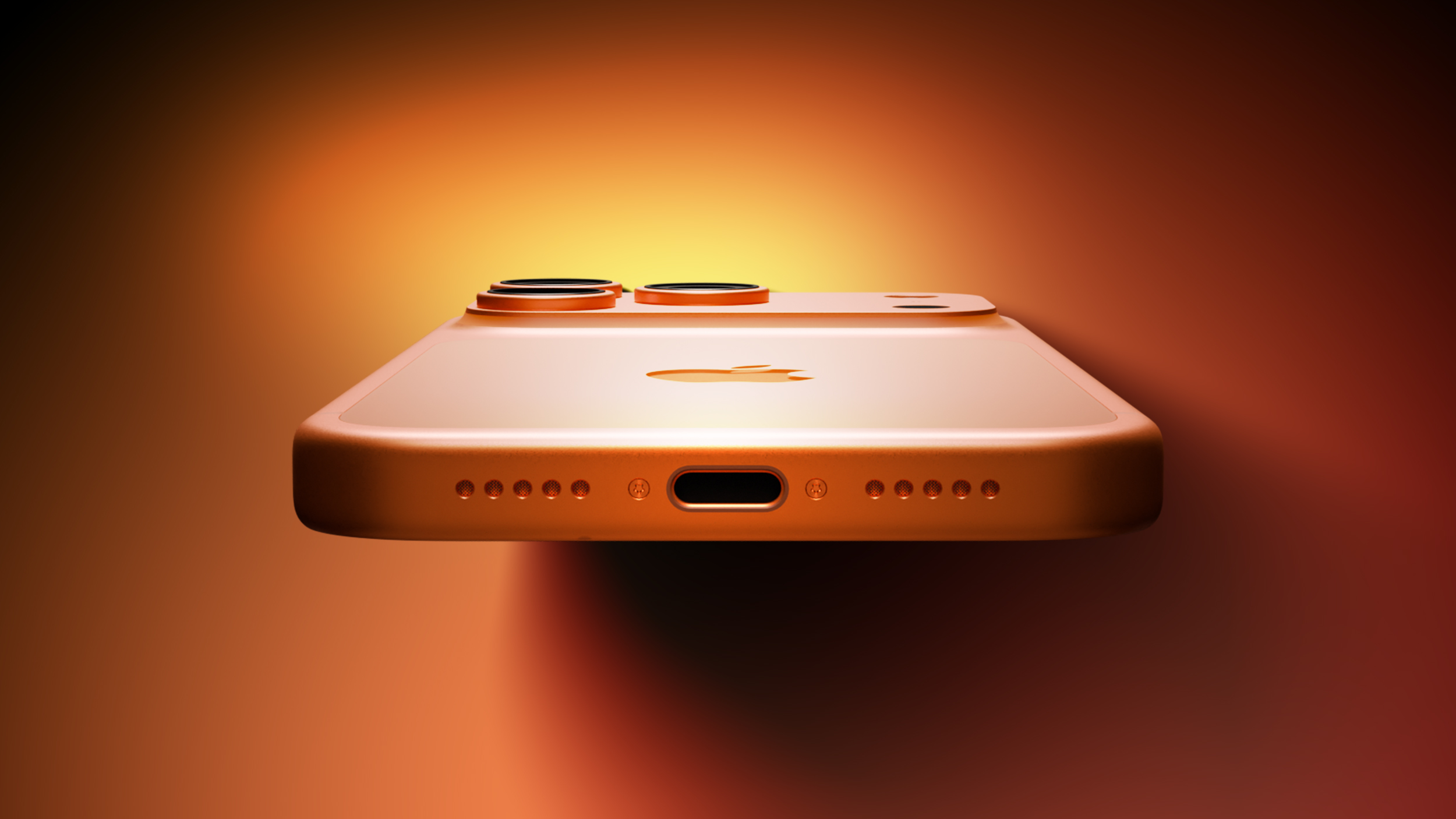
Apple's iPhone 17 Pro has been named the fastest-charging phone overall in a new CNET lab test covering 33 smartphones, with Samsung's Galaxy S26 Ultra taking the top spot for wired charging speed.

iPhone-17-Pro-USB-C-Port.jpg

To determine the rankings, CNET's lab team ran each phone through a 30-minute wired charging test starting at 10% battery or less, using the phone's included cable and a wall charger rated at or above the device's maximum supported speed. Phones that support wireless charging went through a matching 30-minute wireless test using a Qi (7.5W), Qi2 (15W), or Qi2.2 (25W) charger matched to the phone's peak supported speed. CNET then averaged the wired and wireless results into an overall charging score.

The iPhone 17 Pro's win in the overall category is partly a function of its relatively compact 4,252mAh battery, which is smaller than the 5,000mAh or larger capacities common among competing flagships. With less capacity to fill, the 17 Pro charges faster in absolute terms, and it supports both 40-watt wired charging and 25-watt Qi2.2 wireless charging. CNET notes that battery size is just one factor in overall battery life, alongside processor and software efficiency, and in its battery life testing, the iPhone 17 Pro Max came out on top for endurance.

For wired charging, Samsung's Galaxy S26 Ultra took the top spot, adding 76% charge in 30 minutes via its 60-watt wired charging speed, the fastest of any Samsung flagship to date. The iPhone 17 Pro came in second at 74%, tied with Motorola's Moto G Stylus (2025). The OnePlus 15 followed with 72%, while the iPhone 17, iPhone 17 Pro Max, and Samsung Galaxy S25 FE each reached 69%.

Apple's iPhone 17 Pro also claimed the fastest wireless charging result, gaining 55% in 30 minutes. The iPhone 17 Pro Max added 53%, followed by the iPhone 17 at 49%, the iPhone Air at 47%, and the Galaxy S26 Ultra at 39%. CNET again attributes the 17 Pro's edge over the 17 Pro Max largely to its smaller battery, since both devices share the same A19 Pro chip and software.

Across all brands tested, Apple had the most consistent fast-charging performance by a considerable margin, averaging 54.6% across the four iPhone 17 models and the iPhone Air. Samsung's nine-phone average came in at 38.5%, with the Galaxy S26 Ultra as its strongest performer and the Galaxy Z Fold 7 as its weakest at 29%.

Silicon-carbon batteries, which use a silicon-based anode rather than graphite to enable higher capacities and faster charge rates, appeared among several of the top performers. The OnePlus 15, for example, recharged 72% of its 7,300mAh silicon-carbon battery in 30 minutes using a proprietary 80-watt charger. Silicon-carbon phones in the U.S. remain limited to OnePlus, RedMagic, and Poco. Apple, Samsung, and Google have not yet adopted the technology.

Article Link: iPhone 17 Pro Named Fastest-Charging Smartphone

There are Chinese phones that charge much faster but they don’t get any consideration.

This is just engagement bait to get fanboys worked up.
 
  • Haha
Reactions: I7guy
Simple: silicon carbon batteries when they start to fail can physically expand at a much higher level than a failing lithium-ion battery. You really wonder will Oppo realize this issue with their new smartphones that use this new battery technology.

This is why I think Apple is more likely investigating the use of solid-state batteries for future iPhones, iPads and MacBook models.
Oppo is most certainly aware, but it’s not like the chips they use are keeping pace with Apple’s performance/efficiency. Imagine how it’d look with an iPhone capacity cell. 😀
 
2026 tech "reviews", folks. Corporate boardroom slop, like everything else in tech 🤮

Now search for Apple product reviews on YouTube and look at how many shills a $4T megacorp can buy off.
No one has to buy them off. They’re all just producing rage-bait and nothing gets tens of thousands of folks rushing to their keyboards in the comments like ANYTHING including Apple. Oh, and copy/pasting the link hither an yon.
 
What is the use case for needing hyper fast charging? Unless you’re traveling most people need to recharge phone once per day. At your computer/ipad? Plug it in for however long you have. If not using a car charger, carry your iPad/macbook/anker charger and you’re set.
It’s one of the few bullet points where one Android can say it’s better than another Android. For those folks that just buy “whatever the biggest numbers are” when replacing their current phone, it could make a difference.
 
Register on MacRumors! This sidebar will go away, and you'll see fewer ads.