not just latency, but available bandwidth. a single satellite covers a crazy big area. large area -> more UEs -> more traffic, but you have a finite amount of bandwidth.
let's get something straight: there's no free lunch in physics. if you want bandwidth, you need signal level and high signal to noise ratio. the antenna on the iPhone is tuned to work best with terrestrial cell networks, because
a: they're close (a few km away)
b: there's regulations that limit how much power your phone can radiate (to keep it from frying your cells)
now unless you want to add a massive antenna and/or a power hungry dsp, there won't be comparable reception with the same base station that orbits several 100km away from you. also, if you want to transmit to that thing, the weak signal from your phone has to be clear enough to isolate it from the background noise. this might only work if you're in the middle of a wilderness, where there's no RF contamination. otherwise the device will be limited to a low speed, simple modulation to get the message through.
in either way, whatever *higher* speed communication your iphone phone does isn't "satellite magic", it's the same LTE or 5GNR cellular stack, but in this case the base station is bolted to a satellite and has a massive antenna with lots of gain. this is referred as DTC, which stands for direct to cell.
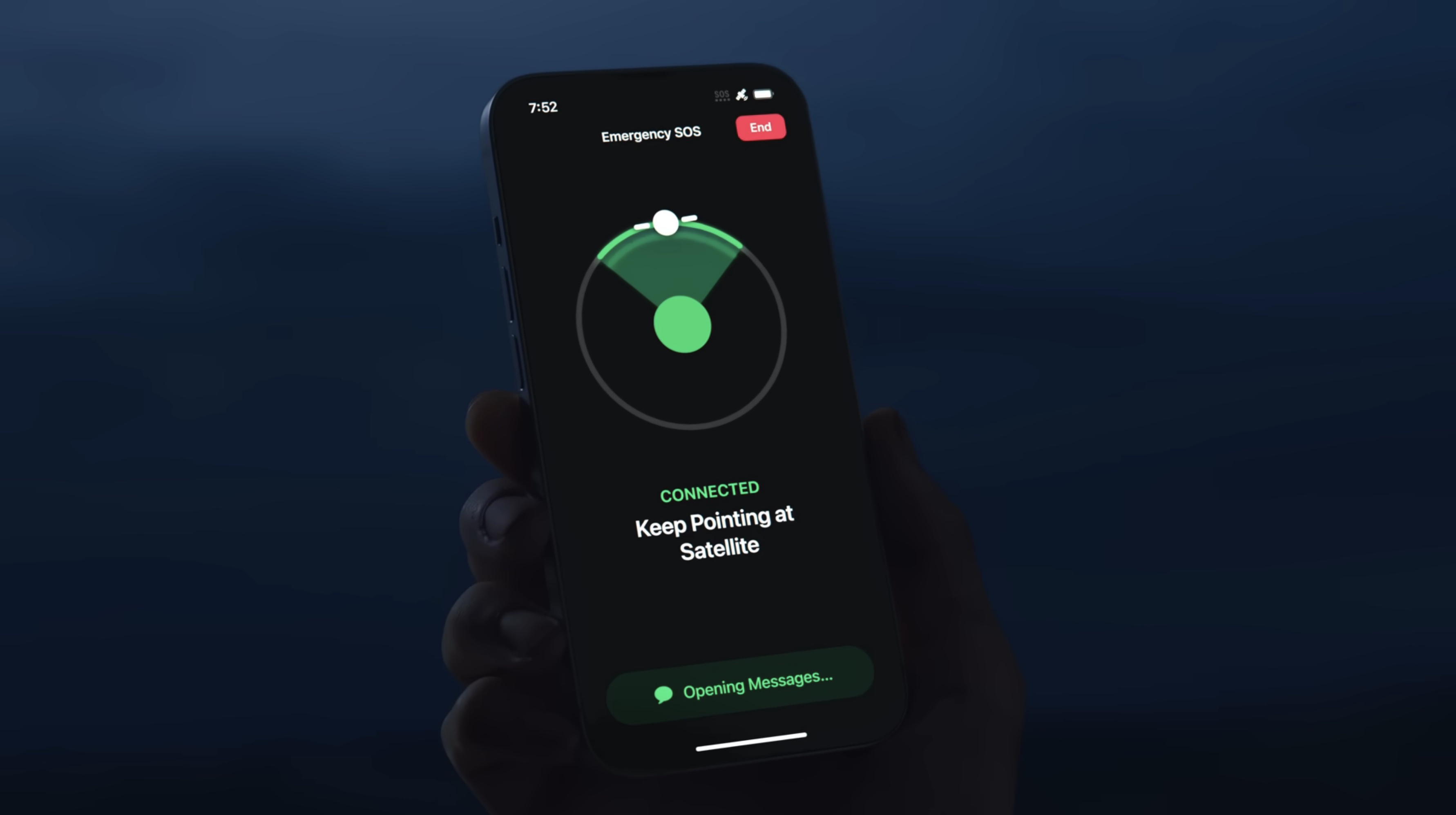
Apple's original satellite services relied (and still rely) on specialized hw (the radio), a custom modulation scheme and there was a reason why one could just choose from a handful of different messages to send: those weren't transmitted as text, but as a few bits. basically every message was translated to a single number and only that bits were sent along with the coordinates of the device for the exact same reason: not enough bandwidth.
DTC is available on all devices, because there's nothing special in it. it's the same LTE as you have it on the ground, but it's a lot further away from you.
latency is also a big challenge as radio waves cannot move faster than they do right now. so transmitting to a distance 10-100x larger than to a terrestrial station will take 10-100x much time, and this also applies to the travel time of the response. and as mentioned, we have the inverse square law in play - so the transmitted signal strength will be reduced by the square of the distance. low signal strength, low SNR -> simpler modulation -> less throughput.
not to mention that it is the dumbest idea ever to have cell transmission to satellites unless there's no easier way (like terrestrial cell stations) available. either the terrain is very challenging or it is really in the middle of nowhere - otherwise in every developed country you'll have some sort of cell signal available.
don't get me wrong: everything that enables communication for folks who got lost and need help is absolutely phenomenal and very much necessary, but please don't expect to rely on this wherever you go if there's a better alternative available. simply put: there's not enough bandwidth available for this.