
Got a tip for us?
Let us know
Become a MacRumors Supporter for $50/year with no ads, ability to filter front page stories, and private forums.
Isn't the resolution on the 15" low?
- Thread starter tofagerl
- Start date
- Sort by reaction score
You are using an out of date browser. It may not display this or other websites correctly.
You should upgrade or use an alternative browser.
You should upgrade or use an alternative browser.
This question seems to come up every fortnight or so, doesn't it?! 🙂 Every time there are posts that say to have WUXGA 15.4" screens one needs to be "young", "have good eyes", "it is hype", "ridiculous", etc etc. High res of course means the hardware provides a higher density of image. A higher density image is easier on eyes, not harder. So the problem is in the software setup. Either the software is not HD-compliant, can't be changed to make it compliant, or the user doesn't know how to configure the software to make it compliant - or a combination of all three. If the software is setup appropriately, in every case, higher HD is clearer and easier on the eyes than lower HD. This of course is even more important if you have poor eyes! I have been using W/UXGA 15.4'/15" screens for 12 years or so, for about 10+ hours a day, and have sub-standard, "old', eyes, and can attest that these screens are by a long way the most pleasant to use - but I do have the software setup appropriate for the hardware - and me. 😀
RaceTripper
macrumors 68030
I call B.S. on your claim. You are ignoring the issue that for some people text that is too small can be very hard or impossible to read without magnification, regardless of how clear it is. I am far-sighted and cannot read the text on a 17" MBP or any other high-res monitor with high pixel density. Just because it works for you doesn't mean it works for other with vision problems. Not all vision problems are the same, and high-res laptop displays are not for everyone. If I had the 17" MBP I would have to hold it too close to my face to use it. There are no software settings that will fix that.This question seems to come up every fortnight or so, doesn't it?! 🙂 Every time there are posts that say to have WUXGA 15.4" screens one needs to be "young", "have good eyes", "it is hype", "ridiculous", etc etc. High res of course means the hardware provides a higher density of image. A higher density image is easier on eyes, not harder. So the problem is in the software setup. Either the software is not HD-compliant, can't be changed to make it compliant, or the user doesn't know how to configure the software to make it compliant - or a combination of all three. If the software is setup appropriately, in every case, higher HD is clearer and easier on the eyes than lower HD. This of course is even more important if you have poor eyes! I have been using W/UXGA 15.4'/15" screens for 12 years or so, for about 10+ hours a day, and have sub-standard, "old', eyes, and can attest that these screens are by a long way the most pleasant to use - but I do have the software setup appropriate for the hardware - and me. 😀
poematik14
macrumors member
Poematick that seems a bit off to me, I mean the new MBP's have better screens... but there is no doubt that a lot of other manufactures dont use the same quality screens, but at the same time they aren't really geared toward the same group of consumers.
Well Im making that statement based on personal experience...when I got my MBP i placed it side by side with my sister's HP and there was a CLEAR difference in viewing angle, contrast, everything.

I call B.S. on your claim. You are ignoring the issue that for some people text that is too small can be very hard or impossible to read without magnification, regardless of how clear it is. I am far-sighted and cannot read the text on a 17" MBP or any other high-res monitor with high pixel density. Just because it works for you doesn't mean it works for other with vision problems. Not all vision problems are the same, and high-res laptop displays are not for everyone. If I had the 17" MBP I would have to hold it too close to my face to use it. There are no software settings that will fix that.
Up the text size. It can be done in almost every program available on the market.
RaceTripper
macrumors 68030
Almost, but not all, and that's just for content. It's not that simple. Not to mention, you still have to contend with menus, text in dialog boxes and other interface widgets, and so on. It makes for a poor user experience if you have a screen resolution that's too small, regardless that you can Cmd-Shift-+ to increase font size. Besides, it's a circular argument to say that higher res is better but that you have to do extra things to make text readable.Up the text size. It can be done in almost every program available on the market.
I've already dealt with this. The Mac is just not that configurable. It's actually easier to deal with this in Windows XP. I have a Dell Precision M90 17" laptop with 1920x1200 res, but I can scale everything up at the hardware level, and it allows me to increase fonts size across the OS & look very good, not just with a hotkey to increment text size in some apps.
I'm sure the high-res displays are great for a lot of people, but they aren't for everyone.

tenderidol
macrumors regular
Up the text size. It can be done in almost every program available on the market.
If this is your only answer to the problem, apparently you haven't used a high resolution screen laptop for a long time (i.e., longer than "playing with it in an Apple store"). It takes a lot of work to get everything to a comfortable level. As mentioned above, it works great for some people and it is simply just torture for others.

Yeah, you're right. Menus and stuff is one point where Mac is behind Windows in the resolution independence thing.
In fact, that could very well be why Apple doesn't use a higher res display on the 15" - people would complain. Still think they should offer an option, but they might not want to deal with the extra SKU on the supply-chain.
In fact, that could very well be why Apple doesn't use a higher res display on the 15" - people would complain. Still think they should offer an option, but they might not want to deal with the extra SKU on the supply-chain.
I have an early '08 version MacBook Pro (bought it a few weeks before the aluminum one's release not knowingly 🙁) and I don't have any issues with the resolution. It is very fine for me, in games, documents, movies, pictures, and everything. It is very portable and in the same its screen is really nice when playing movies. I was going to get the 17" but I figured it's kind of too big since I need to take it to university every day morning and it didn't even fit in the bag sizes that I want (I hate stuff that are too big). The 17" one is awesome for home use, to be honest. Playing movies and games on that screen is amazing!
What's better than all of those is getting a 13" MacBook Pro and buying a 22" (or so) Apple screen then connecting. Take the notebook with you to work or quick use and connect it to the screen at home.
What's better than all of those is getting a 13" MacBook Pro and buying a 22" (or so) Apple screen then connecting. Take the notebook with you to work or quick use and connect it to the screen at home.
sharpblade1986
macrumors newbie
IMO mbp15's screen could be 1680*1050. With 1440*900 the desktop is pretty small unless the dock is on left side or at bottom with auto-hide which is a bit annoying to me. I bought an mbp17 because of gorgeous screen resolution which is very important for me. My bro has an mbp15 and the screen resolution is too low. It is just my opinion. It depends what you do on a computer.
Just my 0.02$.
Just my 0.02$.
Yeah, well wait 'till you're 50. 🙁
My boss is 53 and agrees with me, as does my 63 yr. old father. Both have high res Thinkpads. Both also visit the eye doctor to have their vision corrected. 😉
Both went to the right place for their eyes. For setting up their Thinkpads, they should have gone for help elsewhere! 🙂 Though OSX may not be so HD-friendly, Vista and XP (and Ubuntu even more so) are very easily configurable for HD screens. Once done (takes 5 minutes, if you know how), you should have less eye strain using a 15.4" WUXGA than lower resolutions/densities. Those who complain of eye strain on them (provided there is no hardware defect - like a fading back-light) have ill-configured software - either because of limitations of the software, or because they haven't configured it appropriately, either through choice or lack of ability to do so - or do need need to see an optometrist! 🙂My boss is 53 and agrees with me, as does my 63 yr. old father. Both have high res Thinkpads. Both also visit the eye doctor to have their vision corrected. 😉
Both went to the right place for their eyes. For setting up their Thinkpads, they should have gone for help elsewhere! 🙂 Though OSX may not be so HD-friendly, Vista and XP (and Ubuntu even more so) are very easily configurable for HD screens. Once done (takes 5 minutes, if you know how), you should have less eye strain using a 15.4" WUXGA than lower resolutions/densities. Those who complain of eye strain on them (provided there is no hardware defect - like a fading back-light) have ill-configured software - either because of limitations of the software, or because they haven't configured it appropriately, either through choice or lack of ability to do so - or do need need to see an optometrist! 🙂
1920x1200 is disgusting on a 15" laptop display unless your face is a foot away from the screen..
1920x1200 is disgusting on a 15" laptop display unless your face is a foot away from the screen..
You should check out a Thinkpad with an LED backlit screen. A quality screen like that is worlds different than say the Dell M60 I had @ 1920x1200 w/ 15".
RaceTripper
macrumors 68030
So what? I have my eyes checked and get corrective lens too. I wear very high quality bifocal lens. You can find 100 or 1000 or 1M people that agree with you but it still doesn't make it universally true (which it isn't). Not to mention your elders are using Windows which is configurable for high res screen use, but I use Mac OS which is not.My boss is 53 and agrees with me, as does my 63 yr. old father. Both have high res Thinkpads. Both also visit the eye doctor to have their vision corrected. 😉
So what? I have my eyes checked and get corrective lens too. I wear very high quality bifocal lens. You can find 100 or 1000 or 1M people that agree with you but it still doesn't make it universally true (which it isn't). Not to mention your elders are using Windows which is configurable for high res screen use, but I use Mac OS which is not.
Settle down, Francis. It's an opinion. Did I ever say it was 100% universally true for everyone everywhere in the whole universe to use high res screens?

phairphan
macrumors 6502a
This is clearly an issue for which people have differing personal preferences. I just wish Apple would offer an option for a higher res screen, like they did with the 17" a few revisions ago. I've always thought the resolution on the 15" wasn't quite high enough. The Lenovo x61T I picked up last year has a 1400x1050 12.1" screen and it rocks!
This is clearly an issue for which people have differing personal preferences. I just wish Apple would offer an option for a higher res screen, like they did with the 17" a few revisions ago. I've always thought the resolution on the 15" wasn't quite high enough. The Lenovo x61T I picked up last year has a 1400x1050 12.1" screen and it rocks!
Choice is good.
Attachments
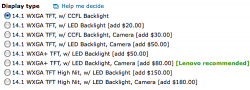
Well, if they wanted to keep it just one SKU, they could ship the better resolution screen, and in the normal "insert name here" configuration at first boot, they could ask if you prefered a normal UI, or a lower DPI version of it that was ~1440 sized.
Of course, they would have to make that lower DPI version, but they've been talking about resolution independence for YEARS now without ever shipping it.
Of course, they would have to make that lower DPI version, but they've been talking about resolution independence for YEARS now without ever shipping it.
Choice is good.
Honestly, that amount of choice would just confuse me, and I know what every damn one of those Three Letter Abbreviations mean.
At work we supply computers to a huge school district (Oslo, Norway) and allow them to pick the models. If the order sheet looked like that for Lenovo, they wouldn't sell a single machine.
So what? I have my eyes checked and get corrective lens too. I wear very high quality bifocal lens. You can find 100 or 1000 or 1M people that agree with you but it still doesn't make it universally true (which it isn't). Not to mention your elders are using Windows which is configurable for high res screen use, but I use Mac OS which is not.
You can make stuff bigger in OSX too..🙄
You should check out a Thinkpad with an LED backlit screen. A quality screen like that is worlds different than say the Dell M60 I had @ 1920x1200 w/ 15".
I meant everything is tiny. Sure you could make it bigger but then it'd defeat the purpose of having such a high resolution.
Honestly, that amount of choice would just confuse me, and I know what every damn one of those Three Letter Abbreviations mean.
At work we supply computers to a huge school district (Oslo, Norway) and allow them to pick the models. If the order sheet looked like that for Lenovo, they wouldn't sell a single machine.
That is Lenovo.
I meant everything is tiny. Sure you could make it bigger but then it'd defeat the purpose of having such a high resolution.
I know what you meant. My point was that the clarity and even lighting of the Lenovo's LED screens are such that even with finer resolution it's not as difficult to read as a machine with a lesser quality display.
In other words, the display's quality certainly plays into how easy it is to view certain resolutions.
If you want to have a lot of real estate you should get a big screen. If you want to use high PPI small screens for lots of real estate then you will have screen objects (especially text) very small, and for most people it will be uncomfortable to use. I haven't been using small WUXGA screens this past 12 years for real estate, but for clarity - that was my purpose in using WUXGA, and it works for me. It doesn't work for everyone - and those who seek both real estate and easy reading on a small WUXGA screen are probably going to be disappointed. The 6" Amazon Kindle, a dedicated electronic text reader, has a much higher PPI than even a 15.4" WUXGA (167 compared to 147)- but it is optimized for clarity of text, not real estate.I meant everything is tiny. Sure you could make it bigger but then it'd defeat the purpose of having such a high resolution.