Most of these ways are not as fast as simply writing it with your finger. Also, many of the 1500 japanese kanji are modified forms of chinese characters, so they aren't even legible to chinese.
More importantly, unlike Japanese, Chinese is ENTIRELY composed of TENS OF THOUSANDS of kanji, all with multiple pronunciations, so it's very difficult to represent with 26 letters.
Japanese input is simple with ROMAJI (not romanji as others have misspelled it)
Chinese is downright difficult, Pinyin being the quickest next to writing and selecting from a list.
Now YOU know 😛
OK, I'm only doing this because you went and corrected a poster above you and you still didn't get your information that correct so I'll correct you:
Japanese:
There are 1945 kanji (漢字) that are in the official jyouyou kanji (常用漢字) not 1500. these are the official kanji that are to be used.
In Japanese there are around 50,000 kanji in the dai kan-wa jiten (大漢和辞典), a dictionary of kanji.
Japanese characters are NOT mostly (or however you define many) modified. They are for the most part the kanji in Japanese are still in the traditional form (used in traditional chinese). Some have been simplified by the Japanese, some of these simplifications are the same as the chinese simplifications and some are unique. Other characters are unique to Japan, known as kokuji 国字.
Chinese:
Yes there are tens of thousands of characters in Chinese, but as you can see above, the same can be said for Japanese. The fact is you don't need to know them all and there are particular characters that are so difficult to write that you cannot type them on the computer do to their being far too many strokes to be legible. such characters are pretty much non-existant in modern chinese. Knowing 3 or 4 thousand characters will be sufficient to be of native level of chinese. not at scholarly level but that is another thing.
Now back on topic, inputs:
for people wanting hand written input in english, lets remember we don't have a stylis to write with, so you would be using your finger. will it really be that much faster over using the qwerty method? especially when it might misunderstand your writing.
As for the chinese hand written input, not sure i would want to be writing traditional chinese characters with my finger on the iphone. sure something like 人 is fine but what about 臓 and that is not even as complex as they get. i'd want a stylis to be trying to write the more complex ones. there are a number of inputs in chinese phones, pinyin and stroke methods are probably the fastest. I didn't see the stroke method in any of the earlier screen shots, perhaps it is not being implemented.
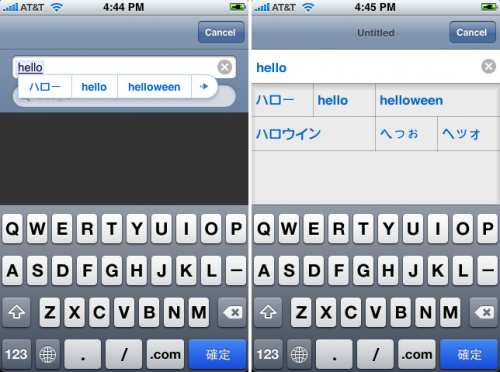
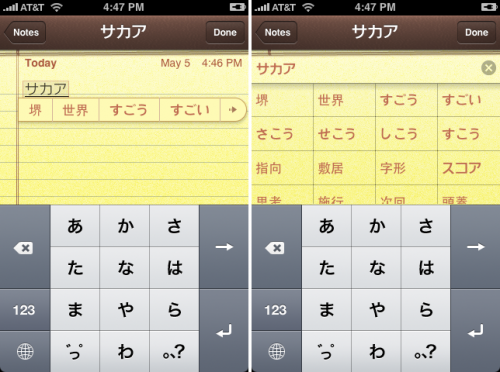
The Japanese input on the top, being input through a qwerty keyboard (via romaji) is good and possibly quick. hard to know when you cannot type on the iphone as quickly as you can on a computer keyboard. The bottom kana based method is exactly like that used on Japanese phones and is fantastic. I find typing on a japanese phone to be very good so I am so glad to see this method added.
Input was one of my worries but Apple have answered that completely with good chinese and japanese input methods. I hope that with this Japanese input we will be seeing the iPhone released in Japan very soon. I'll be rushing to be one of the first in Japan to have the 3G model~ ^^