

Become a MacRumors Supporter for $50/year with no ads, ability to filter front page stories, and private forums.

MacRumors

macrumors bot
Original poster


Apple yesterday announced the M6, its first chip built using a 2nm process and the first Apple silicon design to use three different CPU core types, but how does it compare to the M5?
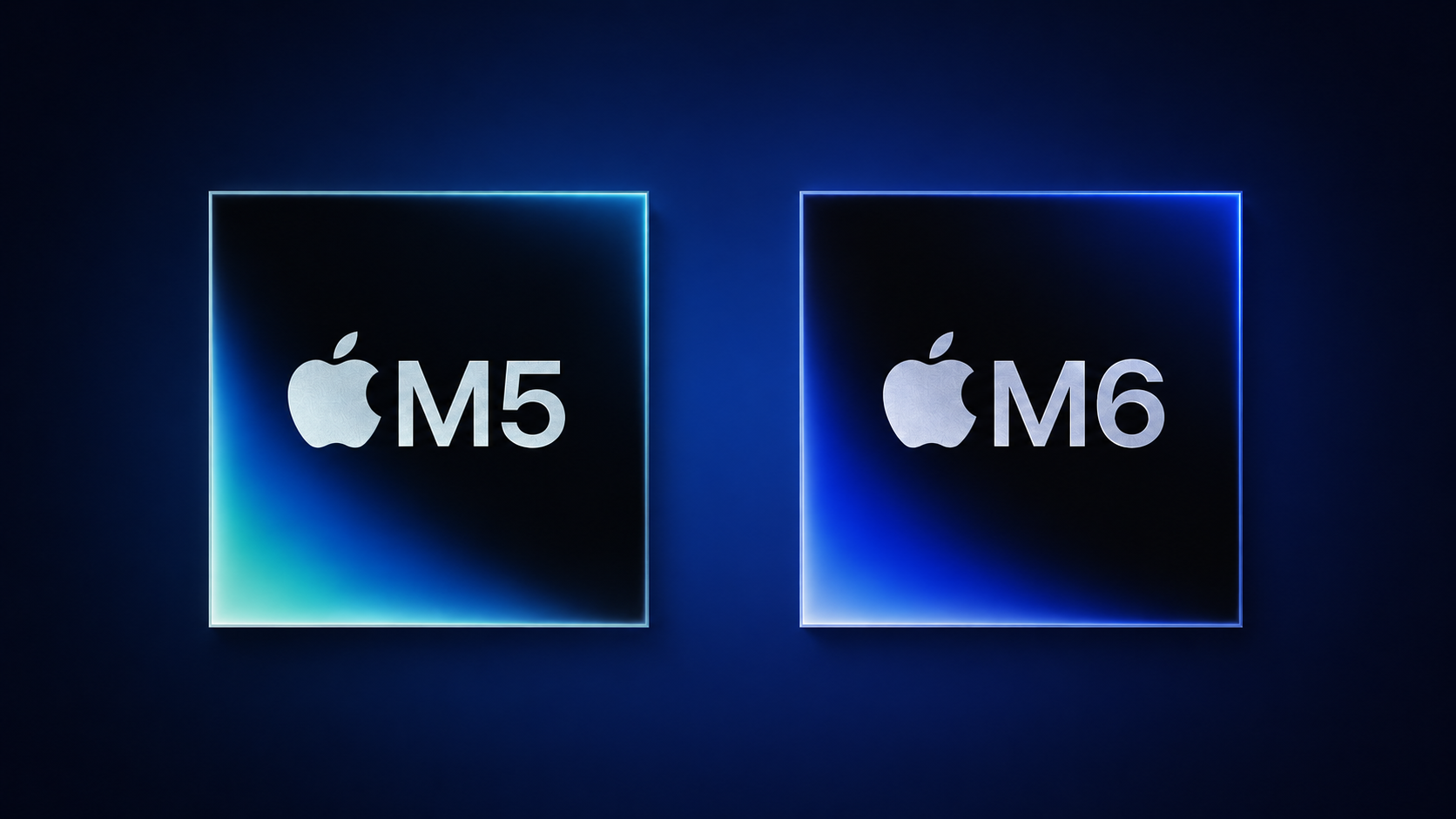
m5-vs-m6-chip.png

Compared to the M5 chip that Apple launched in October 2025, the M6 delivers:

  • Up to 1.2x faster multithreaded CPU performance.
  • Nearly 30% higher peak GPU compute for AI.
  • Up to 2x peak Neural Engine compute.
  • 50% higher geometry rates for complex graphics.
  • 10% higher unified memory bandwidth.

Apple did not publish real-world benchmarks comparing the M6 to the M5 directly, instead framing its Mac mini figures against the M4 and M1 models:

  • Up to 13.5x faster LLM prompt processing in LM Studio versus M1, and up to 4.8x faster versus the M4.
  • Up to 2.3x faster spreadsheet calculations in Microsoft Excel versus M1, and up to 1.5x faster versus the M4.
  • Up to 2x faster gaming performance with ray tracing in "Cyberpunk 2077: Ultimate Edition" versus the M4.

The most significant architectural change is in the CPU. The M5 splits its ten cores into performance and efficiency groups, which is an arrangement Apple silicon has used since the M1. The M6 adds a third tier called "super cores," which handle single-threaded workloads and which Apple says give the chip the world's fastest single-threaded performance.

The performance cores join them for heavier multithreaded work, while the efficiency cores take background tasks. The second major change is the Neural Engine, which is now doubled, with system frameworks able to use both engines at once so apps see faster model execution without any work from developers required. Other hardware changes compared to the M5 include:

Apple M5 Chip (2025)Apple M6 Chip (2026)
Made with TSMC's third-generation 3nm process (N3P)Made with TSMC's first-generation 2nm process (N2)
FinFET transistorsGate-all-around nanosheet transistors
10-core CPU with 4 performance cores and 6 efficiency cores12-core CPU with 2 super cores, 4 performance cores, and 6 efficiency cores
Super cores dedicated to single-threaded workloads
16-core Neural EngineDual 16-core Neural Engine that system frameworks can run simultaneously
10-core GPU with a Neural Accelerator in every core12-core GPU with a Neural Accelerator in every core
Enhanced shader coresUpdated shader core architecture
Second-generation dynamic cachingThird-generation dynamic caching
153 GB/s unified memory bandwidth170 GB/s unified memory bandwidth


The move to a 2nm process is a significant technical change. Apple chips have used FinFET transistors for years, but the M6's N2 process uses a newer design with gate-all-around nanosheet transistors. This means that the transistor's gate wraps around the channel on every side, giving it better control and reducing power leakage at tiny sizes.

TSMC says N2 can offer 10–15% more speed at the same power, or 25–30% lower power use at the same speed, compared with its N3E process. But the M5 uses the newer N3P process, not N3E, so the actual M5-to-M6 improvement is likely to be smaller than those figures suggest.

The M6 is a broad but fairly modest upgrade. It improves the CPU, GPU, Neural Engine, and memory bandwidth, rather than delivering a dramatic gain in one area. The M5's biggest leap was in AI-focused GPU performance, thanks to Neural Accelerators built into each GPU core. The M6's reported 1.2× multithreaded CPU gain and 10% increase in memory bandwidth are good refinements rather than step-changes.

Single-threaded performance is the main exception. Some tasks cannot be split across many CPU cores, including code compilation, file indexing, image editing, and parts of agentic AI workflows. These tasks depend heavily on the speed of one core, and the M6's new "super cores" are designed to improve that directly. A doubled Neural Engine should also help with local AI models, while the larger GPU can process prompts faster.

For everyday work and general responsiveness, the difference will probably be difficult to notice. The M5 already has more than enough performance for normal use, so there is little general-purpose reason to upgrade from an M5 to an M6.

The more consequential question for buyers is where the M6 sits in the lineup, because it is not part of a straightforward replacement for the M5 family. Bloomberg's Mark Gurman reported in July that Apple has no plans to release "M6 Pro," "M6 Max," or "M6 Ultra" chips, having decided to accelerate development of the AI-optimized M7 generation. The new Mac mini illustrates this point, since its higher-specification configuration uses the M5 Pro. That makes the M6 the first of its kind to not have higher-end variants, and it means the M5 Pro, M5 Max, and M5 Ultra remain the chips to buy if you need anything more than base-tier performance.

The dual Neural Engine and 2nm process give the M6 headroom for on-device AI tools that grow more demanding, but the M7 is expected in the first half of 2027 with neural processing upgrades that prompted Apple to cut the M6 lineup short. If your workloads are AI-heavy enough that the M6's gains matter to you, the chip designed for exactly that is less than a year away.

The M6 chip is currently available only in the new Mac mini, which starts at $899 and ships on September 22. M6 versions of the MacBook Pro and iMac are expected to be announced in October. The M5 chip remains available in the 14-inch MacBook Pro, the latest iPad Pro, and the Apple Vision Pro, with M5 Pro and M5 Max in the higher-end MacBook Pro models and M5 Max and M5 Ultra in the new Mac Studio.

Article Link: M5 vs. M6 Chip Buyer's Guide: How Much Better Really Is M6?
 
  • Haha
Reactions: Z-4195
It's still hard for me to get what's better between M6 and M5 Pro.
M5 Pro is twice as expensive, but I believe the race is closer than we think, and M6 most likely beats it at AI.

Of course they charge for +8 GB RAM and +256 GB SSD, so in the end the upgrade to M5 Pro costs 550 CAD, which represents 23% of the cost the of the computer, and I'm not sure it's even worth it.
 
Wait a minute. This doesn’t gel with what we were hearing before about new MacBook Airs coming with M6 and new MacBook Pros coming with M6 Pro and M6 Max chips. Now they’re talking M7 which wasn’t due until late 2027 at the earliest.
 
It's still hard for me to get what's better between M6 and M5 Pro.
M5 Pro is twice as expensive, but I believe the race is closer than we think, and M6 most likely beats it at AI.

Of course they charge for +8 GB RAM and +256 GB SSD, so in the end the upgrade to M5 Pro costs 550 CAD, which represents 23% of the cost the of the computer, and I'm not sure it's even worth it.
Yeah I'm not a fan of these cross-gen chip releases on the same product.

Anyway I'm looking forward to geekbench and metal scores for these!
 
Obviously excited to see the benchmarks and the most relevant YouTube reviews but surely we know now that the M6 is just a 'bridge' to the forthcoming M7 (Spring?) which seems to be far more relevant in terms of Pro / Max / Ultra variants. As an M4 user I'll skip the M6 but the progress Apple is making year on year is astonishing.
 
From my side where my work is mostly in computational biology rather than AI (hence more CPU than GPU/NPU based), I'm more interested in the decision between M5 Pro and M6. Here its less clear, and I think the slightly more powerful M5 Pro option for the mini probably wins out over the M6.
 
  • Like
Reactions: The Mercurian
So, if Apple waits until spring 2027 to refresh the MacBook Air, do you think they will use the M6 or the M7?
We'll be in a different regime as Tim Cook steps down so it will be interesting to see. My hunch is that Apple keeps the MBA & base MBP on M6 and then uses M7 Pro/Max as a bigger carrot to get people to upgrade to the pricier MBP models.
Something else Apple kept quiet about is that the M6 only provides 170GB/s bandwidth on ŔAM sizes of 24 or 32GB. If you purchase an M6 with 16GB of RAM the bandwidth is the same as the M5 @153.6GB/s.
Interesting and they have indeed kept that quiet...
No number on the single-core gains if that now is one of the new things with the M6 ”super-cores”?
This one was surprising given they specifically introduce two new cores just to handle this...
 
Yeah, it's hard for me to get excited about this, but I also don't have a need for the neural stuff.

Someone wake me up when the M7 gets released next year.
 
  • Up to 2.3x faster spreadsheet calculations in Microsoft Excel versus M1, and up to 1.5x faster versus the M4.

Move over Geekbench 7, we have a new metric!
Now when you are dragging your SUM formula across columns you will get results even more instanter!😃 Your manager will be pleased!
 
He is always wrong. He gave a 24 hours heads up and that forgives his god awful track record?

Heck no!

Mark Gurman = low quality rumors

He’s the new Jon Possner
Wait, wait! So you're saying he was right...but because it was only 24 hours before it was invalid. No one else was reporting it but he's still always wrong. Got it.
 
I know I’m not exactly a power user. I’m not running engineering computations or biology stuff like someone upthread.

But who can effectively use all this computing power? Even my M4 MBP is overkill for everything. And I’m not being critical. How do these performance numbers have an impact on real world end users?


Apple yesterday announced the M6, its first chip built using a 2nm process and the first Apple silicon design to use three different CPU core types, but how does it compare to the M5?

m5-vs-m6-chip.png

Compared to the M5 chip that Apple launched in October 2025, the M6 delivers:

  • Up to 1.2x faster multithreaded CPU performance.
  • Nearly 30% higher peak GPU compute for AI.
  • Up to 2x peak Neural Engine compute.
  • 50% higher geometry rates for complex graphics.
  • 10% higher unified memory bandwidth.

Apple did not publish real-world benchmarks comparing the M6 to the M5 directly, instead framing its Mac mini figures against the M4 and M1 models:

  • Up to 13.5x faster LLM prompt processing in LM Studio versus M1, and up to 4.8x faster versus the M4.
  • Up to 2.3x faster spreadsheet calculations in Microsoft Excel versus M1, and up to 1.5x faster versus the M4.
  • Up to 2x faster gaming performance with ray tracing in "Cyberpunk 2077: Ultimate Edition" versus the M4.

The most significant architectural change is in the CPU. The M5 splits its ten cores into performance and efficiency groups, which is an arrangement Apple silicon has used since the M1. The M6 adds a third tier called "super cores," which handle single-threaded workloads and which Apple says give the chip the world's fastest single-threaded performance.

The performance cores join them for heavier multithreaded work, while the efficiency cores take background tasks. The second major change is the Neural Engine, which is now doubled, with system frameworks able to use both engines at once so apps see faster model execution without any work from developers required. Other hardware changes compared to the M5 include:

Apple M5 Chip (2025)Apple M6 Chip (2026)
Made with TSMC's third-generation 3nm process (N3P)Made with TSMC's first-generation 2nm process (N2)
FinFET transistorsGate-all-around nanosheet transistors
10-core CPU with 4 performance cores and 6 efficiency cores12-core CPU with 2 super cores, 4 performance cores, and 6 efficiency cores
Super cores dedicated to single-threaded workloads
16-core Neural EngineDual 16-core Neural Engine that system frameworks can run simultaneously
10-core GPU with a Neural Accelerator in every core12-core GPU with a Neural Accelerator in every core
Enhanced shader coresUpdated shader core architecture
Second-generation dynamic cachingThird-generation dynamic caching
153 GB/s unified memory bandwidth170 GB/s unified memory bandwidth


The move to a 2nm process is a significant technical change. Apple chips have used FinFET transistors for years, but the M6's N2 process uses a newer design with gate-all-around nanosheet transistors. This means that the transistor's gate wraps around the channel on every side, giving it better control and reducing power leakage at tiny sizes.

TSMC says N2 can offer 10–15% more speed at the same power, or 25–30% lower power use at the same speed, compared with its N3E process. But the M5 uses the newer N3P process, not N3E, so the actual M5-to-M6 improvement is likely to be smaller than those figures suggest.

The M6 is a broad but fairly modest upgrade. It improves the CPU, GPU, Neural Engine, and memory bandwidth, rather than delivering a dramatic gain in one area. The M5's biggest leap was in AI-focused GPU performance, thanks to Neural Accelerators built into each GPU core. The M6's reported 1.2× multithreaded CPU gain and 10% increase in memory bandwidth are good refinements rather than step-changes.

Single-threaded performance is the main exception. Some tasks cannot be split across many CPU cores, including code compilation, file indexing, image editing, and parts of agentic AI workflows. These tasks depend heavily on the speed of one core, and the M6's new "super cores" are designed to improve that directly. A doubled Neural Engine should also help with local AI models, while the larger GPU can process prompts faster.

For everyday work and general responsiveness, the difference will probably be difficult to notice. The M5 already has more than enough performance for normal use, so there is little general-purpose reason to upgrade from an M5 to an M6.

The more consequential question for buyers is where the M6 sits in the lineup, because it is not part of a straightforward replacement for the M5 family. Bloomberg's Mark Gurman reported in July that Apple has no plans to release "M6 Pro," "M6 Max," or "M6 Ultra" chips, having decided to accelerate development of the AI-optimized M7 generation. The new Mac mini illustrates this point, since its higher-specification configuration uses the M5 Pro. That makes the M6 the first of its kind to not have higher-end variants, and it means the M5 Pro, M5 Max, and M5 Ultra remain the chips to buy if you need anything more than base-tier performance.

The dual Neural Engine and 2nm process give the M6 headroom for on-device AI tools that grow more demanding, but the M7 is expected in the first half of 2027 with neural processing upgrades that prompted Apple to cut the M6 lineup short. If your workloads are AI-heavy enough that the M6's gains matter to you, the chip designed for exactly that is less than a year away.

The M6 chip is currently available only in the new Mac mini, which starts at $899 and ships on September 22. M6 versions of the MacBook Pro and iMac are expected to be announced in October. The M5 chip remains available in the 14-inch MacBook Pro, the latest iPad Pro, and the Apple Vision Pro, with M5 Pro and M5 Max in the higher-end MacBook Pro models and M5 Max and M5 Ultra in the new Mac Studio.

Article Link: M5 vs. M6 Chip Buyer's Guide: How Much Better Really Is M6?
Your specs are wrong. M5 introduced "Super cores". It has 3/4x sCores and 6 eCores. Also the memory is still 153GB/s for the 16GB. Just the 24/32GB has 170GB/s.

More info

No number on the single-core gains if that now is one of the new things with the M6 ”super-cores”?
Nothing new on that front. Super Cores was on M5 too.
 
Register on MacRumors! This sidebar will go away, and you'll see fewer ads.