
Got a tip for us?
Let us know
Become a MacRumors Supporter for $50/year with no ads, ability to filter front page stories, and private forums.
Mac Pro 2013 Rumored Specs?
- Thread starter Nandifix
- Start date
- Sort by reaction score
You are using an out of date browser. It may not display this or other websites correctly.
You should upgrade or use an alternative browser.
You should upgrade or use an alternative browser.

simsaladimbamba
Guest
If there is indeed a new Mac Pro in 2013, then it will be much faster than an iMac, as even a 2012/2010 Mac Pro is faster than a 2012 iMac, if you configure the Mac Pro to have eight or twelve cores compared to the measly four cores the iMac has.

GGJstudios
macrumors Westmere
You may find some useful information in some of the many existing threads on this, such as these:
Performance to be expected in 2013 Mac Pro
Likely 2013 Mac Pro Equipment List
2013 MacPro CPU and GPU
Opinions on what the next MP GPU will be?
Performance to be expected in 2013 Mac Pro
Likely 2013 Mac Pro Equipment List
2013 MacPro CPU and GPU
Opinions on what the next MP GPU will be?

Tesselator
macrumors 601

handsome pete
macrumors 68000
We would really need to know what you would be using the computers for. A mac pro could be absolutely necessary or complete overkill depending on what you do!
Yeah, this. No one can give you a reasonable answer until you tell us what these new Macs are going to be used for.
deconstruct60
macrumors G5
So a couple of guys in my office are going to be needing new Mac's this year and I am enquiring whether I should go for a maxed out iMac or will the new Mac Pro be much faster?
If "maxed out" means the top end iMac with perhaps one BTO option then debatable. If "maxed out" means every expenisve BTO option present then probably not. That is based not so much of "faster" but on $/performance. Apple's mark-up on some of their BTO options so sky high that it isn't worth for most folks ( unless have money to burn and are required to do it all in a single purchase order).
As other folks have pointed out though. "Faster" doing what?
if the workload these folks are doing now is about same level of computational horsepower need as 3 years ago then yeah modestly spec'ed up iMac should work. If the machines are being dropped because have depreciated to zero and time to replace on schedule may need to move "down" to a more affordable Mac option.
For better or worse, the specs of the iMac aren't a rumor. Apple could be operating on a dubious plan to wait until around Q3-Q4 transition time to "fix" the Mac Pro. At that point there likely would be new iMac rumors to chase after.

phrehdd
Contributor
If there is indeed a new Mac Pro in 2013, then it will be much faster than an iMac, as even a 2012/2010 Mac Pro is faster than a 2012 iMac, if you configure the Mac Pro to have eight or twelve cores compared to the measly four cores the iMac has.
More isn't always faster. This is the typical argument for max "power" machines. It depends on the applications being used and if they can really exploit the additional cores. In fact, software such as Photoshop scores poorer with too many "cores" and seems to be ideal with a Hex core and no more.
I am a fan of the Mac Pro with certain applications and its near all in one design that can be modified and upgraded but one is a fool to get the top of the line Mac Pro to do simple chores such as an office suite or web browsing etc.
I am not a fan of the iMacs as there are some real challenges with the design that make it (for me) a PITA. 21" models are not powerful enough and limited on RAM while the 27" has the glass finish which at that size, creates glare that is not tolerable. The list goes on about dislikes. They are not that all in one given that everything must be added externally and thus the footprint is actually larger.
Mac Pro on the other hand has its silliness too. Not everyone needs a Xeon nor the full size of that machine. Similar powered non-Xeons are half the size with room to spare. Darn shame Apple doesn't make two Mac Pros - workstation and then professional render (Xeon) models. Oh well can't have everything.

Tesselator
macrumors 601
The new Mac Pro is going to be just a bunch of Mac minis stuck in a Mac Pro chassis with a new "fusion" Mac setup that combines the power of those Mac minis. 😛
You're close! But it's 92 iPhones actually... 😀

Rocketman
macrumors 603
Besides the obvious 2013 Haswell update as soon as Intel is ready, what if Apple also released an ARM based Pro? A blade format multi-chip solution with up to perhaps 16 chips with 16x4 cores, something like an A7?
If Apple were to do the next gen development in the Pro form factor, it would support legacy and future peripherals better than some sort of all-in-one as a dev platform. The advent of ARM based server farms demonstrates it is real and practical right now.
Initially it could also have an Intel chip so you have a boot instance of Intel OSX and a "server farm" inside the box running instance(s) of OSX (iOS) for ARM.
A Haswell chip is going to cost Apple between $350 and $1000 each raw cost. ARM chips cost them under $30 raw cost. So 10-30 A7 chips per box is not price out of bounds.
Rocketman
https://www.macrumors.com/2013/03/1...r-20-nm-a7-chip-with-early-2014-availability/
If Apple were to do the next gen development in the Pro form factor, it would support legacy and future peripherals better than some sort of all-in-one as a dev platform. The advent of ARM based server farms demonstrates it is real and practical right now.
Initially it could also have an Intel chip so you have a boot instance of Intel OSX and a "server farm" inside the box running instance(s) of OSX (iOS) for ARM.
A Haswell chip is going to cost Apple between $350 and $1000 each raw cost. ARM chips cost them under $30 raw cost. So 10-30 A7 chips per box is not price out of bounds.
Rocketman
https://www.macrumors.com/2013/03/1...r-20-nm-a7-chip-with-early-2014-availability/
Last edited:
If there is indeed a new Mac Pro in 2013, then it will be much faster than an iMac, as even a 2012/2010 Mac Pro is faster than a 2012 iMac, if you configure the Mac Pro to have eight or twelve cores compared to the measly four cores the iMac has.
...you do realize the "measly" four core i7s also have 4 virtual cores that enable the iMac to match or even beat the performance on the aging Mac Pros?
...you do realize the "measly" four core i7s also have 4 virtual cores that enable the iMac to match or even beat the performance on the aging Mac Pros?
Huh? The Mac Pro has the same feature (the 12 core Mac Pro has 12 virtual cores as well, for a total of 24 logical cores.)
The virtual cores help with scheduling and pipelining, but beyond that they're not actually adding any speed.
Besides the obvious 2013 Haswell update as soon as Intel is ready, what if Apple also released an ARM based Pro? A blade format multi-chip solution with up to perhaps 16 chips with 16x4 cores, something like an A7?
If Apple were to do the next gen development in the Pro form factor, it would support legacy and future peripherals better than some sort of all-in-one as a dev platform. The advent of ARM based server farms demonstrates it is real and practical right now.
Initially it could also have an Intel chip so you have a boot instance of Intel OSX and a "server farm" inside the box running instance(s) of OSX (iOS) for ARM.
A Haswell chip is going to cost Apple between $350 and $1000 each raw cost. ARM chips cost them under $30 raw cost. So 10-30 A7 chips per box is not price out of bounds.
Rocketman
https://www.macrumors.com/2013/03/1...r-20-nm-a7-chip-with-early-2014-availability/
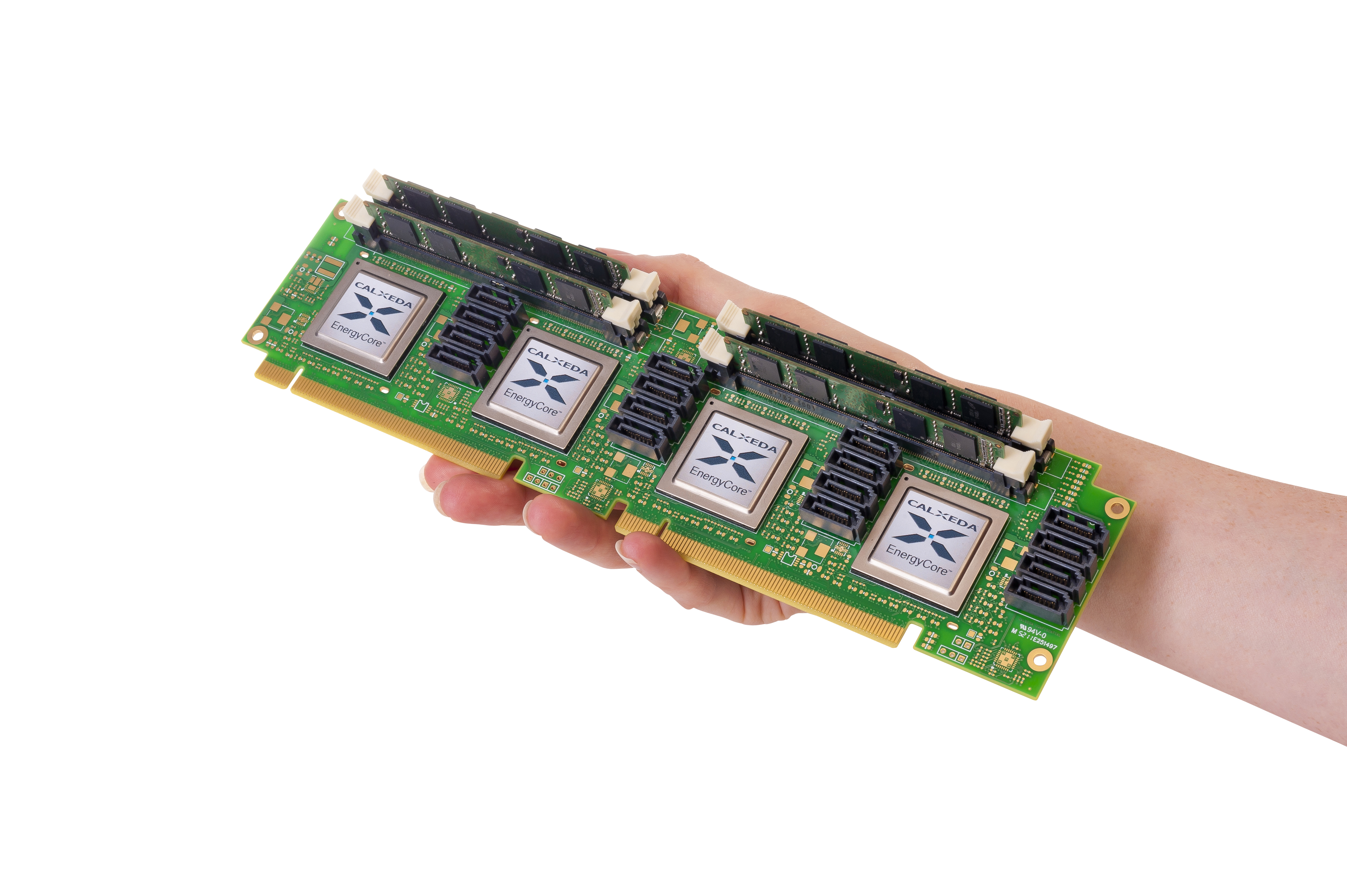
ARM is much, much slower than the Xeon, for a much, much higher price.
http://www.anandtech.com/show/6757/calxedas-arm-server-tested
ARM is in no way usable for the Mac Pro.

deconstruct60
macrumors G5
If they are going to use the Ivy "E"'s, then it looks like Intel has delayed these till the 4th quarter of 2013.
It is highly dubious that they are waiting specifically for Ivy Bridge EP designs to roll out on. Far more likely that substantive parts of the rest of the system are not ready if they are waiting till Q3-Q4 transition timeframe to launch new Mac Pro.
Unless there have been new one, the last leaked Intel roadmap placed them at Q3. Of course given track record over last 2 years, Intel isn't going to deliver on time. That probably does mean a time much closer to Q4 than start of Q3. Mainstream Haswell sliding backwards all the way to June makes that all the more likely.
Stuff like :
"... Originally Ivy Bridge E was supposed to launch in Q3, one quarter after the launch of quad-core Desktop Haswell processors. ... "
http://www.fudzilla.com/home/item/30699-ivy-bridge-e-delayed-to-q4
was all very predictable as soon as confirmations that Haswell was sliding backwards surfacing months ago. Given those desktop quads aren't launching until beginning of June:
http://www.cpu-world.com/news_2013/2013012201_Availability_date_of_Haswell_processors_confirmed.html
sliding 3 months back is September. If Intel announces and real volume availability doesn't appear for 1-2 months ( like in 2012 with Sandy Bridge models ) then solidly in Q4.
There is no good reason for Apple to use Ivy Bridge -E ( i7 39xx) options over the Xeon E5 1600 & 2600 series offerings.

deconstruct60
macrumors G5
Besides the obvious 2013 Haswell update as soon as Intel is ready, what if Apple also released an ARM based Pro? A blade format multi-chip solution with up to perhaps 16 chips with 16x4 cores, something like an A7?
It is a 32-bit chip. Why would Apple slide backwards to a 2004 era workstation that was capped on 4GB processor address space limitations????????????
Maybe if they were smoking drugs. But if they are suicidal about perusing the workstation market there are far more efficient ways to kill it. Going ARM for any of the Mac options is setting them up for failure. Also, going head-to-head with Intel on CPU design is a beyond dubious track for Apple to engage in.
Apple has a solution on ARM. It is called iOS. iOS devices have sold more at this point that all Macs sold over its entire history 20+ year history. If Apple is going to a totally ARM future would be on iOS. They are not. So far, there is not a really good reason to either. If Intel blows it over the next 3 years then maybe. But when is the last time Intel did something that dumb for that long ?
Large cluster of general computation cores on a card? Already here: Intel Phi , AMD FirePower 9000, and Tesla K20. There is nothing that Apple needs to invent other than an enclosure that can hold one or more of these and sell in sufficient numbers so that one of those cards vendors will finish the drivers to enable the card. That's it. No ARM hand waving necessary.
deconstruct60
macrumors G5
Don't forget, Apple gets first dibs...
No they don't. For Xeon E5 class processors Supercomputer vendors do. They got Sandy Bridge Xeon E5 back in Oct-Nov of 2011. The rest of the workstation market didn't ship until late April-May of 2012.
so I bet they use Intel's newest processor that is only available to Apple then the rest of the industry...just like Thunderbolt.
Apple wanted Thunderbolt when few others did. Most still don't. That is completely different context.
Apple's product line is chock full of products that do not have any PCI-e expansion capabilities. That is way Apple moved over the whole product line quickly. The Mac Pro being the only 2012+ era product that had any non TB based PCI-e expansion ( including the ExpressCard which disappeared with the MBP 17" ).
Not sure any evidence that Apple got an "exclusive" on Thunderbolt. Sony got burnt rolling out a LightPeak flavored variant that didn't hijack-with-permission mini displayPort sockets. That probably also dropped the number of folks willing to get on board.
Apple naturally drifted to Thunderbolt. They basically went to something similar back with Apple Display Connector ADC (http://en.wikipedia.org/wiki/Apple_Display_Connector) back a decade ago (2004 ). Only with Intel backing it, this solution doesn't have the appearance of being quite so proprietary. However, the controllers having a single source which can be throttled for enforcement pragmatically make it one.
Rocketman
macrumors 603
I may have confused you by saying "like an A7". Oops. 64 bit ARM is the hinge point.It is a 32-bit chip.
Here's a relevant link.
http://www.extremetech.com/computin...-to-64-bit-will-enter-the-server-room-in-2014
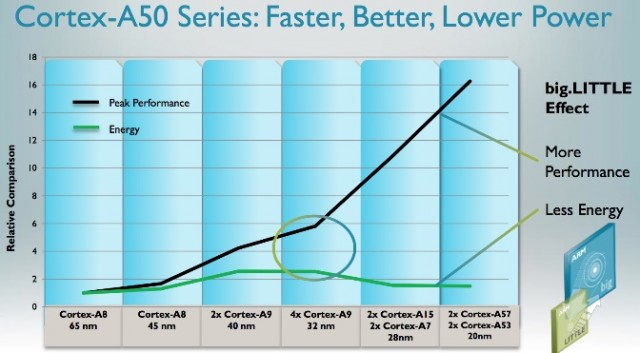
A related article today said TSMC is piloting its 20nm process, which the Cortex A57 intends to be the process in 2014. Apple intends to use it for the 2014 consumer releases as well. If they can make tens of millions of chips for phones and pads, they can make 8-16 chips per MacProPlus. All the software to control that many chips exists in Apple's x86 software for grids and parallel and server systems. That's why I think the ARM stuff will be a coprocessor system inside an x86 box.
https://forums.macrumors.com/threads/1556650/
Rocketman
Last edited:
deconstruct60
macrumors G5
More isn't always faster. This is the typical argument for max "power" machines. It depends on the applications being used and if they can really exploit the additional cores. In fact, software such as Photoshop scores poorer with too many "cores" and seems to be ideal with a Hex core and no more.
However, more isn't always about cores either .
The Xeon E5 1600 class is also clocked higher and has far more memory and PCI-e bandwidth ( 2x memory and 2.5x PCI-e ) than the iMac has.
The line up is here:
http://ark.intel.com/products/series/63197
the 1620 weights in at 4 cores at 3.6GHz (faster) , 10MB L3 cache (bigger) , and larger Max Memory size. than the top end iMac BTO offering.
Where the Mac Pro struggles the most ( on the boundary between top end iMac and lowest Mac Pro ) is exactly where Intel fell down on the job from 2010-2012.
21" models are not powerful enough and limited on RAM while the 27" has the glass finish which at that size, creates glare that is not tolerable.
The new 27" models are not in the same class at the old 27" models ( or Apple's current display line up).
Darn shame Apple doesn't make two Mac Pros - workstation and then professional render (Xeon) models. Oh well can't have everything.
People don't buy enough Mac Pros now to get Apple highly motivated. Splitting that demand in two isn't going to help. There is a relatively small intersection of that aren't covered, but Apple isn't an everything for everybody company.
Apple does sell not-so-max-performance options. People just choose to ignore them and complain on "form over function" issues. That is also isn't likely to be successful long term in changing Apple's product offering line-up.
Last edited:
A related article today said TSMC is piloting its 20nm process, which the Cortex A57 intends to be the process in 2014. Apple intends to use it for the 2014 consumer releases as well. If they can make tens of millions of chips for phones and pads, they can make 8-16 chips per MacProPlus. All the software to control that many chips exists in Apple's x86 software for grids and parallel and server systems. That's why I think the ARM stuff will be a coprocessor system inside an x86 box.
Except the costs increase exponentially the more chips you add. 8-16 chips aren't 8-16 times the cost. They're more in the realm of 50 times the cost.
Current ARM chip clusters are about $20,000. That's not cheap. Your pricing is off. This is all detailed in the article I linked to.
The Xeon and GPU co-processors are still much cheaper.
Rocketman
macrumors 603
Right, but a 4x ARM57 co-processor board would be like a PCI board with 4 $30 main chips. The added memory would cost more than the rest of it. In any case ARM chips are under 1/4 the cost of an x86 chip and use a bunch less power. They are also on a steeper speed vs time and cost curve right now.Except the costs increase exponentially the more chips you add. 8-16 chips aren't 8-16 times the cost. They're more in the realm of 50 times the cost.
To quote your link
My point started with 2014, 20nm and 64 bit, all of which are addressed as very hopeful trends for ARM vs x86 in your quoted article.article said:ARM based CPU have also made giant steps forward when it comes to performance. To give you a few data points: a dual ARM Cortex-A9 at 1.2GHz (Samsung Exynos 1.2GHz) introduced in 2011 compresses more than 10 times faster than the typical ARM 11 based cores in 2008. The SunSpider performance increased by a factor 20 according to Anand's measurements on the iPhones (though part of that is almost certainly thanks to browser and software optimizations). The latest ARM Cortex-A15 is again quite a bit more powerful, offering about 50% higher performance. The A57 will add 64-bit support and is estimated to deliver 20 to 30% higher performance. In short, the single-threaded performance is increasing quickly, and the same is true for the amount of RAM that can be addressed. The ARM Cortex-A9 is limited to 4GB but the Cortex-A15 should be able to address 16GB while the A57 will be able to address a lot more.
Last edited:
deconstruct60
macrumors G5
I may have confused you by saying "like an A7". Oops. 64 bit ARM is the hinge point.
Here's a relevant link.
http://www.extremetech.com/computin...-to-64-bit-will-enter-the-server-room-in-2014
Not particularly relevant. Two huge issues.
1. Apple just rolled out there ARM A7-A15 compromises implementations. They are extremely unlikely to dump that in 2014 given that the full roll out of it isn't going to occur until the Q4 of 2013.
2. There is nothing that says that can't implement A7-A15 on 20nm. In fact, Apple implemented A5 on two. Exact same reason why Intel goes Tick/Tock. arch implementation focus. Process shrink. There is no good reason to do both if taking aggressive upgrades at each step.
3. A57 doesn't have any performance track record. There is some hand waving that it may be better than current Intel Atom solutions, but Intel isn't going to have current Atom solutions in 2014. They will have the 2014 ones. ARM did not sneak up on Intel. They've seen this coming for years.
The individual Phi cores currently shipping are probably at least as good if not better at crunching float workload as A57 implementations will be able to do in 2014. Again that is now, not a year from now.
What is flawed with your little diagram in the implicit inference that those vertical bars above the A9 , A7/A15 , A57, etc. are a year in width. They haven't been in the past. There is nothing to indicate that is going to change in the future.
4. A57 implementation is more optimized along same track that A15 has started with is quasi 64 bit support. It is aimed at running multiple Virtual Machine (VM) instances. They need 64-bits far more to run multiple 64 Linux instances than for raw float output. That is the far more sane metric where ARM can be competitive with Intel. Cloud VM hosting density at low power usage.
Like I said before. lots of hand waving.... very little substance to this at all.