
Got a tip for us?
Let us know
Become a MacRumors Supporter for $50/year with no ads, ability to filter front page stories, and private forums.
Mac Studio M4 Max and SSD Drive Speed
- Thread starter krell100
- Start date
- Sort by reaction score
You are using an out of date browser. It may not display this or other websites correctly.
You should upgrade or use an alternative browser.
You should upgrade or use an alternative browser.

shinseiromeo
macrumors 6502
Everything I've read so far is yes to that. IIRC, 512gb is 3000mb/s, 1tb is 4500mb/s, and 2tb is 6000mb/s.
funny enough a samsung 990 Pro 4tb is over 7000mb/s and around $300.
funny enough a samsung 990 Pro 4tb is over 7000mb/s and around $300.

Everything I've read so far is yes to that. IIRC, 512gb is 3000mb/s, 1tb is 4500mb/s, and 2tb is 6000mb/s.
funny enough a samsung 990 Pro 4tb is over 7000mb/s and around $300.
Thanks for the reply, thats extremely useful information!
The M3 Ultra review units Apple sent out are 4TB, most of the tests I see they don't exceed 7000MB/s.
I wonder with the 512GB being just 3000MB/s does it mean it only uses 2 x 256GB NANDs? That's what happened with the base M2 Max Studio. But with M3 and M4 MacBook Pros, they went back to using 4 x 128GB to get better speed than 3000, as with the base M4 Pro mini.
I wonder with the 512GB being just 3000MB/s does it mean it only uses 2 x 256GB NANDs? That's what happened with the base M2 Max Studio. But with M3 and M4 MacBook Pros, they went back to using 4 x 128GB to get better speed than 3000, as with the base M4 Pro mini.
Last edited:
My Mac Studio M4 Max as 1TB at 6449.73 read and 6487.40 writeDoes it still hold true with the 2025 Mac Studio M4 Max that the speed available from the SSD(s) is compromised with lower capacities?
ie the 512GB, 1TB and 2TB options are much slower than the 4TB and 8TB options.
Thats impressive!My Mac Studio M4 Max as 1TB at 6449.73 read and 6487.40 write
Another base M4 Max owner in my local forum reported 5200 read 4100 write. Not as bad as 3000 but clearly inferior to the usual 6-7000.
For reference my M1 Max base was 6979 read 5023 write when new.
Do you know if that was the 512GB or 1TB option?
Base, 512GB.Do you know if that was the 512GB or 1TB option?

spiritbox
macrumors member
Thank you! I have been searching online for SSD benchmarks on M4 Max with 1TB all week. <3My Mac Studio M4 Max as 1TB at 6449.73 read and 6487.40 write
shinseiromeo
macrumors 6502
Thank you! I have been searching online for SSD benchmarks on M4 Max with 1TB all week. <3
I wonder if something changed from the m4 pro in the MacBook to the m4 max studio. I researched as well and had no base line for nvme speeds for the new studio. I’d love to see real numbers soon.
Yeah overall the M4 series of Macs do seem to have higher SSD speeds overall, perhaps from 1TB up they are now using multiple NANDs.I wonder if something changed from the m4 pro in the MacBook to the m4 max studio. I researched as well and had no base line for nvme speeds for the new studio. I’d love to see real numbers soon.


xraydoc
Contributor
Excellent. Thanks for posting. I bought 2TB, so I know I'll at least be getting this speed.My Mac Studio M4 Max as 1TB at 6449.73 read and 6487.40 write
Actually, I’m not sure there is a speed hit for the smaller SSD anymore. In a different thread on this forum there was a link saying Apple is using a dual chip RAID in the 512 as well unlike the singe chip the smaller SSDs used before.Yeah overall the M4 series of Macs do seem to have higher SSD speeds overall, perhaps from 1TB up they are now using multiple NANDs.
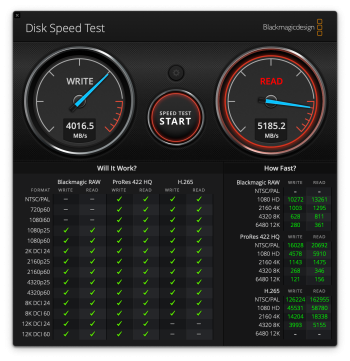
M4 base studio, so 512GB SSD. Blackmagic says write is 3,900-4,200. Read is 5,000-5,100. Works great!Actually, I’m not sure there is a speed hit for the smaller SSD anymore. In a different thread on this forum there was a link saying Apple is using a dual chip RAID in the 512 as well unlike the singe chip the smaller SSDs used before.
Attachments
shinseiromeo
macrumors 6502
M4 base studio, so 512GB SSD. Blackmagic says write is 3,900-4,200. Read is 5,000-5,100. Works great!
Thank you for the screenshot. How does it compare to your 'old' m2 max nvme speed?

JSRinUK
macrumors 6502a
I don’t know if this is of any use to anyone, but here are some results from my Mac Studio and my MacBook Pro:

Mac Studio (M4M, 128GB, 1TB)

MacBook Pro (M4P, 24GB, 1TB)
They look almost identical to me. I’m guessing the “AP1024Z” means they’re both the same SSD?
Mac Studio (M4M, 128GB, 1TB)
MacBook Pro (M4P, 24GB, 1TB)
They look almost identical to me. I’m guessing the “AP1024Z” means they’re both the same SSD?
The base 512GB Studio is “supposed to” get 6000+ if all 4 NAND pads are occupied on one card. My M1 Max base 512GB could reach that speed, since it is using 4 NANDs on one card. 3-4000 really looks like only having 2 NANDs.M4 base studio, so 512GB SSD. Blackmagic says write is 3,900-4,200. Read is 5,000-5,100. Works great!
Not saying it is deal breaking, it is not as bad as the M2 Air and mini’s single 256GB at 1-2000. But still.
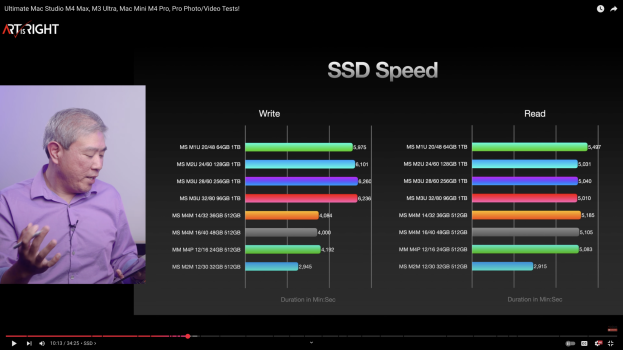
As per Art's video, here are a few Studio and mini Pro base SSD speeds. So it seems the M4 Max base 512GB is still getting 4 NANDs, if it were 2 NANDs the speed would have been as low as <3000MB/s as indicated at the bottom with the M2 Max Studio.
yes it is! I just put one in my B&H cart 🙂Thanks for the reply, thats extremely useful information!

MBehr2
macrumors member
The M3 Ultra review units Apple sent out are 4TB, most of the tests I see they don't exceed 7000MB/s.
I wonder with the 512GB being just 3000MB/s does it mean it only uses 2 x 256GB NANDs? That's what happened with the base M2 Max Studio. But with M3 and M4 MacBook Pros, they went back to using 4 x 128GB to get better speed than 3000, as with the base M4 Pro mini.
From past designs for the Mac Studio M1/M2 etc. there are always 4 NAND chips per storage module, that add up to the storage amount:
1 module = 512Gb = 4 x 128gb NAND chips per storage module (2 on front, 2 on backside)
1 module = 1Tb = 4 x 256gb NAND chips per storage module (2 on front, 2 on backside)
1 module = 2Tb = 4 x 512gb NAND chips per storage module (2 on front, 2 on backside) *
2 module = 4Tb = 4 x 512gb NAND chips per storage module (2 on front, 2 on backside) - total of 2 storage modules
2 module = 8Tb = 4 x 1Tb NAND chips per storage module (2 on front, 2 on backside) - total of 2 storage modules
* There appears to be some discrepancy that says 2Tb is two modules, while aftermarket modules are done with one module. (PolySoft)
shinseiromeo
macrumors 6502
View attachment 2492816
As per Art's video, here are a few Studio and mini Pro base SSD speeds. So it seems the M4 Max base 512GB is still getting 4 NANDs, if it were 2 NANDs the speed would have been as low as <3000MB/s as indicated at the bottom with the M2 Max Studio.
That looks like a perfect summary. Funny how the base m4 max shows a mildly faster nvme speed. Probably just a + or - of test results.
So based on that chart, the base M2 Max 512gb nvme was 3000mb r/w. The base m4 max 512gb is 4000mb r/w and the 1tb nvme is 6000mb r/w.
It’s still a shame that it seems every company in the world makes better and faster nvme’s than apple. Which I don’t understand! Their CPUs seem blazing fast, yet my seagate firecuda, western digital 850x, and Samsung 990 Pro all do 7000mb r/w and above. Half the price and better than apple hard drives.
From past designs for the Mac Studio M1/M2 etc. there are always 4 NAND chips per storage module, that add up to the storage amount:
1 module = 512Gb = 4 x 128gb NAND chips per storage module (2 on front, 2 on backside)
1 module = 1Tb = 4 x 256gb NAND chips per storage module (2 on front, 2 on backside)
1 module = 2Tb = 4 x 512gb NAND chips per storage module (2 on front, 2 on backside) *
2 module = 4Tb = 4 x 512gb NAND chips per storage module (2 on front, 2 on backside) - total of 2 storage modules
2 module = 8Tb = 4 x 1Tb NAND chips per storage module (2 on front, 2 on backside) - total of 2 storage modules
View attachment 2493014
* There appears to be some discrepancy that says 2Tb is two modules, while aftermarket modules are done with one module. (PolySoft)
This video confirms a few things:
The base M4 Max 512GB is single card, 4 x 128GB NANDs.
The previous M2 Max base 512GB was single card but only 2 x 256GB NANDs.
Soldering 4 x 512GB on the M4 Max vanilla card to make 2TB works.
Adding a 2nd donor card from M2 Studio, soldering 8 x 1TB NANDs to make a total 8TB works.
This means the M4 Max and M2 gen Studio cards are interchangeable.
No reason to think 16TB DIY soldering job wouldn't work, he just doesn't have the 2TB NAND supply.