Become a MacRumors Supporter for $50/year with no ads, ability to filter front page stories, and private forums.

MacRumors

macrumors bot
Original poster
Apr 12, 2001
70,385
42,002
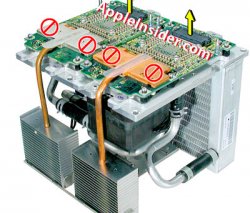
Appleinsider publishes more diagrams of the Liquid Cooling System found in the high end PowerMac G5s.

The new cooling system is apparently necessary for higher density PowerPC 970FX chips according to the Apple senior director of desktop product marketing:

The processor was built using the 90-nanometer process. When you do that, you challenge the power density. You could see the same problem happening with Intel's 90-nanometer chips.
 
At the bottom it says all the new models are 970FX chips. I wonder how those compare at the same clock speed to the old 970s.
 
well

that resolves it for everybody

it has a pump

it ain't a heat pipe

it is water cooling
 
DGFan said:
At the bottom it says all the new models are 970FX chips. I wonder how those compare at the same clock speed to the old 970s.

AH. That's my question too... I didn't know until now that the "new" 1.8 and 2.0 dualies were the 970fx....

I'd love to see a comparison or hear more details (links) on the differences.
 
Here's the pics


Attachments

  • G5internalcooling2small.jpg
    G5internalcooling2small.jpg
    35.1 KB · Views: 716
  • G5internalcoolingsmall.jpg
    G5internalcoolingsmall.jpg
    52 KB · Views: 606
pjkelnhofer said:
Accord to BareFeatsthere is no perceptable difference between the new and the old.
There shouldn't be. The only difference is PowerTune and the use of SS-SOI which are power-saving features. At the same clock, the performance should be identical.
 
It is a big deal because this is a commercial desktop that comes with a liquid cooling system designed and built by professionals. Liquid cooling is now mainstream in the off-the-shelf consumer desktops from Apple.

Most other liquid cooling systems are bolt-ons that serious hardware modders add after overclocking the snot out of their PeeCee.

People are just always attracted to the radically new/different. It's human nature. That and a lot of gear-heads are interested in the "how it works" aspects.

Pretty soon someone in Japan will put up a web site full of pictures showing them disassembling (and pretty much destroying) one of the modules.

If you don't like the reactions, stop reading the threads. The hype will die down eventually.
 
[url=http://www.internetnews.com/ent-news/article.php/3366061]internetnews.com[/url] said:
Apple said speed is not the only factor in the design of its systems, but boasted that its 2.5GHz ran significantly faster than Intel's 3.4 GHz Pentium 4 systems in benchmark tests of Adobe Photoshop, Logic Pro 6, and Final Cut Pro.

How do you benchmark Logic Pro and Final Cut Pro on an Intel proc?
 
Yeah, but...

Macrumors said:
Appleinsider publishes more diagrams of the Liquid Cooling System found in the high end PowerMac G5s.

The new cooling system is apparently necessary for higher density PowerPC 970FX chips according to the Apple senior director of desktop product marketing:

From AI (at the end, first link above):
>>
In a recently published self-training course on the new line of Power Mac G5 computers, Apple confirms that all models feature IBM's 970FX PowerPC G5 processor.

"Power Mac G5 (June 2004) models use the PowerPC 970FX processor. Previous Power Mac G5 models used the PowerPC 970. Compared to the 970, the 970FX has a smaller die, higher speeds, and has been optimized more for higher performance."

The dual 2.5 GHz Power Mac G5 model, which is the only model to utilize the liquid cooling system, will begin shipping from Apple in July.
<<

I don't get it...

...if the new cooling system is necessary for higher density PPC 970FX chips...:eek:

...and *all* the new PMac models (including the 1.8 and 2.0 dualies) have 970FX chips (not vanilla 970 chips as before)...:D

...then something ain't right :confused: [i.e. Why does only the 2.5 dualie need the new liquid cooling and not the others? ] :rolleyes:

If they are all 90nm 970FX chips (running at different speeds) and only the 2.5 needs the liquid cooling system, then can we conclude that the cooling problems are more related to processor speed (GHz) and less related to manufacturing processes (90nm vs. 130nm)? :eek:

Or do some of these news/rumor sources have the facts confused? :(

---MacUnit
 
MacUnit said:
...and *all* the new PMac models (including the 1.8 and 2.0 dualies) have 970FX chips (not vanilla 970 chips as before)...:D

...then something ain't right :confused: [i.e. Why does only the 2.5 dualie need the new liquid cooling and not the others? ] :rolleyes:

If they are all 90nm 970FX chips (running at different speeds) and only the 2.5 needs the liquid cooling system, then can we conclude that the cooling problems are more related to processor speed (GHz) and less related to manufacturing processes (90nm vs. 130nm)? :eek:

Or do some of these news/rumor sources have the facts confused? :(

---MacUnit

Cooling is related to processor speed and surface area. Obviously only the 2.5 reaches the threshold where the old heatsinks can't handle the load.

Something from the barefeats article that caught my eye was the comment that the new dual 2.0 is identified as 7,3. I would assume the dual 2.5 is also. Which makes one wonder what 8,1 is....???
 
Why the delay

So we see the drawings... we know the seekrit... why the 6 week+ delay for shipping? Let's start a predict the actual shipping date pool. :rolleyes:
Um I say Aug 2nd... the original ship date until SJ realized that Aug 2nd IS NOT July. No more bad PR for Steevie!

I'm so excited...my first new mac in 5 years - a record as once I went 23 months... that sucked!

IJ
 
Jeff Harrell said:
By comparing them to Cubase and Avid Media Composer.

Problem is anyone who's actually used all of those programs know that there is no direct way to compare them. For instance, for CubaseSX2 vs LogicPro, what constitutes the reverbs or the track count, what audio equipment is being used in conjunction, etc. For video, what makes up "supporting" the number of video layers.. real-time rendering, just playback, etc. Plus, why would you compare to Avid MC and not AvidXpressPro (which supports 12 realtime layers out of the box) or Avid Adrenaline (which supports alot more.) Either way, real professionals are not swayed by marketing numbers. They'd have a specialist sales rep show them the machines and actually use them in comparison. These silly numbers are for general laymen to say "machine x" is more powerful than "machine y", but it doesn't mean anything to actual users who make real money off of the product.
 
eric_n_dfw said:
From the pic's it looks like a pump for the top of the chips and heatpipes for the bottoms.
Seems like I keep repeating myself. ;)

The LCS is for the CPU only, replaces the previous monster sized stack of plates on the 2.0GHz and below machines.

The heatpipe is for the Voltage Regulators on the daughtercard, it was also there (and still is) on the 2.0GHz and below machines.
 
BTW, Cubase SX2 and Avid MC and Avid XpressPro and Avid Adrenaline are all available for MacOS X. Why not at least attempt to look fair and use the same programs?!! They are all used professionaly on both platforms.

(maybe, Apple is trying to push another agenda too?? or maybe they specifically tweaked their in-house programs to make the results possible...)
 
New feature set - Power mac's with aircon?

And this is reason people that we won't see a 5 in a Powerbook for some time yet... these chips are little furnaces!!! You just can't grab them and shove them into a confined space like a PB without causing serious damage to your legs or desk or whatever....

Still - a water cooled chip is a cool thing to have on your desk... maybe you could reverse engeineer it somehow and turn it into an aircon unit?? Would that suck or blow?? :D
 
DGFan said:
Cooling is related to processor speed and surface area. Obviously only the 2.5 reaches the threshold where the old heatsinks can't handle the load.

Right, so the surface area of the 970FX (90nm) chips are all the same. Check. And this surface area is smaller than the 970 chips used before (130nm) in the older PMacs. Check.

That leaves ONLY processor speed (clock rate) as the differentiator (for heat generation and therefore cooling system requirements) on the 970FX machines (1.8D, 2.0D, 2.5D). Yeah, I expect the faster chips to produce more heat that the slower chips.

But the dude from Apple said (and this is where I have problem): that it is the higher density PowerPC 970FX chips that make it necessary to use the liquid cooling. Well...if all the new dualies have the 970FX chips (i.e. the density is the same because the chip design is the same -- same masks, etc), then why only liquid cooling for the top end? Speed (i.e. clock rate), not "chip density" (i.e. process shrink to 90nm) is "apparently" the source of the heat problem.

Was the Apple dude just talking jive marketspeak, or was he misquoted or paraphrased incorrectly? (I can't find the original quote from the links above).

Any chipheads with knowledge out there?

---MacUnit
 
Industrial vs. Elegant

The Dual G5 systems requiring a liquid cooling system need it to keep the machine quiet. No one wants G5s that sounds like G4 MDD. Unless you're in to sticking your head down the front end of a turbo jet engine. The Towers are "industrial" machines. Power over portability. I don't think anyone is planning on dual 2.5s in a 12" PowerBook. But one could imagine much like a 3.5 inch drive was made smaller for a laptop... An LCS or other interesting form of cooling in a compact and efficient set up for a single 2.5. Like encasing the board in a thermal diffusing hydro-polymer. Science fiction sure. But Apple is capable of innovation. There is a difference between what goes into an industrial cheese grater and one used on one of those cooking shows. Same idea, cheese grating, but size and application come into play. G5 Towers are an enigma of Industrial Power and carry a certain elegance. But the LCS within them I doubt will be used in what we see here today for smaller machines built around the G5.
 
Register on MacRumors! This sidebar will go away, and you'll see fewer ads.