
Become a MacRumors Supporter for $50/year with no ads, ability to filter front page stories, and private forums.

MacRumors

macrumors bot
Original poster


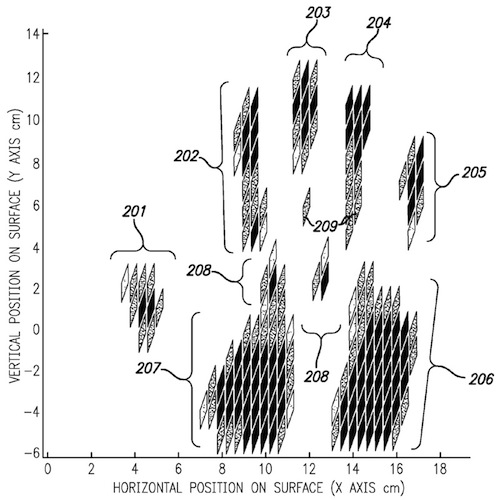
AppleInsider points to a patent application filed in June and released yesterday that brings renewed attention to two-handed multi-touch capabilities previously included in patent applications from Apple and Fingerworks, the company acquired by Apple in 2005 for its multi-touch technology.


124928-two_hand_sensing.jpg


The latest patent application appears to be a slightly edited version of content found in several patent applications made by Fingerworks in mid-2006.
Apparatus and methods are disclosed for simultaneously tracking multiple finger and palm contacts as hands approach, touch, and slide across a proximity-sensing, multi-touch surface. Identification and classification of intuitive hand configurations and motions enables unprecedented integration of typing, resting, pointing, scrolling, 3D manipulation, and handwriting into a versatile, ergonomic computer input device.

The technology has gained renewed interest as a rumored launch of Apple's much-anticipated tablet computer appears to be approaching and speculation mounts about how the device will function. In brief, the Fingerworks patent application addresses multi-touch functionality extended to be able to sense full touch input from ten fingers, as well as the palms of the hands. The complex touch sensing would allow for such features as intelligent typing capabilities and graphical manipulation abilities more sophisticated than the "pinch and zoom" found on the iPhone and multi-touch trackpads, and provide the versatility for multiple types of input without the need for multiple input devices.

124928-full_hand_sensing.jpg


Article Link: Two-Handed Multi-Touch Technology Gains Renewed Exposure
 
That would be sweet IF they included the tactile feedback as well that they have been working on....
 
That would be sweet IF they included the tactile feedback as well that they have been working on....

Is tactile feedback really necissary anymore? I thought the iPhone changed that with it's little clicking sound. I figured they would do the same on an iTablet.
 
My iPhone have given me arthritis. This nonscence will not help. I like the idea. I like the LCARS computer on Star Trek. But it really does strain my hands.
 
You know, all this stuff is cool, and will have great applications, but I'd really rather be using a mouse and a pointer (or fingers for touch stuff) for most things, I don't want a work out every time I use the computer(!), I like that a mouse and pointer system minimises how much physical interaction I have to make to do something.
 
In 5 years the macbook range will have this as the primary form of input. There will be a screen as normal but instead of a keyboard it will have one piece of aluminium across the whole section. Kind of like the palm rest but over the whole section. The keys would illuminate in the aluminium for typing but there would be an option for it to be used as a graphics tablet as well, depending on the application in use.

Ok maybe not but would you prefer it to a tablet? 😀
 
After actually reading the application...

This isn't about small touchscreen tablets. After all, it would need a lot of space to put your hands down in the usual two-handed typing position as diagrammed.

It seems to be about a fairly large (standard keyboard sized at least, with palm areas) standlone entry device with multiple input modalities:

Type, and it types. Move two fingers and it scrolls. Tap two fingers and it's a mouse click. Spread a finger from a thumb and it scales. And bring your fingers together in a pencil-holding position and it emulates a stylus.

Remember, Fingerworks was about both conserving motion and spreading it over different parts of the hand to prevent injury. They also specialized in opaque touch surfaces, not screens.

Certainly some of these ideas could be incorporated into a tablet, but that's not what this patent is about.
 
Is tactile feedback really necissary anymore? I thought the iPhone changed that with it's little clicking sound. I figured they would do the same on an iTablet.

I was thinking about that the other day actually. I have an old Treo 750 and I really really love the hardware qwerty keyboard. You get used to it to the point of being able of touch typing on the phone. I feel it would take a very long time to be able to touch type on a touch keyboard, due to the lack of touch feedback.

My opinion though. I would be much better if the thing could just read my mind and type what I'm thinking though 😛.
 
This could be a departure from QWERTY!

Lotsa touch typists out there will most likely find a key-less keyboard on glass awkward at best without the sensory feedback from physical keys.

In the early ’80s there was an input device with a key for each finger and thumb for one hand which rested on it, which substituted for a conventional keyboard. With practice learning the key combinations, you could do all of your keying with one hand.

Perhaps Apple has a two-handed system in which you leave your fingers in one place and use different combinations of fingers and thumbs to cover all of the possible characters. That way, the software could automatically calibrate to the respective fingertip placements every time you touched the sensing area and provide a little fudge space for each of them.

That would be interesting if Apple somehow freed us from the QWERTY arbitrary we've been saddled with for decades.
 
Lotsa touch typists out there will most likely find a key-less keyboard on glass awkward at best without the sensory feedback from physical keys.

In the early ’80s there was an input device with a key for each finger and thumb for one hand which rested on it, which substituted for a conventional keyboard. With practice learning the key combinations, you could do all of your keying with one hand.

Perhaps Apple has a two-handed system in which you leave your fingers in one place and use different combinations of fingers and thumbs to cover all of the possible characters. That way, the software could automatically calibrate to the respective fingertip placements every time you touched the sensing area and provide a little fudge space for each of them.

That would be interesting if Apple somehow freed us from the QWERTY arbitrary we've been saddled with for decades.

One handed input would be ****ing great!
 
Finally, the controls from the bridge in Star Trek come to home computing!

First thing I thought of when I saw this -- life imitating art in a major way. First we get the iTablet that they all carry around on the show, then we get the computer workstations.

Want to take bets on when the iTransporter or iWarpdrive is launched?
 
I was thinking about that the other day actually. I have an old Treo 750 and I really really love the hardware qwerty keyboard. You get used to it to the point of being able of touch typing on the phone. I feel it would take a very long time to be able to touch type on a touch keyboard, due to the lack of touch feedback.

My opinion though. I would be much better if the thing could just read my mind and type what I'm thinking though 😛.

I found my old Treo the other day and can't believe I used to be able to type on that thing. Never liked it then and certainly don't now.

Apple has been moving away from 'feedback' since the introduction of the latest (slim) keyboards, whose physical response is tantamount to 'touch' typing.
 
Lotsa touch typists out there will most likely find a key-less keyboard on glass awkward at best without the sensory feedback from physical keys.

In the early ’80s there was an input device with a key for each finger and thumb for one hand which rested on it, which substituted for a conventional keyboard. With practice learning the key combinations, you could do all of your keying with one hand.

Perhaps Apple has a two-handed system in which you leave your fingers in one place and use different combinations of fingers and thumbs to cover all of the possible characters. That way, the software could automatically calibrate to the respective fingertip placements every time you touched the sensing area and provide a little fudge space for each of them.

That would be interesting if Apple somehow freed us from the QWERTY arbitrary we've been saddled with for decades.

Home%20Row%20Is%20Where%20The%20Hand%20Is.jpg
 
Lotsa touch typists out there will most likely find a key-less keyboard on glass awkward at best without the sensory feedback from physical keys.

In the early ’80s there was an input device with a key for each finger and thumb for one hand which rested on it, which substituted for a conventional keyboard. With practice learning the key combinations, you could do all of your keying with one hand.

Perhaps Apple has a two-handed system in which you leave your fingers in one place and use different combinations of fingers and thumbs to cover all of the possible characters. That way, the software could automatically calibrate to the respective fingertip placements every time you touched the sensing area and provide a little fudge space for each of them.

That would be interesting if Apple somehow freed us from the QWERTY arbitrary we've been saddled with for decades.

I like your post. We all know the QWERTY was invented to slow down typing but how could you even think you could change that. Its too hard because every other device in the world uses it or a basis of it. Fudge keys is an interesting concept. I know where the keys are on a QWERTY without looking, well my mind does. If they could combine finger position and what you are typing I guess the software can guess what you want to type.
 
I like your post. We all know the QWERTY was invented to slow down typing but how could you even think you could change that.

Sidenote: that's a common myth.

QWERTY was invented to SPEED up typing, not slow it down. The whole point was to put the keys in an arrangement so that their arms wouldn't hit each other... therefore the typist could go faster.

At the time, there was a lot of competition in typewriter design. Slowing it down would've been a huge mistake.

An actual myth is: same say the keys were arranged so salesmen could pick out "typewriter" using just the first row.
 
First thing I thought of when I saw this -- life imitating art in a major way. First we get the iTablet that they all carry around on the show, then we get the computer workstations.

Want to take bets on when the iTransporter or iWarpdrive is launched?

Hehehe this sounds good!!!
 
Register on MacRumors! This sidebar will go away, and you'll see fewer ads.