Become a MacRumors Supporter for $50/year with no ads, ability to filter front page stories, and private forums.
What will you use the PCI slots for? Not GPUs

One of the issues that Apple brought up in the April 2017 meeting about what went 'wrong' on the Mac Pro 2013 was that it had one , and only one, internal drive. iMac Pro and Studio didn't (and don't) resolve that at all. If Apple drops the Mac pro their entire line up will have that restriction. Apple's groupthink mindset of "our SSD is the only worthy drive" already pervades ... it will only be a more giant bucket of Cupertino kool-aid if true across the whole line up.
 
  • Like
Reactions: Omega Mac
GPU were not the singular problem with the Mac Pro. In the April 2017 Apple outlined three issues. First, The trend of two GPUs not getting as much traction as they thought. (Mac Pro 2019 still shipped with a DUO option though. It also shipped by default with a W580X which would not be a stretch for the MP 2013 chassis. ). One, and only one, internal storage drive was a problem in workstation user space ( iMac Pro and Mac Studio still did nothing to solve that issue). And Apple leaned to heavily on Thunderbolt ( again iMac Pro , Mac Studio still doing the same thing).

Software wise Apple also did a 'left turn' with the foundation. Mac Pro 2013 was suppose the leverage OpenCL for extracting most of the value out of the 2nd GPU. In 2014, Apple decided to shift focus to Metal ( in part because of impediments from anti-OpenCL folks like Nvidia ('OpenCL has to loose for CUDA to win' ) and others plus the long term unifying effect of Apple GPUs would have across whole product line.

The iMac Pro has basically the same power and very similar thermal constraints as the Mac Pro 2013 .. and yet Apple managed to get a decent GPU inside of it. It was far more the Apple induced coupling of the thermals (shared heat sink) that was a problem, not the thermal limit. The limitation was the dogma that had to 100% reuse the exact same case design down the the fans and thermal core. [ Similar dogma of making RAM door disappear on iMac Pro because it was a priority to 'hide' the large exhaust vent behind the pedalstal arm so there is no immediately obvious vents visible. And same reason Mac Studio is a vacuum cleaner for dust on your desktop. ].
What's the situation with a dedicated Apple Silicon Ai chip?

Isn't this were Apple might walk into the market with an offering that no one can exactly assemble.

Them neural cores, how efficient are they for LLM boom or is it GPU only?

When you control your own silicon, the whole package , surely then this is a segment airing to be blown right open, something could be done here surely?

Maybe I should take this to the Silicon forum, but I feel Apple may between two horses here and this is how they negate the Ai criticism, of missing the boat as such. If anyone can cook up a dedicated Ai compute chip, well Johhny Srouji surely is the man who can?

If it's not a secret program already I'd be surprised.

Apple Brain Pro ... who needs a chip in your brain when you can buy a whole new brain! 🤣
 
Apple knew that Nvidia's market cap would exceed it's own, so it made sure not to allow it go up even more with sales to Mac users. Clearly a smart move!

Nvidia burned their bridge with Apple long before the Crypto Craze boosted their GPU sales , let alone what the rocket the AI boom has done. Nvidia-less Macs is over a decade in the making. Apple isn't trying to cut Nvidia's stock price. Nvidia is 'out' because they were not a good partner with Apple. Period. The data center hardware/software is not a space that Apple competes in for external sales. Apple services use datacenters (not all Apple run ones though), but those are system sales.
 
  • Like
Reactions: KeithBN
Seem likely Apple could call the high end Studio the Mac Studio Pro. So, two Studio models (as it is now), and they retain the "Pro" moniker. Also seems that a external PCI with a TB5 connection would be a win (even if only by 3rd parties).

Just my two cents...
 
Apple knew that Nvidia's market cap would exceed it's own, so it made sure not to allow it go up even more with sales to Mac users.
When Apple stopped using Nvidia products, I don't believe they even thought Nvidia would still be in business by 2025. Apple stopped when Nvidia refused to extend support for faulty cards and were facing multiple class action lawsuits. It was looking really bad for Nvidia for awhile there.

Here's the history lesson if you are curious: https://blog.greggant.com/posts/2021/10/13/apple-vs-nvidia-what-happened.html
 
  • Like
Reactions: Omega Mac
Given the recent adoption of rDMA in Mac OS there's an obvious way for the Mac Pro to distinguish itself from the Mac Studio as something other than an overpriced PCI-E chassis.

You could sell one stuffed full of M5 family chips networked together over an internal rDMA setup. The hardware and software are both fully capable of it, and it would put the Pro in a different class of machine from the Studio. Then sell it at around or slightly less than the cost of 4 Mac Studios, and while it might not be a huge seller it would fill some HPC niches that the old pre-trashcan Mac Pro was popular in.

 
They better have something for local LLM development, which means huge GPUs or TPUs. Likely will need PCIe slots for those. (although it may be possible for low-bandwidth interconnect between machines or external accelerators through Thunderbolt, like what they just announced)
Or an rDMA network in a single chassis. See the video I linked in my previous post.
 
What's the situation with a dedicate Apple Silicon Ai chip?

Isn't this were Apple might walk into the market with an offering that no one can exactly assemble.

There is no 'market' there. Apple was reportedly building a chip to specially run Apple Private Cloud Compute (PCC) workloads. Period. It wouldn't be 'sold' to anyone but Apple. The 'market' there is a AI in the cloud service that Apple has stumbled significantly on.

For example, the rumors are that Google Gemini is being ported to PCC nodes. That is what Apple licensed (bringing software to their cloud. not other folks hardware to their cloud. ). [ Microsoft , AWS , Google etc all have their own custom TPU/AI accelerator projects going on. If going to deploy in the millions to own data centers than the volume can justify doing your own custom silicon that isn't for sale. Rivian is doing a chip for their cars. ]

I suspect that people are deeply misguided to think this will turn into a candidate for a "Mac Pro" deployed processor. It is likely a processor that is deeply integrated data center communications links on it. ( e.g., dump the Thunderbolt and display out and substitute Broadcomm datacenter communication subsystems to get to higher perf/watt for DC class network aggregation. ). The customer PCC operating system isn't a GUI interface operating system. ( a stripped down iOS with a sprinkle of some macOS subset thrown in just for the 'headless' cloud nodes).
Attaching display engines to that is a just a waste of silicon area that could do something else more productive.

Them neural cores, how efficient are they for LLM boom or is it GPU only?

It is probably all three. CPU AMX , NPU , and new GPU 'tensor' stuff that showed up in M5. [ this chip is a follow on to M5 generation; 2026/2027 ] The ratio of cores in each of the groups may be different from the mainstream M-series. [ Longer term Apple probably want to ship some of their own models from 'too big to run local' up to PCC node. So likely want a very similar structure since the models would have been tuned that way. Same vice versa. Some PCC 'now' workloads want o migrate down in 2-4 years when better local hardware arrives.


When you control your own silicon, the whole package , surely then this is a segment airing to be blown right open, something could be done here surely?

Since Apple wants their datacenters to running exclusively on renewable electricity, there is a pretty good chance what will be "blow right open" here is something that is significantly better power consumption than the Nvidia powered, "I can drain the local power grid faster than you" solution being rolled out a other AI megaplexes.

That isn't going to make the folks who want more power burnt for discrete RAM and discrete GPUs happier.
 
  • Love
Reactions: Omega Mac
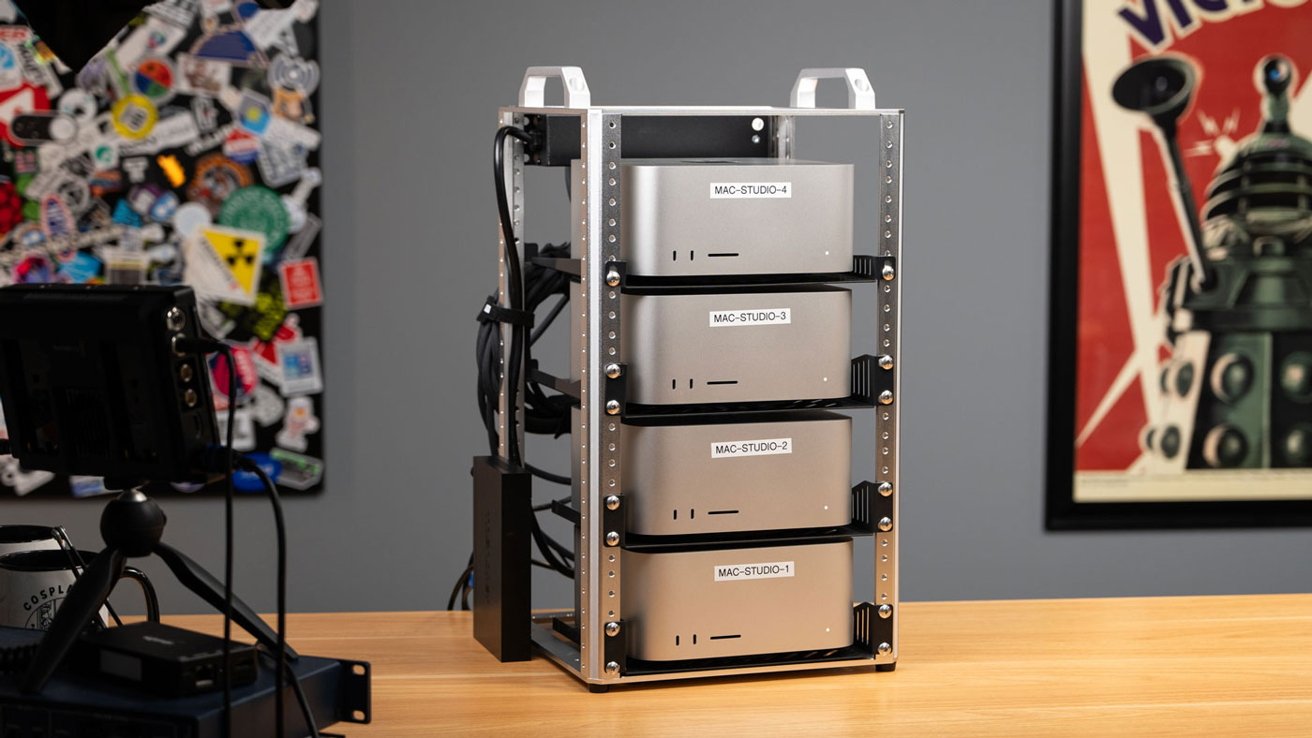
Not only that, the cluster functionality of Thunderbolt 5 seals the deal. https://appleinsider.com/articles/2...-boost-from-new-rdma-support-on-thunderbolt-5


66149-138645-mac-studio-cluster-1-hero-xl.jpg
What a stupid design by connecting tons of TB cables while Mac Pro can easily achieve that.
 
That's because Apple cant make Mac Pro grade chips with upgradability in mind. They barely make Max and Ultra chips due to large die size which only makes them too expensive and difficult to mass produce.

If M6 series uses MCM based design instead of SOC, then they can truly remake Mac Pro grade chips while making it upgradable in their own ways instead of using TB5 cables like that. With their proprietary PCIe-like slot and proprietary designed GPU-like Apple Silicon chips, it can add and expand.

I'm sure they really want workstation grade Apple silicon to take back lost markets and AI.

Btw, TB5 sucks and it can NOT even replace PCIe slots due to slow bandwidth compared to PCIe 5.0 x16's 512Gbps. It's just another stupid idea of Mac Pro 2013.
 
Given the recent adoption of rDMA in Mac OS there's an obvious way for the Mac Pro to distinguish itself from the Mac Studio as something other than an overpriced PCI-E chassis.

rDMA is not a panacea some folks are trying to make it out to be. Only corner a subset of what the Mac Pro could/would cover.

You could sell one stuffed full of M5 family chips networked together over an internal rDMA setup.

Highly doubtful. It is way more straightforward for Apple just to sell the Mac Studio and let 3rd parties build 'containers'. Has worked for over a decade for the Mini and doing just fine with the Studio for several years.


Apple coming in and 'Sherlocking' Sonnet and other partners is a short sighted, chessy move that doesn't really go anywhere.


The Mac Pro selling in two different chassis probably isn't helping it get faster update cycles as that likely increases the development overhead. If Apple is dumping the Mac Pro completely then there is a pretty good chance they are going to 'eject' doing rack versions altogether.

Apple's new Private Cloud Compute (PCC) nodes don't look like Mac Pro rack versions.

SSEHQHMXD5KDJJ3FA5LSFSQYQI.jpg


If Apple has design folks doing internal only cases for their own services , then I doubt they would have 'spare cycles' left to do external stuff.

What could make more sense is Apple putting. "Mac on PCI-e card ". If just a standard bus power card ( e.g., Mini Pro ) with 3-4 thuderbolt slots then coulpd put 4 nodes in a Mac Pro. If the cards all independent systems could put 4 nodes in a Windows PC computer too.

The hardware and software are both fully capable of it, and it would put the Pro in a different class of machine from the Studio. Then sell it at around or slightly less than the cost of 4 Mac Studios, and while it might not be a huge seller it would fill some HPC niches that the old pre-trashcan Mac Pro was popular in.

If the cluster of 4 doesn't sell well , then Apple (and retailers) are stuck with the inventory. If the cluster is composed of discrete Studio then can just sell each as individual systems. Far less inventory drama.

 
The PCI expansion chassis for an eGPU has never worked well. It's too bad that Apple doesn't have the "vision" to partner again with NVIDIA (GPU/Ai race is basically over)

In a M5 MacPro, one could have an onboard dedicated compute GPU for local LLM. Something I'm not seeing discussed here is the ability to run a machine at it's peak ability quietly and without the fan screaming all day. So people may have to go back to using machine rooms because Apple can't be bothered with considering the thermals over visual aesthetics of the SFFF. [Small Form Factor Fetish]
 
  • Like
Reactions: baryon

It's too bad Apple didn't go ahead with the rumoured 2022 Intel Mac Pro refresh with Ice Lake Xeon processors. Up to 38 cores, up to 4TB RAM, shipping with AMD RDNA2 GPUs with RNDA3 options added as they became available in 2023, it would have given the Mac Pro a useful niche for high RAM capacity, expandability, and x64 compatibility to make it distinct from the Apple Silicon Mac Studo. In such a timeline, the 2023 M2 Ultra Mac Pro would not exist and a 2022 Intel Ice Lake Mac Pro would be sold alongside the 2022 M1 series Mac Studio and later 2023 M2 series Mac Studio. The Mac Pro could then be completely discontinued in 2025 allowing the Mac Pro line to end cleanly on a strong last Intel iteration just like the Power Mac line ended on a last PPC iteration rather than carrying on as an Apple Silicon afterthought as it does now. Of course if Apple had introduced a new Intel Mac Pro they would need to maintain Intel support in MacOS for several more years which they don't want to do.
 
Last edited:
  • Like
Reactions: CIA and ikir
The great thing about the Mac Pro would be if you could put nVidia GPUs in it and run AI software locally with CUDA... Except of course Apple doesn't support nVidia anymore for some reason. And as it has become pretty obvious in the past 3 years, there is no AI without nVidia, not even close.
 
I still think a Mac with PCIe slots is needed. But on another note, I've considered getting a 2019 model because of how expandable it is.
Apple silicon is superior, you can always use a Thunderbolt to PCIe on a Mac Studio.

Regarding the rumors, I think Apple will release a Mac Pro with M5 Ultra
 
  • Like
Reactions: Omega Mac
The great thing about the Mac Pro would be if you could put nVidia GPUs in it and run AI software locally with CUDA... Except of course Apple doesn't support nVidia anymore for some reason. And as it has become pretty obvious in the past 3 years, there is no AI without nVidia, not even close.
You can run local AI in super efficient way with Apple Silicon and create a cluster with Thunderbolt.
 
Given the fact that Apple effectively controls the entire chain from software through to hardware, designing their own processors, etc, it’s disappointing that they could not offer the original Apple Silicon Mac Pro with a socketed processor so you can buy it with an M2 Max the maybe decide you want more power so plug in an M2 Ultra, then when Apple release new M series chips, M3 Ultra, M4, etc, you just buy the chip and swap it out in your Mac Pro chassis with all your important PCIe cards. This must surely be possible with SOC, especially when Apple controls everything.
 
  • Like
Reactions: Omega Mac
rDMA is not a panacea some folks are trying to make it out to be. Only corner a subset of what the Mac Pro could/would cover.


Highly doubtful. It is way more straightforward for Apple just to sell the Mac Studio and let 3rd parties build 'containers'. Has worked for over a decade for the Mini and doing just fine with the Studio for several years.


Apple coming in and 'Sherlocking' Sonnet and other partners is a short sighted, chessy move that doesn't really go anywhere.


The Mac Pro selling in two different chassis probably isn't helping it get faster update cycles as that likely increases the development overhead. If Apple is dumping the Mac Pro completely then there is a pretty good chance they are going to 'eject' doing rack versions altogether.

Apple's new Private Cloud Compute (PCC) nodes don't look like Mac Pro rack versions.

SSEHQHMXD5KDJJ3FA5LSFSQYQI.jpg


If Apple has design folks doing internal only cases for their own services , then I doubt they would have 'spare cycles' left to do external stuff.

What could make more sense is Apple putting. "Mac on PCI-e card ". If just a standard bus power card ( e.g., Mini Pro ) with 3-4 thuderbolt slots then coulpd put 4 nodes in a Mac Pro. If the cards all independent systems could put 4 nodes in a Windows PC computer too.


If the cluster of 4 doesn't sell well , then Apple (and retailers) are stuck with the inventory. If the cluster is composed of discrete Studio then can just sell each as individual systems. Far less inventory drama.
Do you think Apple will also start to sell its own Ai compute power into the market?

If it has a power consumption advantage using it's own Apple Silicon it could price itself very aggressively compared to others.

Who is to say this hardware kit dev does not trickle down in some way to the retail product line either.

Thanks for that linked story.
 
Personally at this point in time, I believe the Mac Pro is done.
Every year we get a new M-series chip. Each iteration has pretty much had a 10-20% improvement over the last one.
Sure TB5 and external PCI-e expansion isn’t the best, but I think that is probably more of a 3rd party offering then an Apple not having a Pro machine with built in PCI-e slots.

I forget the article, but one came out I think with the M5 the compared Apple’s performance increases vs the other guys (AMD, Nvidia etc). The other guys release new hardware every 2-3 years, if you compared Apple’s gains over the same period they are smoking the other guys in gains.
 
  • Like
Reactions: Omega Mac
Personally at this point in time, I believe the Mac Pro is done.
Every year we get a new M-series chip. Each iteration has pretty much had a 10-20% improvement over the last one.
Sure TB5 and external PCI-e expansion isn’t the best, but I think that is probably more of a 3rd party offering then an Apple not having a Pro machine with built in PCI-e slots.

I forget the article, but one came out I think with the M5 the compared Apple’s performance increases vs the other guys (AMD, Nvidia etc). The other guys release new hardware every 2-3 years, if you compared Apple’s gains over the same period they are smoking the other guys in gains.

In terms of the silicon transition roadmap and pipeline it would not surprise again to see the Mac Pro left till last to get a full re-vamp, since all the r&D and rollout roadmap would naturally target the main sales and consumer mass market products, especially as the M chips etc. mature and kinks are worked out, then you can offer the "beast" option expected of that product tier.

I would not be surprised to see a redesign with all that has been learned thus far.

I know nothing and this is conjecture based on some practical thinking, but money is not the issue, it's simply the will, and the vision, beyond market, sometimes your product can create a/the market.
 
Given the fact that Apple effectively controls the entire chain from software through to hardware, designing their own processors, etc, it’s disappointing that they could not offer the original Apple Silicon Mac Pro with a socketed processor so you can buy it with an M2 Max the maybe decide you want more power so plug in an M2 Ultra, then when Apple release new M series chips, M3 Ultra, M4, etc, you just buy the chip and swap it out in your Mac Pro chassis with all your important PCIe cards. This must surely be possible with SOC, especially when Apple controls everything.

Each generation of M SoC has different physical dimensions and almost certainly has different physical pinouts so the only way to "upgrade" would be to replace the entire systemboard.
 
If the cluster of 4 doesn't sell well , then Apple (and retailers) are stuck with the inventory. If the cluster is composed of discrete Studio then can just sell each as individual systems. Far less inventory drama.
You hit the nail on the head about one of the main problems casting doubt on the future of the Mac Pro: Return on investment (ROI), or profitability, or a lack thereof in the Mac Pro's case.

In a dwindling desktop computer market, there are at least three factors that help keep Apple's desktops profitable:
1. Price. Apple's most popular desktops (Mac mini and iMac) are cheaper and more affordable than their laptops.
2. Volume. More cheaper computers are bought than the more expensive models. Vast quantities of Mac minis are bought for server farms, and large numbers of iMacs are bought for homes, schools, libraries, and businesses. The pricier models aren't purchased in quantities as great.
3. Shared Silicon. Apple can reuse their laptop processors for their desktop computers.

But guess what? The Mac Pro has none of those advantages:
1. Price. The Mac Pro has the highest starting price out of all of Apple's computers.
2. Volume. The Mac Pro has the fewest sales out of all of Apple's computers.
3. Shared Silicon. The Mac Pro is the only desktop that doesn't share a processor with a laptop. It only shares development costs with one other model, the Mac Studio, which can also use the Ultra chip, but is cheaper.
 
  • Like
Reactions: CWallace and cosmos
Register on MacRumors! This sidebar will go away, and you'll see fewer ads.