Become a MacRumors Supporter for $50/year with no ads, ability to filter front page stories, and private forums.
The other thing that seems useful with these machines would be the ability to run ARM versions of Windows and Linux. I want to run macOS most of the time, but I’d like to be able to run Windows and Linux occasionally without need for separate hardware. It’d be great if Apple re-launched Boot Camp for this purpose.
On the M1s and M2s, good news, you can already run linux :)

 
  • Like
Reactions: darkblu
Currently, Apple hardware does not offer a choice. You cannot run native Windows or dozens of Linux distributions. It is unclear what the situation will be in a few years. With Hackintosh, you have a choice; you can do anything, but you don't have to.
 
I appreciate you digging that up. However, I'm perplexed by that report, as are many others in this thread...It's difficult to tell if the numbers represent total sales or revenue, and, of course, that chart changes every quarter. Even more perplexing is that CIRP's data varies widely even within the same year: (both charts are from 2023).

I honestly could see initial M2 Ultra Mac Pro sales being "robust" for anyone using a 2019-era Mac Pro for non-GPU accelerated tasks since it was clear Intel support in macOS was not long for the world. But once that initial demand was met, sales of the model fell off a cliff since "everyone who needed/wanted one had one".


Apple could make their own system with upgradability. 4 slots and each slot can take one GPU-like SoC. Since Apple has their own ecosystem, it's not difficult to make their own PC system and parts which only works with Mac Pro chassis.

I expect Apple could make a PCIe card with thousands of GPU or NL cores on it, coupled with terabytes of RAM, but without third-party support, how useful would it be? Even if Apple offered CoreML support for it, the common refrain in these forums and elsewhere is "It's CUDA or Nothing!" so how many people would spend the astronomical amounts of money it would cost if it only supported Apple's AI?


I think thats a weak excuse for not supporting upgradeability.

I can take a PC case from 30 years ago and put the latest motherboard and processor in it.

If Apple ever updates the Apple Silicon Mac Pro, you might be able to do the same (provided you can secure a system board).


The processor has different pin outs, fine put them on a daughterboard = problem solved.

And more problems created since you increase cost and complexity. Back in 1986, my $25,000 HP Vectra RS/25C workstation had its 25MHz 80386 CPU, 80387 FPU, 82385 Cache Controller (effectively an external L1 cache for the CPU) and 16 30-pin DIMM slots on a daughter card that plugged into the system board backplane that had the ISA slots for peripherals. I presume this was designed to allow customers to start with a slower CPU (like the 16MHz model) and then upgrade to a faster model (like the 33MHz model) without having to toss the entire chassis.

But once the i486 was released, HP never offered such an upgrade and I instead had to replace my i386 with a Cyrix 486DLC. However, even if HP had offered an i486DX option, I would still have been stuck with 8-bit and 16-bit ISA for expansion, missing out on PCI and VESA expansion slots to support faster video, storage controller and network controller cards.

So even if Apple offered an M6 system card to replace the M5 card the machine originally came with, if the new M6 model came with faster PCI or TB generations that allowed for faster SSD speeds or newer peripherals like HDMI 2.2 or 100Gb Ethernet ports, you would lose out on all that. Now perhaps you personally would not care, but presuming that M6 card will probably cost over 50% of the price of the new M6 model, how many would just not buy a new machine? Or wait until the M7 or M8 arrives with even more performance and replace the entire machine then?
 
Last edited:
1. The M-chips don't have multiprocessor support, and at the same time, they pushed their top end chips into the Studio and lower tiered macs. So where is the opportunity to distinguish the model line from a performance perspective?
Apple bringing high end single threaded performance to even the lowest end devices is “dropping the ball”?
 
Another Tim Cook drop the ball IMO.

There are a bunch of reasons why

1. The M-chips don't have multiprocessor support, and at the same time, they pushed their top end chips into the Studio and lower tiered macs. So where is the opportunity to distinguish the model line from a performance perspective?

Does a 32-core CPU really need a second socket? The 64 cores in the Threadripper Pro 9985WXs are barely faster in practice.

 
  • Like
Reactions: MacPowerLvr
Currently, Apple hardware does not offer a choice. You cannot run native Windows or dozens of Linux distributions. It is unclear what the situation will be in a few years. With Hackintosh, you have a choice; you can do anything, but you don't have to.
On the M1s and M2s you have Linux options…
 
Does a 32-core CPU really need a second socket? The 64 cores in the Threadripper Pro 9985WXs are barely faster in practice.
Depends entirely on what you’re doing. There’s plenty of “embarrassingly parallel” workloads where that absolutely helps
 
  • Like
Reactions: Basic75
There are people willing to pay up to $100,000 or even more for an HP Z8 G5 with multiple high end GPUs and tons of RAM and storage. So there is a market for that.
...but that doesn't mean that there's a market for a Mac with those specs. Those "multiple high-end GPUs" (probably NVIDIA or AMD) aren't going to magically get faster because they're slotted into a Mac rather than a HP. In fact, they're gonna get slower because (even if Apple added PCIe GPU support) a Mx Ultra only has enough PCIe lanes to drive a single 16x GPU. Most must-have software at that level is available for Windows and/or Linux, the "user friendly" Mac UI is no big deal if you're immersed in hugely technical pro software, and the power efficiency of Apple Silicon is drowned out by those big, sweaty GPUs.

The reality is that Apple Silicon is great for the tablets, laptops and small-form-factor systems that account for the vast majority of Mac sales but if you want a multi-PCIe-GPU workstation, a M-series chip just isn't the tool for that job. Apple doesn't have anything special to bring to the "big box'o'slots" market - and they don't need to.

Apple could easily offer a Mac Pro with four M5 Ultra for example.
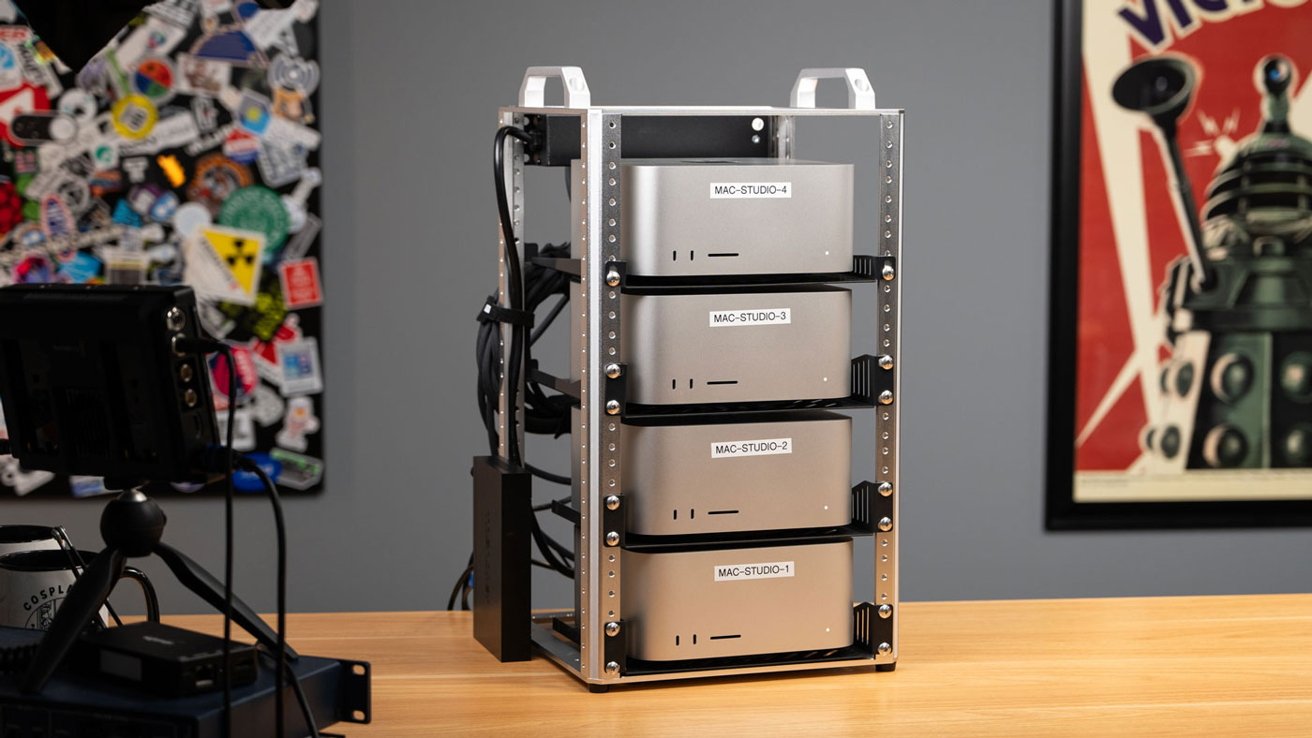
Of course you can build a cluster of four Mac Studios, but some people want it in a single case.

The only advantage of that would be if it used "raw" PCIe for RDMA interconnects to get an edge over Thunderbolt. An Mx Ultra still only has 16-24 lanes of PCIe to play with, but that's usually a generation ahead of Thunderbolt. Not sure how much that would improve performance, and they'd need to design a 5xM5 Ultra logic board with all the PCIe plumbing, and a case... to serve a tiny market.

What they have with the Studio is something that performs exceptionally well in relation to its size and power consumption - even if it can't compete with a rack stuffed with HP's finest - with a (relatively) large potential market, with a software-only (well, plus a bunch of Thunderbolt cables) route to scaling it to multiple machines for more specialist apps. 4 Studios in a stack is still smaller and more power-frugal than a massive tower - and there's plenty of scope for a third-party to come up with a better way of organising it than a generic mini-rack designed for Raspberry Pi clusters (as shown in the video) and regular TB5 cables.

 
Comparing apples and oranges though. That single NVidia card is drastically more capable than the studio. Get a low end or last gen NVidia and it’ll still cream the Mac. I’ve nothing against Apple, but they are what they are. If it’s powerful enough for your use-case then great, but denying that there are more appropriate systems out there isn’t achieving anything.

It just won't though, because you can't fit half a a few hundred gigs on your low end Nvidia card's VRAM.
 
Depends entirely on what you’re doing. There’s plenty of “embarrassingly parallel” workloads where that absolutely helps

There aren't that many where 1) many cores helps, 2) I/O is not a bottleneck, and 3) moving to GPU cores instead isn't practical.
 
  • Like
Reactions: throAU
This was a goal of Steve Jobs. It was one of the reasons when he returned to launch the G4 Cube to see how his idea would fare. He never liked anyone to have the ability to change out the internals of his machines. Apple Silicon favors his "closed system" design that he envisioned the Macintosh would be in his eyes.

Also, I knew Arm and RISCV based machines would need a different type of thought process when it came to upgradeability versus X86. Even adding in a basic M.2 slot on a Raspberry Pi required a daughter board. I hope the Mac Pro could evolve over time rather than the Studio replacing it.
 
Bet there is not enough demand for a company the size of Apple to invest in a niche machine.

Except its the niche machine that designs all the other machines...

But I do think it's a bit pointless with RAM / GPU baked into CPU.

I do wonder if they will create a bespoke connection to an enclosure that is faster and more Direct than Thunderbolt 5

A stacked system baed on Mac Studio.
Drive units
PCIE Units
Input / Output
GPU / ML units.

Mix and match - chose what you need to make it more powerful.
 
Except its the niche machine that designs all the other machines...

It isn't. That was true in the 1990s.

With ARM Macs, most of the design takes place on the iPhone, and most of it is just scaled up. Macs add some features like Thunderbolt, and complexity like dual-boot, but not that much. Apple does not take a high-performance machine and scale it down.

 
  • Like
Reactions: CWallace
expect Apple could make a PCIe card with thousands of GPU or NL cores on it couple to terabytes of RAM, but without third-party support, how useful would it be? Even if Apple offered CoreML support for it, the common refrain in these forums and elsewhere is "It's CUDA or Nothing!" so how many people would spend the astronomical amounts of money it would cost if it only supported Apple's AI?
It would be another afterburner card. And look how useful that turned out to be when Apple shackled it.

Apple has to adopt standards rather than dogmas if it wants to do a workstation. And that means something else other than a king sized Mac Mini with an Apple Tax added.

That’s how they open it up to more buyers who aren’t tied to the Apple ecosystem.

5

A stacked system baed on Mac Studio.
Drive units
PCIE Units
Input / Output
GPU / ML units.

Mix and match - chose what you need to make it more powerful.

Nice idea, it what if they have a change of heart and scrap the lot 2-3 years later for the next big thing? All of those become expensive hard to find orphans.

Try finding W6800X Duos or the W6900X card now at a reasonable price. You won’t. They are rare and expensive.

Half the Apple staff you speak to have no idea what a Mac Pro even is, they correct you “you mean a MacBook Pro” and then you need to explain what your computer is. That’s happened numerous times for me at flagship Apple stores and on their support phone lines.

Given that, why should you or anyone else risk buying such a product in the future?
 
Last edited:
~

So even if Apple offered an M6 system card to replace the M5 card the machine originally came with, if the new M6 model came with faster PCI or TB generations that allowed for faster SSD speeds or newer peripherals like HDMI 2.2 or 100Gb Ethernet ports, you would lose out on all that. Now perhaps you personally would not care, but presuming that M6 card will probably cost over 50% of the price of the new M6 model, how many would just not buy a new machine? Or wait until the M7 or M8 arrives with even more performance and replace the entire machine then?
Look at the current Mac Pro design. It would be a replacement logic board, so you’d get full support for all those things. Contemporary silicon architecture and advanced packaging doesn’t allow for anything else. Nvidia’s logic boards are no different.

But you’re right about the cost equation, and that’s likely why they won’t do it — a new replacement M2 Ultra Mac Pro logic board today is whatever it is, depending on memory and core counts, basically you can’t get it without a trade in. Between the logic board and new I/O cards, the cost of an upgrade kit would be at least 80% of a new machine.
 
Last edited:
Not only that, the cluster functionality of Thunderbolt 5 seals the deal. https://appleinsider.com/articles/2...-boost-from-new-rdma-support-on-thunderbolt-5


66149-138645-mac-studio-cluster-1-hero-xl.jpg
PCIE Gen 6 does 1024Gbps vs 120Gbps of TB5. I could see a system with 4-6 Ai accelerator cards to really push the local LLMs.
 
In AI, only Nvidia matters, and Apple lost touch with the leaders long ago. Anyway, serious AI applications use computing servers whose power exceeds the imagination of the average PC or Mac user. AI in personal computers is just a toy.
 
It just won't though, because you can't fit half a a few hundred gigs on your low end Nvidia card's VRAM.
Perhaps not, but (and this may blow your mind) other computers have upgradable memory as well as massive PCIe bandwidth. Max Studio maces out at 128GB memory which is pretty small.
 
Perhaps not, but (and this may blow your mind) other computers have upgradable memory as well as massive PCIe bandwidth. Max Studio maces out at 128GB memory which is pretty small.
Mac Studio with the M4 Max maxes out at 128, but with the M3 Ultra it maxes out at 512 GB.
 
In AI, only Nvidia matters, and Apple lost touch with the leaders long ago. Anyway, serious AI applications use computing servers whose power exceeds the imagination of the average PC or Mac user. AI in personal computers is just a toy.
Not true, GPU itself is extremely inefficient cause it was never meant for AI and compute. That's why NPU came out and Google's TPU proven that with Gemini 3.0 which outperformed OpenAI with Nvidia.
 
Mac Studio with the M4 Max maxes out at 128, but with the M3 Ultra it maxes out at 512 GB.
That's nothing compared to Mac Pro 2019 with 1.5TB of RAM and 128GB VRAM. And yet, Mac Pro 2019 had less RAM and VRAM compared to other workstations.
 
Not true, GPU itself is extremely inefficient cause it was never meant for AI and compute. That's why NPU came out and Google's TPU proven that with Gemini 3.0 which outperformed OpenAI with Nvidia.
Gemini 3.0 it is software not hardware. Nvidia supplies 90% hardware for AI. You could say it has a monopoly )
But Apple can lock itself in its ecosystem and pretend it's the best at everything.
 
  • Disagree
Reactions: 1d1otic
The M-chip development paradigm is a non-upgradable disaster - once you buy a M-Mac, it’s a dead end. So a M-chip Mac Pro is absolutely pointless anyway.
And no: there are virtually NO uses for PCI slots besides GPUs.
The architecture was designed for embedded systems first and it shows in the lack of expandability and repairability.

Only the very hardcore Apple fans that drank a bit too much of Apple Marketing's kool-aid believe otherwise.
 
For the 2019 mac pro?

Not happening, no one is writing new firmware for this (well, apple are the only ones who can, given the code-signing requirements) given that both Apple and intel consider it EOL/EOS.

They don't need a million reasons, they have two:
  1. we have only validated the CPU options we provide; third party CPU upgrades are not supported
  2. we aren't writing new firmware for a machine deemed end of support
They do have a precedent for doing so however. They added a lot of additional functionality to the old 2010 cheese graters well after they had been discontinued. So it's not unheard of.
 
  • Like
Reactions: seek3r
Register on MacRumors! This sidebar will go away, and you'll see fewer ads.