Become a MacRumors Supporter for $50/year with no ads, ability to filter front page stories, and private forums.
Waiting till someone posts some real data on this....

To buy a whole new machine for VMWARE.... it better be 4x the speed of my current Mac Pro 2.8 Octo. Benchmarks that Apple post are really not very good....

Truthfully, anyone with a previous gen model shouldn't be considering the new Mac Pro. The speed increase just won't be there, even given what Apple claims.

Otherwise, people are just comparing to see how "obsolete" there machines are perceived to be.


Yes, you will be able to. No, you won't be able to "future proof" your machine. It will be obsolete over time. No, not to many of us that use the first gen Mac Pro feel that it's any slower.

They are much MUCH faster than my dual 2.0 G5 which I have had for going on four years now. With the price range of this current Mac Pro I may be waiting another year just to raise the money for it, putting my upgrade time at 5 years! :eek: How could I ever live with myself and a 5 year old machine.
 
Look at [Apple's] posted benchmarks for [some program] which shows a [ten frillion X] improvement over the previous generation of Mac Pro utilizeing all 8 cores. [some other program you don't use] show a [arbitrary number X] increase.

Apple's benchmarks are notoriously biased and not to be relied upon. For all we know, they were epic fail on other benchmarks and they refused to include them.

I think it was the iMac G5 that had a stated "22x improvement in FPS" in quake 3 over the previous model. Many other benchmark sites attempted to duplicate their results. They handicapped the previous model, put more RAM in the G5, anything they could think of--still, nobody could get near that kind of performance difference.

Apple changed their website as a result.

Yeah so the moral here is: full of crap.
 
Some people here obviously misunderstood the meaning and importance of Intel's "Turbo Boost Technology" and should read the specifications, available on-line here: http://download.intel.com/design/processor/applnots/320354.pdf?iid=tech_tb+paper

I hope that the provided link will help you to understand what this technology means, because it is of more importance than what most people here seem to think.

I can't comment on speed/benchmarks here, but I'm sure that most people will be happy with the single chip configuration - let's laugh at the benchmark results later shall we (when OS X 10.5.7/10.6 are released)?

/me back to benchmarking and finishing my article :)
 
So is Nehalem the next version of the i7? Otherwise, Apple didn't really get shotgun on these processors.
 
That's the big deal with Nehalem.

http://www.apple.com/macpro/performance.html

Look at posted benchmarks for Maxwell Render which shows a 1.7x improvement over the previous generation of Mac Pro utilizeing all 8 cores. Mathmatica show a 1.8x increase.

Applications as these are the best case for an upgrade from the previous generation. Otherwise, not much benefit to an upgrade.
True. The synthetic benchmarks also look very good. On the other side you have 3 of the 5 Final Cut Studio benchmarks, the Xcode one, and both Imaging and Graphics ones that show 1.1x or 1.2x improvements.

2.4| x
2.3|
2.2|
2.1|
2.0|
1.9| x
1.8| x
1.7| x
1.6| x
1.5| x x
1.4| x x
1.3| x x x
1.2| x x x x x
1.1| x

Median = 1.35x

These are from the performance page, don't read too much into them. Plus they are likely skewed towards the new model.
 
Not with a RAM cap of 8GB. My 4 year old G5 can get up to 16GB no problem. For me, the Mac Pro starts at $3299. The base model is that xMac that we've all been looking for, just at twice the price.

Yes, that currently, read currently sucks for some, but the memory (4GB is still ridiculously expensive) and drive configuration will change (soon I hope)!

EDIT: I just called the Cupertino based company and they said, and I quote: "There wasn't enough demand for the SAS drives, possibly because of the limited size/high price tag".
 
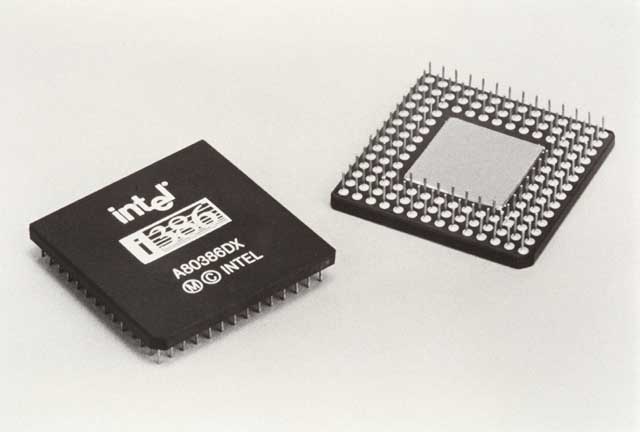
Intel 12Mhz 80386

You meant a 286 system. Intel never produced a 12 MHz 386 CPU officially--the first 80386 CPU started at 16 MHz.

And now, my home computer's Intel Pentium Dual-Core E2200 runs at 2,200 MHz. :rolleyes:

Intel did make a 12Mhz 80386, even though the first chip they introduced was the 16Mhz version.

I remember it being used in Zenith laptop computers.

Here is a link:

http://www.x86-guide.com/en/cpu/Intel-386DX-12-cpu-no1327.html

Here is a picture:
Intel%2080386.jpg
 
True. The synthetic benchmarks also look very good. On the other side you have 3 of the 5 Final Cut Studio benchmarks, the Xcode one, and both Imaging and Graphics ones that show 1.1x or 1.2x improvements.

2.4| x
2.3|
2.2|
2.1|
2.0|
1.9| x
1.8| x
1.7| x
1.6| x
1.5| x x
1.4| x x
1.3| x x x
1.2| x x x x x
1.1| x

Median = 1.35x

These are from the performance page, don't read too much into them. Plus they are likely skewed towards the new model.

I'm curious how you could make a case that these are skewed towards the new model if the testing conditions are given (the small print).

Nehalem (Gainestowne) has three major improvements over the previous generation of Xeons: single quad core die in lieu of two dual core die; on chip memory management, and; Quickpath in lieu of a frontside bus which show a 2.2x improvement in memory bandwidth.

Nehalem is all about memory bandwidth, with some lesser functionalities (Turbo) added. The benchmarks appear reasonable and repeatable.

Arguably, Apple is migrating its pro applications to 64 bit Cocoa to take advantage of the new hardware and Snow Leopard's OpenCL and Grand Central improvements for GP GPU and multithreading respectively.
 
No you aren't

knight_rider_turbo_boost.jpg

LOL... LOL... LOL... what a crap! we just went back to the 80's!!!

Oh God... Steve Jobs defintly is unconsious some where.

What good is a turbo bust then? If I have an application that does not need the 8 cores that mean there is no actual need to ask for aceleration any way... that is why we have more cores today!!!

Who was the engineer of that one... Alf?
 
Why is it every time I hear the name "Nehalem" I want to reply with "guzunheit"?
 
So, here is my question:


Are any of you folks with the very first gen Mac Pros feeling like it is out of date, obsolete, and too slow? I am just curious as to the longevity of these machines, as it seems that G4s and G5s from many years ago still see current, heavy use in some applications.

Thanks!

I'm not. I have a 1st Gen Mac Pro & I haven't even maxed out memory or HD space yet.

I have done some upgrades (3870 video card, upped ram to 15Gig & added a 2TB raid.):D

For me, the limitation is software. The only thing I have that pushes my machine is Vue 7.

In 2009, I'll max out my machine (32GB ram, 4 more 1TB HDs) while I wait for everyone to get around to developing software that can actually use what I already have.
 
Actually, 400% would be the correct percentage.

He was talking about the % increase in performance so it is 300%:

If it took exactly the same amount of time, it would have 100% of the original performace, for a 0% increase.

Since it takes 1/4 the time, it has 400% of the performce, or a 300% increase. That is the performance went from 100% of the original to 400% for the new mac, for a 300% increase.
 
As far as people know, Nehalem's main advantage is utilizing multicores better than Penryn. For example Cinebench render using multi core in my octo 3.2 shows 5.6x speed increase over using single core. That means 8 core /= 8x1core for Penryn.

But early Nehalems showed almost 100% utilization of multicores in tests. So if your application is multicore aware, chances are you are going to see a decent performance boost over Penryn. But don't expect much from single threaded/single core applications. They are more or less going to be performing similar to Penryn. If you pay attention, none of the Apple's benchmars are single thread benchmarks. They are all about utilizing 8 cores. That's why they get so big difference compared to previous generation.
 
the new 4core nehalem MacPro-basic can't beat the old 8core basic Hapertown in parallel (render, encoding) tasks, I highly doubt it. So the basic MacPro has become slower (!) for most of the tasks I would use it for...

I find that very confusing by Apple

Don't be so sure.. I wouldn't be surprised to see amazing performances from the nehalem family all together.

It has been said that nehalem family is a huge technological jump, we'll see. But my guess is that IT IS a huge jump :) Even on a single quand core (wich virtually works as 8 core thanks ti HT technology)
 
..
What good is a turbo bust then? If I have an application that does not need the 8 cores that mean there is no actual need to ask for aceleration any way... that is why we have more cores today!!!
...

Turbo boost helps with operations that can't (or don't) take advantage of all available processing cores.

So suppose you have an app that, IDK, automagically strips commercials from recorded television. Let's suppose it works great for you but unfortunately it is slow and can only take advantage of two processing cores.

So when you're running this on your 4-core Mac Pro, two cores chug away at 100% while 2 cores remain mostly unused.

Turbo boost will increase the clock speed so that the two cores that are being used run faster. (It can get away with this because with only two cores doing work, the CPU still stays within its overall thermal and electrical limits.)
 
Turbo boost helps with operations that can't (or don't) take advantage of all available processing cores.

So suppose you have an app that, IDK, automagically strips commercials from recorded television. Let's suppose it works great for you but unfortunately it is slow and can only take advantage of two processing cores.

So when you're running this on your 4-core Mac Pro, two cores chug away at 100% while 2 cores remain mostly unused.

Turbo boost will increase the clock speed so that the two cores that are being used run faster. (It can get away with this because with only two cores doing work, the CPU still stays within its overall thermal and electrical limits.)

But is not the OS already encharged of distribuiting automaticly the process of any application between the available cores?
 
But if you think the new ones are faster than the one I just bough 3 months ago... forget about it.

It is a huge pile of marketing BS unless you have one of the first Intel machines, THEN is when NOW you will see an improvement.

The benchmarks are such waiste of time, nothings more unrealistic in this world.

That's not true according to some developers.

According to some developers at Maxon, when rendering in Cinema 4d, the new Quad Core i7 (4 cores) is almost equal (like 95%) in speed to an 8 core macPro previous gen xeon running at the same clock speed.

When you compare the new 8 core to an old 8 core and you hit render- they are seeing immense perfomance increases when rendering in CInema 4d R11 (Cinebench is only at version 10, version 11 added additional optimizations).

one guy in particular called the speed when rendering with a Nehalem "ridiculous". An 8 core nehalem would render with 16 simultaneous render threads thanks to Hyper threading. That is nuts.


Will you see a big difference when running Firefox? Probably not. I haven't been impressed with Apple's multi-threading performance in their apps, but Maxon really knows how to push any machine their software runs on.
 
Turbo boost will increase the clock speed so that the two cores that are being used run faster. (It can get away with this because with only two cores doing work, the CPU still stays within its overall thermal and electrical limits.)

Well that actually seems useful. I was under the impression that it's some eco-friendly thing.
 
Crank it to 11 with Turbo Boost!

One thing I wonder about is why the x264 guy claims that this Nelhalem processor SIMD engine boosts performance of encoding so much compared to the Penryn chips. Penryn has SSE4 and this CPU has SSE4.2, which is SSE4 plus like 5 additional instructions. Curiously, when SSE4 was first released, the x264 people claimed that it was pointless and that they would never be implementing it (and unfortunately, not a single other application out there currently supports SSE4). Now they can't get enough of it? What does that handfull of additional instructions do?

The instructions are mostly the same. However, they get executed a lot faster now. Say you have a single precision floating point operation that executes in one cycle and a vector operation that does four of these in four cycles - pointless. Now with the newer processor the same instruction does the four operations in one cycle - and suddenly it makes a lot, lot more sense to use it.
 
Register on MacRumors! This sidebar will go away, and you'll see fewer ads.