Pets.com was never a true dot-com business. Like most of the losing companies in the dot-com era, all they did was slap .com on their brand rather than building out a true internet presence and internet-based business plan. Without a question there will be companies that thought they could bolt on some aspect of AI without any business plan or AI-based business strategy. They'll eventually get shaken out but those aren't real players anyway... they're all small potatoes who invest more in marketing than an actual sustainable business models.Exactly.
Amazon.com has been around for more than 30 years.
Pets.com was gone in less than 3 years.
I wonder how many of these AI companies will have the staying power of Amazon? And how many will suffer the same fate as Pets.com?
🤔

Got a tip for us?
Let us know
Become a MacRumors Supporter for $50/year with no ads, ability to filter front page stories, and private forums.
Apple Will 'Watch Everything Burn' When AI Bubble Bursts - Ed Zitron
- Thread starter MacRumors
- Start date
- Sort by reaction score
You are using an out of date browser. It may not display this or other websites correctly.
You should upgrade or use an alternative browser.
You should upgrade or use an alternative browser.
DaveCummings
macrumors member
The thing is Though Amazon lost money for 20 years, the money brought into Amazon during those non profitable years is not nearly as much as the money spent on AI without any profit. Also Amazon could have easily have been a casualty of the dot com crash.This is missing the whole story. Amazon lost money for 20 years before it ever turned a profit. The costs drop in fractions monthly. The biggest costs they have is in power infrastructure. When they have that solved, it will become so cheap to run LLMs and potentially open source LLMs could run on our own devices for almost no cost other than electricity. This is a business model based on expected hype. Anthropic is killing it. Maybe only one company survives the biggest blow but I suspect there will always be competition and AI itself will disrupt entire industries and workflows forever. Anyone who doesn’t see it isn’t using the latest models to see the improvements. It’s truly staggering what they have accomplished, and my big bet would be AI leads to quantum AI which breaks our own reality as we know it. AI wins any outlook AI wins and returns the money to the investors. It will become profitable but it will take a few years and investors believe in it. Unless there’s a solar storm that takes away and destroys all of our tech and energy infrastructure, AI wins.
On a totally unrelated note regarding AI and sustainability is with the sheer number of these data centers and what they want to build and the impact that it could have on the environment and seeing the record heat this year, another way this growth is not sustainable is that unless some kind of way to power this data is changed to where it doesn't impact the environment as much, it's going to cause serious issues really fast. But I know this isn't a concern to the current administration since all they worry about is how they can make money from it

False equivalency and janitorial/HVAC doesn't count 😉 Auto plants weren't needed once we outsourced auto manufacturing to other countries. There's no scenario in which we outsource our data centers specifically for US needs to other countries. Data sovereignty rules worldwide are becoming more strict, not less.I've worked in data centers—understand who you are talking with before you start.
Trust me... there are plenty of people who thought auto plants in the US would "always been[sic] needed." The simple fact of the matter is nothing is ever indispensable.
slothinker
macrumors regular
Great article. Oracle has been living on acquisitions and 'sweet talking' clients and client technology buyers into staying with the growing, disparate 'Oracle stack' for 40 years ... not 20. Larry Ellison would be hard pressed to point to a single best-of-class product ever developed by direct Oracle hires.
Memory prices have doubled, Macs and iPads have gone up, and iPhones are expected to follow. Ed Zitron – who writes the Where's Your Ed At newsletter, hosts the Better Offline podcast, and has been described by Politico as the AI boom's most "acerbic gadfly" – has spent years arguing the buildout driving those costs will never pay for itself.
We asked him what happens to Apple if he's right.

You've been calling AI a bubble since before it was fashionable. For MacRumors readers who mostly know it as ChatGPT or Apple Intelligence on their iPhone, what, in plain terms, is actually broken about the economics of the LLM industry?
At their very core, Large Language Models' costs run contrary to basically every model of selling software.
Consumers and enterprises alike have been trained to pay a monthly fee for a service, and while these services might have limits or strictures, basically nobody buying software expects to have a metered service, let alone one that's both metered and with hard to measure costs.
LLMs burn tokens at a per-million rate regardless of whether or not you get the response you want, or whether it does what you ask it to do. If you ask a coding agent to do some sort of software task and it goes off and spins its wheels in a loop, you're paying for the tokens regardless.
AI companies knew that consumers would never pay the actual cost of their AI services, so they have, for the most part, sold them monthly subscriptions with vague rate limits that allow them to burn way more in tokens than the cost of their subscription. SemiAnalysis found that you can burn hundreds of dollars on a $20-a-month subscription and thousands of dollars on a $200-a-month subscription, and while AI boosters will claim that these companies have "70% gross margins on tokens," there is little proof that this is the case, and my own reporting shows that OpenAI lost $20.9 billion on $13.07 billion in revenue in 2025.
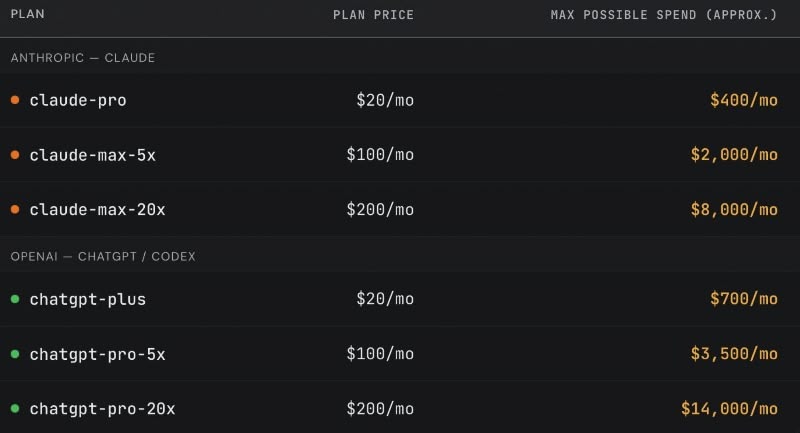
Image credit: SemiAnalysis
This means the very basic economics are broken. If Anthropic and OpenAI believed customers would actually pay the real cost of AI tokens, they wouldn't have to give away 20 to 40 times the amount of tokens to subscribers.
Meanwhile, back in March of this year, both moved their enterprise customers over to token-based billing. Within a few weeks, it came out that Uber had spent its entire annual token budget in the space of a quarter, and its COO said that it was getting "harder to justify" the cost of AI because it was hard to track the cost of AI to any actual useful features shipping. Sam Altman would eventually say it was a "huge issue" but declined to say how it might be fixed.
This is a problem across basically every single AI-powered startup, which has to pay the per-million token rate. Perplexity, Cursor, GitHub Copilot (which moved to token-based billing in June) – every single AI startup is unprofitable because their users don't want to pay the actual cost of AI.
Another issue is that AI services are just not that useful or differentiated. While people get some sort of benefit out of AI-generated code, these tools actually end up making them slower, and are filling codebases full of slop. Otherwise, an LLM is an LLM is an LLM – it can generate, it can summarize, it can search, and that's about it, which means that every AI service is effectively the same. That's why 89% of all AI revenues are Anthropic and OpenAI, and why every AI startup talks in terms of "annualized revenue" (monthx12) – because actual revenues are very depressing. Even then, most are barely at $100 million annualized.
Then there are the data centers. An AI data center is very, very expensive to build, takes 18 to 36 months, and costs billions of dollars, which means effectively anyone building one will be raising debt and only get paid once a customer moves in... except there aren't really any customers for AI data centers outside of Anthropic and OpenAI, both of whom are so unprofitable that they've had to raise hundreds of billions of dollars even when Microsoft, Google and Amazon built all their infrastructure.
The only reason everybody isn't freaking out about this is because AI-related stocks have done well, even though none of the hyperscalers actually share their AI revenues.
You've argued that AI's demand story is essentially a mirage – that most of the data center capacity is being absorbed by OpenAI and Anthropic themselves, which is masking the absence of real enterprise demand. If that's right, who do you think will actually bear the cost when the whole thing unravels?
Honestly, it's going to be a lot of private credit funds, because they're the ones funding the data centers, and they're funded by pension funds like the SF teachers fund or CalPERS, which makes me really, really worried about the systemic contagion.
People will argue that this means there's going to be a bailout, but this isn't really a bailoutable thing. These data centers are funded by project financing, which means that the money is basically gone and the only way to "make them whole" would be to either buy out the debt or feed them revenues. While you could theoretically bail out these special purpose vehicles (SPVs), doing so would be to the tune of hundreds of billions of dollars and be political cancer.
I also fundamentally believe that Oracle gets killed by OpenAI. Its revenues have been stagnating for 20 years, and the only way it's kept its head above water is $85bn+ in acquisitions, and even then, that's just kept things flat. Its bets on AI data centers – $340bn+ with hundreds of billions in debt – require OpenAI to become t... Click here to read rest of article
Article Link: Apple Will 'Watch Everything Burn' When AI Bubble Bursts - Ed Zitron

DaveCummings
macrumors member
I'm convinced that a lot of these people glazing AI are the same people with blue checkmarks on Twitter who post AI slop videos going on about how "Hollywood is cooked"How much do you have invested in AI? 😆

adrianlondon
macrumors 604

Michael Scrip
macrumors G3
Comparing Amazon.com to Pets.com is nonsensical because Pets.com was never a true internet business. Like most of the losing companies in the dot-com era, all they did was slap .com on their brand rather than building out a true internet presence and internet-based business plan. Without a question there will be companies that thought they could bolt on some aspect of AI without any business plan or AI-based business strategy. They'll eventually get shaken out but those aren't real players anyway... they're all small potatoes who invest more in marketing than an actual sustainable business models.
My point was: one company has lasted for over 30 years... and another company was gone in less than 3 years.
So this is what I'm asking: 👇
How many of these AI companies will last for 30+ years?
And how many of these AI companies will fizzle out in just a few years?
🤔
platinumaqua
macrumors 65816
I'm not so sure. Given Apple have given in to FOMO with AI and is now haphazardly implementing AI features, I suspect they'll also be late to stop investing money and effort into AI when the bubble bursts.
All of us are already paying a tax for Ai. In the form of increased utility rates, RAM, SSD, computer, and even car prices. Everything that uses RAM/SSD/GPU has significantly increased in price. Basically the 0.1% found a way to tax everyone and make themselves richer without anyone ever voting for it.

nikhsub1
macrumors 68030
Yeah and it took amazon 9 years before it made a profit...Exactly.
Amazon.com has been around for more than 30 years.
Pets.com was gone in less than 3 years.
I wonder how many of these AI companies will have the staying power of Amazon? And how many will suffer the same fate as Pets.com?
🤔
There is a difference between AI and data centers. AI is here to stay but that doesn't mean the infrastructure used to run them is the same. The models are the real valuable product, the data centers are just large money sinks needed to run what companies think is the AI business model. With much more powerful consumer and desktop processors, on device Ai is the next big thing, IMHO. That addresses data privacy concerns and the tool can be tailored to an individual need, not a large generic model that attempts to address everyone. Having specific criteria and data requirements makes smaller models and efficient way to use AI, which I currently do for free on my MacBook. It's not as fast as Claude, but speed is not an issue for me.
Local LLMs also mean models will no longer be free but like subscription based and bespoke for larger companies for a fee.
This.
As you say, AI is here to stay.
Let's stop for a while and survey the scene.
The sort of things that LLMs can do now - generate 4k images and videos, analyse data, create original creative works etc. - would be unthinkable at the start of say, 2020.
All the AI naysayers remind of people in the late 90s saying that e-commerce is a flash in the pan, as people love going to bricks and mortar outlets to buy things.
As for Apple - it has been not so smart and smart, simultaneously.
That Apple is woefully behind on AI is without doubt.
TC has said that Apple is continuing the Steve Jobs credo of owning the primary technology behind its products. They don't own anything approaching a frontier LLM and have had to go to their frenemy Google to bail them out.
But as you say, how Apple sees AI working is obviously with models on primarily running on device.
I'm going to bet that the vast majority of prompts that go up to the cloud are pretty trivial requests (I know mine are).
So you won't need an advanced LLM running on the most expensive Nvidia clusters to answer them.
Your 2027-28 Apple device with more RAM and vastly more capable NPU power - plus some extra web searches and API calls to apps etc. will likely be able to manage most people's requests locally most of the time. Oh and to run persistent AI agents.
I'd not be surprised if the entire industry moves to this model given the sheer expense of data centre buildouts - so yeah, I'd agree with EZ that this datacenter capacity might be a house of cards. I mean we will all need more data centres - but maybe not at the price that people are paying.
Great for Apple then - they don't have buy any datacenter (or not the insane levels of buildouts that Google, Amazon etc. are doing).
And even better, as Apple's models get better and enable better features, they'll need more powerful hardware to run on = upgrades $$$!
And with users with older hardware, if Apple can make the business case work, I wouldn't be surprised if they charge users for AI cloud compute, to enable more powerful features (slower than on device obviously).
And oh yeah, Apple will do their usual privacy marketing ('stays on your device'). But really it's all about the upgrades.
So is Apple being smart? Probably, maybe!

Wrangle
macrumors newbie
Has anyone noticed how often the phrase "AI is here to stay" is getting repeated in some form in nearly every discussion of it?

rhett7660
macrumors G5
There are two "r"s in Strawberry.
Plus another one 😁
LOL... there are three "r's" in stRawbeRRy.
🙂

IJ Reilly
macrumors P6
Yes, and as I said, we don't know yet will win and who will lose. But to imagine that AI will go bust and blow away due to over investment is to miss the story by two country miles.My point was: one company has lasted for over 30 years... and another company was gone in less than 3 years.
So this is what I'm asking: 👇
How many of these AI companies will last for 30+ years?
And how many of these AI companies will fizzle out in just a few years?
🤔

PBG4 Dude
macrumors 603
Do you expect it to go away? It will continue growing and morphing, but it isn’t going away. I currently have 10 local models on my MBP I’m messing around with, and those cost me nothing. Been messing with AI seriously for 3 months now and haven’t set up an account with Anthropic, OpenAI or anyone else.Has anyone noticed how often the phrase "AI is here to stay" is getting repeated in some form in nearly every discussion of it?
Virgilisleading
macrumors newbie
I feel like he is wrong and a little right. Makes sense that the players like OpenAI and Anthropic might not be able to survive the bubble, but I think where he is wrong is this tool is actually very useful. It feels like early days of the internet before the bubble. A lot of companies died, but there were a lot of useful companies that pulled out of it. AI is actually a genuinely powerful and useful tool. As someone that runs a small business and works with a lot of other people who have small businesses, the tool is transformative. Most of us never had coders on staff or financial analysts or so many other things that now we have the same resources and capabilities as the big guys. It feels like when it comes to AI, either you have people talking about it in reference to big enterprise (which it is going to slaughter, and you see that with all the layoffs) or people that never actually use it in their day-to-day lives. But 89% of businesses in America are 20 or less employees. Small business has always been the driver of the economy, and AI actually offers benefits that we never ever had. So yes, I can see OpenAI and Anthropic maybe die out in the first run, but these data centers are actually useful, and people can actually use more AI compute to help them do stuff. There is an actual need even if the starting companies haven't figured out how to make money from it yet.
Absolutely.AI can be the most transformational tech for a very long time and can be here to stay.
AI spending can be totally out of control, and not every company heavily investing will necessarily make it. Today's winners are not guaranteed to be long-time winners.
Both statements ^ can be true at the same time.
Over-investment into fiber eventually worked out; but the landscape of winners and losers has changed dramatically in the mean time. Most companies that over invested went under. With AI models being more and more of a commodity, it is very reasonable to ask yourself (if you invest in this space) just how much investment is too fast and too much.
In 1998, the portals to the web were Yahoo, Excite, and Altavista.
And of course AOL, who were a giant at the time.
Google was a scrappy proof of concept around that time.
But guess who is the home page for billons of users nowadays? Clue: it's not Excite.
And illustrating your out of control spending example of datacenters nowadays - AOL even 'merged' with i.e. bought - Time Warner, which at the time, I remember thinking was kinda insane (not in a good way) and from 25-26 years on, it looks insane.
Perhaps we will look back at this datacenter build out in the same way in 25 years time - when we are using ultra powerful LLMS residing on our devices.
The fact that all this carnage is essentially "on the way" is made much worse by the fact that there are really no regulators in our money markets anymore. The SEC was DOGE-defanged, and the Fed has a toady at the helm. I'm trying to figure out how to tell the managers of where my retirement funds reside (mostly Schwab) that I don't want to be in any ETF's that are investing in this junk.
GrumpyOldGuy52
macrumors 6502
But to imagine that AI will go bust and blow away due to over investment is to miss the story by two country miles.
The bubble bursting doesn't mean that AI itself is going to burst. The technology isn't the bubble—the investor insanity around it is. It's the exact same thing as the dotcom bubble—the tech wasn't the bubble. Pets.com was never worth over half a billion in today's cash ($300 million, which was their peak, works out to roughly $580 million today). The same goes for a lot of companies today.
AI is here, and it has been for decades. We know that, and we know (barring a Buterlian Jihad) it's not going to just disappear. It's the exuberance surrounding it. That's what's going to burst (and it's going to hurt).
Last edited:
Michael Scrip
macrumors G3
Yeah and it took Amazon 9 years before it made a profit...
It's my understanding that Amazon was making money... but they chose to put that money into expansion.
If you bring in a billion dollars... but you pay out a billion dollars... then you have zero profit on paper.
But it clearly worked. To go from just selling books to selling just about everything took a lot of capital expenditures. And once they had the distribution centers built... and the logistics and transportation systems in place... then the real fun began.
So yes... it took a long time for Amazon to show a profit on paper. But the money they spent was to build their future. They had something to show for it in the end. And all that investment makes them profitable today.
AI companies are spending a lot of money. I was asking if it will work out for them, too.
DaveCummings
macrumors member
Its funny that you say that, considering that so many of us "AI Naysayers" reference the dot com bubble of the late 90s. None of us bringing it up are saying that AI is going away. This is a bubble, this growth is not sustainable in a financial, infrastructural or environmental way. But like with ecommerce during the dot com bubble, when it burst, it didn't go away. It did clear the deck of so many people trying to cash in. And it did allow ecommerce and the web to evolve into something useful, especially when the fiber infrastructure to accomodate the growth of the internet. And AI will evolve into something more useful and more of a tool and less of something replacing people. People trying to make AI be everything for everyone. Regardless of if this bubble is a dramatic burst or a slow deflation, I think that as that happens, people will see where AI will be a helpful tool. And I do think it's helpful as a research ASSISTANT or a organizational assistant, doing the scut work that no one wants to do. I capped the assistant in that one part because people think that AI can do the research for them instead of helping them do the research themselves. That said, I do honestly think that AI should have no part in the full creation of art, be it visual art, movies, music or books. Its soulless and devoid of the spark that fuels the creative endeavor.All the AI naysayers remind of people in the late 90s saying that e-commerce is a flash in the pan, as people love going to bricks and mortar outlets to buy things.
As for Apple - it has been not so smart and smart, simultaneously.
That Apple is woefully behind on AI is without doubt.
Comic artist and writer Frank Miller said something recently about people trying to deify AI and seeing some peoples comments here in favor of AI, its easy to see that argument. AI is their new god and people are trying to take advantage of that to make money. And that's part of the problem.
As for Apple being behind, I think it is eventually a smart move for them, because if this is a bubble with a sharp and dramatic burst, of all the tech companies, they will be the best equipped to handle the turmoil of what would happen in case of this bubble bursting, because they aren't so heavily invested in the creation of AI. Microsoft and Google, though they've heavily invested in the creation of AI, they have so much more to their companies so they'll survive, albeit hurt. xAI and Open AI I honestly don't see surviving. Anthropic is iffier since it did find some profit, but its hard to see if its enough if the bubble bursts and it hurts it enough to destroy it, or makes it a weaker company that will get swallowed up by a much larger company.
thecombatwombat
macrumors regular
It's shockingly timely. AAPL just surpassed NVDA to be the most valuable public company again.why is this news?
Michael Scrip
macrumors G3
But to imagine that AI will go bust and blow away due to over investment is to miss the story by two country miles.
I don't think "AI" will go bust.
But maybe some AI companies will.
😎

Timpetus
macrumors 6502a
Another point that's worth keeping in mind as we grapple with all this is that "datacenter capacity" is not a single, flexible-use thing. As soon as the money spent on datacenters is converted into the physical building and equipment, flexibility is lost. The building itself may be usable for multiple generations of compute technology, but the equipment itself becomes outdated and relatively useless as time marches on, with big jumps down whenever models are revised away from older tech to take advantage of changes in the newest compute architecture(s).I'd not be surprised if the entire industry moves to this model given the sheer expense of data centre buildouts - so yeah, I'd agree with EZ that this datacenter capacity might be a house of cards. I mean we will all need more data centres - but maybe not at the price that people are paying.
Great for Apple then - they don't have buy any datacenter (or not the insane levels of buildouts that Google, Amazon etc. are doing).
Even if all of this money is going into the right kind of datacenters with the optimal equipment for the near-term, it still needs to pay back the investment within 2-3 years to make any sense, because that's about the timeline I've seen for the useful life of a given datacenter before it needs a revamp. The revamp often means increased power and cooling needs, too, so even the building and supporting infrastructure may need to be updated.

BC2009
macrumors 68020
New Siri worse than the Old Siri? Every blogger I have read who has run the beta claims it is far better.
Everybody hates Apple Intelligence? Not what I am reading from reliable tech bloggers -- so far they seem impressed.
Some of this stuff this guy is saying rings true, but he is so far invested in the AI hate, that his doom-and-gloom predictions lose credibility.
Where AI has failed for me is when I ask it to "create something new", but when I have relied on it for the "busy work" of converting to a new version of some third-party dependency or supporting a new database platform based on previous work, it has really shined.
AI is a tool and wielding that tool properly can make you far more efficient. However, you can also use your tools to demolish and ruin things. Just because you have idiots running around with hammers punching holes in walls does not mean the hammer in the right hands is not incredibly effective.
Everybody hates Apple Intelligence? Not what I am reading from reliable tech bloggers -- so far they seem impressed.
Some of this stuff this guy is saying rings true, but he is so far invested in the AI hate, that his doom-and-gloom predictions lose credibility.
Where AI has failed for me is when I ask it to "create something new", but when I have relied on it for the "busy work" of converting to a new version of some third-party dependency or supporting a new database platform based on previous work, it has really shined.
AI is a tool and wielding that tool properly can make you far more efficient. However, you can also use your tools to demolish and ruin things. Just because you have idiots running around with hammers punching holes in walls does not mean the hammer in the right hands is not incredibly effective.